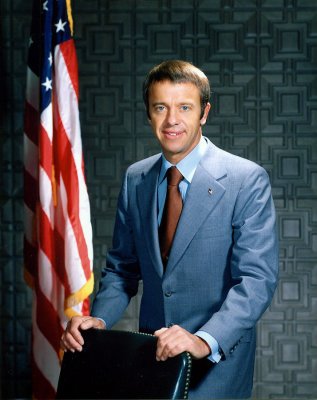
Alan Shepard

Naval aviator and astronaut; the first American in space and the fifth person to walk on the Moon

Recorded said elsewhere, not written here
Those are important, but there is still a need for any youngster who has any scientific interest at all to continue the lead that we have on technology in the world today, if we are interested in the future of the United States.

Houston, Texas, Academy of Achievement, 1 February 1991 source ↗

Others on this question

View all 51 →
Drew Houston Co-founder and chief executive of Dropbox
I was going to say work on what you love, but that's not really it. It's so easy to convince yourself that you love what you're doing — who wants to admit that they don't? When I think about it, the happiest and most successful people I know don't just love what they do, they're obsessed with solving an important problem, something that matters to them.
Recorded MIT 147th Commencement, MIT News (Massachusetts Institute of Technology), 7 June 2013 source ↗
Elinor Ostrom Political economist; laureate of the Sveriges Riksbank Prize in Economic Sciences, 2009
Yes, but not with a formula. So there are many, many efforts now to decentralize and they create a rigid formula and give people rules from on top and say, 'Now it's yours.' And that isn't worked very well either. … And, you think about the variety. If you look at a countryside, think of the variety out there in terms of the ecological variety. Well, if people are going to manage ecological variety, no single set of rules will work in a semi-arid versus a tropical-wet region. They have to be different.
Recorded Adam Smith, Telephone interview recorded immediately after the prize announcement, Nobel Prize Outreach, 12 October 2009 source ↗
Magnus Carlsen Norwegian chess grandmaster; World Chess Champion 2013–2023
Not very well. I try to win the next one. I've always been told that you should win and lose with a smile, but since I became a professional, I've thought the best way of learning to deal with defeat is not to lose.
Recorded On-stage interview, Milken Institute Global Conference, Los Angeles, Chess.com, 5 May 2017 source ↗
Robert S. Langer Biomedical engineer; Institute Professor at MIT
I didn’t realize that scientists were like that, and that people were like that. I would have thought — and I like to hope — that I encourage people rather than discourage people. I think you can say no and still say, “Boy, that might be a tough problem, but if you really work at it maybe you’ll solve it,” rather than, “No, it will never happen.”
Recorded Academy of Achievement interview, 25 October 2012 source ↗

More from Alan Shepard

View profile →
Question What do you need to believe in order to get through the day? Values & belief
No. I think all of us had such confidence in the technology that it was not a question. It was just a question of scheduling and a question of the funds to do it. I think one has to have that kind of an attitude, particularly when you are involved in research and development. You’ve got to believe it’s going to be done eventually.
Recorded Houston, Texas, Academy of Achievement, 1 February 1991 source ↗
Question Who helps you get things done? Craft & work
We worked with the engineers in the design and construction and testing phases in those various areas, then we would get back together at the end of the week and brief each other as to what had gone on. So even though we were there competing with each other for the first ride, we were still acting as a team, and helping each other in those days.
Recorded Houston, Texas, Academy of Achievement, 1 February 1991 source ↗

More on craft & work

Also answered this

Elinor Ostrom, Robert S. Langer, Aaron Ciechanover, Ahmed Zewail, Richard Feynman, Terence Tao

Search the directory for somebody in particular.

Explore further

Report this answer