Which teacher, parent, coach or friend most made you who you are, and what did you learn from them?
Recorded
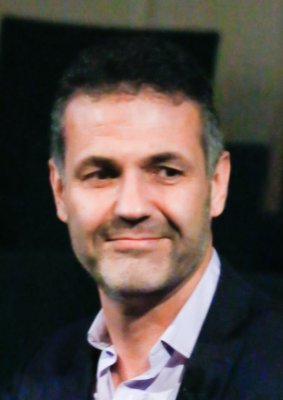
Khaled Hosseini
·
said elsewhere, not written here
I had really good teachers in high school. Probably I connected the best with an English teacher that I had my junior year in high school, Miss Sanchez, Jan Sanchez — God bless her. I’m still in touch with her, had lunch a couple of years ago, and we email each other and still exchange, recommend books to each other: “What novel are you reading lately? I read this book — you want to read this.” That kind of thing. But she really was the first time — I remember it was in her class that I read The Grapes of Wrath , which was the first time I had read a novel in English where I felt like I got it at the time. I had the, I felt really connected to the writer and to the story. I told her how much I loved that book and what it meant to me, and I think I saw part of my own family, and a lot of the Afghans in that story — people who would, they become uprooted and homeless and kind of drifting around trying to find a new home. So Jan Sanchez was probably my favorite teacher in high school, and although I never shared with her any of my writing, she came to one of my book readings as a surprise. I hadn’t seen her in over two decades, and she showed up, and she goes, “Remember me?” Obviously, I knew immediately who she was, and it made me so proud that she had read my book and she had loved it. I felt like I had done good. You know, when your teacher comes up to you, even if you are middle-aged and have your own family, having your teacher come up to you and pat you on the back is still a pretty special feeling.
Academy of Achievement interview
source ↗
I had the benefit of some very good high school English teachers. One in particular when I was a senior in high school. I was a jock, okay. I was not a student. Although I enjoyed reading, that was about it as far as academics. But she forced us to read good books and good writers, particularly good American writers. We weren’t too thrilled to do it initially, but she taught us how to do it. Through that, I discovered some of my favorite authors, particularly John Steinbeck. Once I had gone through all of Steinbeck’s books, I realized that I had had a wonderful experience.
Recorded
Academy of Achievement interview
source ↗
Pete Rozelle
Commissioner of the National Football League, 1960–1989
My dad certainly, and coaches I had that I was very close to. They took a big part in my developing an interest in sports, actually. One has passed away I was very close to. His name was Bill Slybaum. He was my coach in junior high school for tennis and then he moved up the ladder academically and went to the high school about the time I got there. He was my high school coach in basketball. I became very close to him. Later on, when I came back after the service, I went to Compton Junior College near Los Angeles, and he was the junior college basketball coach. I was very close to him.
Recorded
Academy of Achievement interview
source ↗
Rita Dove
Poet; Poet Laureate of the United States, 1993-1995; Pulitzer Prize for Poetry 1987
Well, I had a couple. I had a couple teachers who did inspire me. One was this eleventh grade English teacher — eleventh and twelfth grade. She and I, we still have tea together sometimes today. I was frightened before I went into her class. I heard she was a battle axe. I heard that she would flunk you if you split an infinitive. And it’s true. She would, but she also would tell you what a split infinitive was, and then once you knew, you never did it again. She just opened up to me, how language — how the written word — can also sing. And she spent, I remember once, 45 minutes on one page: the first page of a novel. By the end of the class, no one had taken down a single note, because we were absolutely enthralled. It was incredible.
Recorded
Academy of Achievement interview
source ↗
There was a teacher at school who was fun. I don’t know if he had a big impact on my thinking, but he was a lot of fun. His name was Dow Bunyan Bean, and he had a Doctor of Divinity degree, from some place in the South. I think he came from Georgia. And he had lost his faith and he had lost his interest in religion, and had become a secular high school teacher. Everybody called him Doc Bean. He was marvelous. He was full of animation. He was relatively old at that time. At least we kids considered him relatively old. But he was very lively, jumping around, raising his voice, lowering his voice in all sorts of interesting ways, with a racy line of talk about whatever he was discussing, and suddenly stopping and asking somebody a question to make sure the person was listening. Writing down some little grain in his book. He was lively, and it was marvelous. And if he didn’t know something, then he would immediately send whoever asked the question to the library to see what was known on the subject. I thought that was particularly splendid. Not that, of course, everything is available in a library. Lots of things are simply not known, or maybe unavailable in a high school library. But the fact that he wanted to push every inquiry as far as it could be pushed with the local resources, that really impressed me. I thought that was great.
Recorded
Academy of Achievement interview
source ↗
Question
How much rewriting or revision do you do?
Craft & work
So I use the first draft purely as a frame on which to build the actual story. So a lot of my writing is done through rewriting. And I don’t become discouraged by the notion that my first draft is not going to win any prizes or that it’s not going to be — I understand that it’s going to be lousy, but I want all of the essential elements to be there. The heart of the story has to be in that first draft, and then I can use that to create something and discover things about the story. When I wrote, for instance, The Kite Runner , there were a lot of things in that first draft that stayed, but some things in that first draft were tossed, and the transformation in some passages were very dramatic. I wrote an entire draft where the two kids were not brothers, and it really wasn’t until a subsequent draft when I realized that the kids, suddenly the idea came — well, what if the kids are brothers, and that changed the whole tone of the story. And when I rewrote it, writing it with that knowledge, it changed everything. And so you can get discouraged. Writing is largely about rewriting, and I abhor writing the first draft. I love writing subsequent drafts because that’s when I can see the story getting closer and closer to what I intended and what my original hopes for it were.
Recorded
Academy of Achievement interview, 2008
source ↗
Report this answer