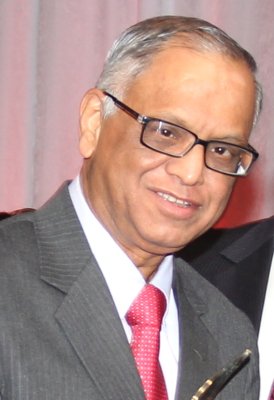
N. R. Narayana Murthy

Co-founder and former chairman of Infosys

Recorded said elsewhere, not written here
I will begin with the importance of learning from experience. It is less important, I believe, where you start. It is more important how and what you learn. If the quality of the learning is high, the development gradient is steep, and, given time, you can find yourself in a previously unattainable place. I believe the Infosys story is living proof of this. Learning from experience, however, can be complicated. It can be much more difficult to learn from success than from failure. If we fail, we think carefully about the precise cause. Success can indiscriminately reinforce all our prior actions.

New York University Stern School of Business pre-commencement lecture, 9 May 2007, Rediff, 28 May 2007 source ↗

Others on this question

View all 69 →
Christiane Nüsslein-Volhard Developmental biologist; Nobel laureate in Physiology or Medicine, 1995
As I was lazy and rarely did my homework, I finished high school with a rather mediocre exam. I almost did not pass in English language. Recently, my previous teachers allowed me to see their report on my high school performances, which included the following statements: Despite the fact that her talents are rather equally spread among many areas of knowledge, her performances are rather different depending on the distribution of her interests. Thus, with her strong display of self will she can be decidedly lazy in some topics over years, while in her areas of interests she performs to a degree far extending that required for normal school purposes.
Recorded Laureate-written autobiography for Les Prix Nobel, Nobel Prize Outreach, 1 December 1995 source ↗
Melanie Perkins Co-founder and chief executive of Canva
To launch Canva, we needed investment and a tech team. Finding the right people for both took two years but there is always a lot of rejection for entrepreneurs in their early days. But every time we got a hard question or a reason why people wouldn't invest, we stayed focused on what we could change. I revised our pitch deck after every meeting, more than 100 times in one year, to answer the questions or fix the reason for rejection from the last time. You just have to keep going. The normal thing to do after your 100th, 80th or even 20th ‘no’ would be to stop, but you just have to persevere.
Recorded Irish Tech News interview source ↗
Francis Collins American physician-scientist
about 95% of the experiments we do are total failures, and that’s because we’re out there on the leading edge of what’s possible, and most of the time it isn’t quite possible.
Recorded Academy of Achievement, Academy of Achievement interview, Bethesda, Maryland, 1 April 2000 source ↗
Mikhail Gorbachev General Secretary of the Communist Party of the Soviet Union 1985–1991; President of the Soviet Union 1990–1991
A period of transition to a new quality in all spheres of society's life is accompanied by painful phenomena. When we were initiating perestroika we failed to properly assess and foresee everything. Our society turned out to be hard to move off the ground, not ready for major changes which affect people's vital interests and make them leave behind everything to which they had become accustomed over many years. In the beginning we imprudently generated great expectations, without taking into account the fact that it takes time for people to realize that all have to live and work differently, to stop expecting that new life would be given from above.
Recorded Oslo City Hall, The Nobel Foundation, 5 June 1991 source ↗

More on failure & regret

Also answered this

Melanie Perkins, Tony Fadell, Steve Jobs, Sheryl Sandberg, Whitney Wolfe Herd, Brian Chesky

Search the directory for somebody in particular.

Explore further

Report this answer