Which teacher, parent, coach or friend most made you who you are, and what did you learn from them?
Recorded Willie Mays said elsewhere, not written here
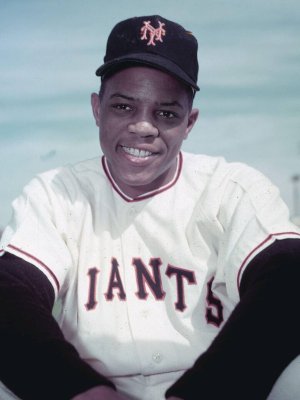
I had an uncle that played a great role in my life as far as sports. Like I said, in the South we would always play like three or four o’clock in the afternoon. I would have to go to school, and he would do my chores. When I say chores, that means I had to cut the wood, I had to wash the clothes; I had to do everything that everybody in the house had to do. So he would do all that stuff for me, and I was very happy about it because I wasn’t about to mess my arms up and my hands, so I could go and play ball and didn’t have to do too much.

Academy of Achievement interview source ↗

Others on this question

View all 57 →
Wendy Kopp Founder of Teach For America; chief executive of Teach For All
There were definitely teachers who made a huge impact. I think about a woman whose name was Mrs. Fish who was my seventh grade English Language Arts teacher. What I remember about her was just how hard she pushed. I thought I was a perfectly strong student at this point, but she just pushed everyone to their limits. That was very instrumental for me. In fact, all the teachers I remember had that same thing: they just had such high expectations and wouldn’t stop pushing. I think she just conveyed the idea that good wasn’t good enough, and I think the skill development and critical thinking skills that that year developed were also instrumental. But I also think, I don’t know, there’s something about that year that probably instilled within me that ethic that you just have to keep pushing to get better and better, and that if you work hard enough it will pay off.
Recorded Academy of Achievement interview source ↗
Robert J. Lefkowitz Physician and biochemist; Nobel laureate in chemistry for work on G protein-coupled receptors
One in particular, Mrs. Gordon. I hated her. I took AP English. The AP courses were just starting in the ’50s. And you could take a maximum of two. I took Chemistry and AP English. Today, the kids come into Duke, they have ten, 12, 15 AP courses. They start taking AP courses in their first year of high school. It’s absolutely amazing. Mrs. Gordon taught AP English. And she took a disliking to me for some reason early on, and she didn’t like the way I wrote, so she gave me very bad grades on all my essays. She pounded into me about how to write clear, effective, succinct English. And I learned those lessons well. But what I remember — and I pay her a tremendous tribute for that because there’s no more important skill, certainly for a scientist, but really for almost any profession, than to be able to express yourself clearly and succinctly. And I think she really taught me that.
Recorded Academy of Achievement interview source ↗
Francis Ford Coppola Film director, producer and screenwriter; director of The Godfather and Apocalypse Now
I had a number of very strong personalities in my family. My father was a concert flutist, the solo flute for Toscanini. That was an unusual profession for a kid to have as his father. He would dress up in a tuxedo. A concert musician has to practice a lot, and my earliest memories are of that. He was a great musician, very knowledgeable, and he used to tell us the stories of the operas, and all about the composers. He had a lot of knowledge, and he would make a point of telling us about it. I had an older brother who was five years older than me. He was a very successful student, a very handsome kid. Having an older brother by that many years was really an edge that I had. I had an older brother who would protect me. He was a very sensitive and talented boy, and he became interested in literature. So at the same time that I had all this information from my father, I also had a brother who was giving me books at a young age that I would not normally have run into. Brave New World, of course, which was fun, because it was sort of science fiction. As a kid, he was showing me books by James Joyce, and André Gide. So I was really stimulated at a younger age than I normally would have been exposed to that kind of thing.
Recorded Academy of Achievement interview source ↗
Edward Teller Theoretical physicist; co-founder and director of the Lawrence Livermore National Laboratory
It so happened that we had a very good math teacher, who was a Communist. I remember having learned from him something that I never forget: the rule of nines. A simple point: you add up the numerals in a number, and if the original number was divisible by nine, then the sum of the figures also is. For instance, you take a number like 243. Two and four and three is nine. Therefore, 243 must be divisible by nine. Actually it is nine times 27. The rule is interesting because it’s so simple. What was really interesting to us ten-year-olds is that our math teacher proved it. The proof is not terribly difficult, but it was one of the first simple and not quite obvious mathematical proofs that I encountered.
Recorded Academy of Achievement interview source ↗

More from Willie Mays

View profile →

More on relationships

Also answered this

Arnold Palmer, Herschel Walker, Mike Krzyzewski, Pete Rozelle, Julius Erving, John Wooden

Search the directory for somebody in particular.

Explore further

Report this answer