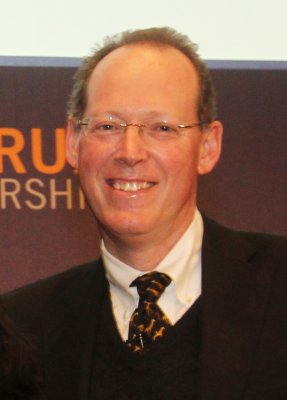
Physician and medical anthropologist; co-founder of Partners In Health
The idea that some lives matter less is the root of all that is wrong with the world.
unknown, unknown, Good Good Good, 21 February 2022 source ↗
The question
What belief do you hold that most people around you would reject or find surprising?Originally asked
Peter Thiel, to job candidates, Zero to One, chapter 1, 2014
Peter Thiel, Zero to One, chapter 1, where it is introduced as his job-interview question. Thiel supplies his own standard: a good answer takes the form "most people believe x, but the truth is the opposite of x."
You answer as yourself. Nobody on FLAPSS answers as anybody else.
Physician and medical anthropologist; co-founder of Partners In Health
The idea that some lives matter less is the root of all that is wrong with the world.
unknown, unknown, Good Good Good, 21 February 2022 source ↗
Pix is probably the most successful payment infrastructure run by a government in history. I think Pix has been what has allowed a country like Brazil to leapfrog developed economies like the U.S. and in Europe, and has positioned Brazil today probably five years ahead of the U.S. I don't think anybody understands that, and probably in the U.S. they didn't really expect that.
I try to be realistic about it. I’ve never had people come up to me and say, ‘I didn’t believe in that until I heard your music.’ Usually they’re like, ‘That’s how I feel too.’ I would love to be able to write a song to save the world, but I’m not converting anybody: it’s preaching to the choir. But the choir needs preaching to.
My own answer to the contrarian question is that most people think the future of the world will be defined by globalization, but the truth is that technology matters more. Without technological change, if China doubles its energy production over the next two decades, it will also double its air pollution. If every one of India's hundreds of millions of households were to live the way Americans already do — using only today's tools — the result would be environmentally catastrophic. Spreading old ways to create wealth around the world will result in devastation, not riches. In a world of scarce resources, globalization without new technology is unsustainable.
I read my customers feedback obsessively. The best person to help you is your customer. The first ten people who download your app are the ones who will help refine your product. Your first 100 customers teach you a lot.
I think we will see better vaccines within the next 15 years, but I'm not a scientist and am focused on the short-term - what will happen in the interim.
I had lots of teachers encourage me. And I still know some of them, my high school teachers. But one of them encouraged me. She said, “Well, what do you want to do?” I said, “I want to be a doctor.” And she asked me where I wanted to go to school, and so I named all the Florida public universities which seemed within reach, financially. And she said, “Well, maybe you ought to apply to Duke, and maybe you’ll get a scholarship.” And I did both those things. I applied and got a scholarship.
I had lots of teachers encourage me. And I still know some of them, my high school teachers. But one of them encouraged me. She said, “Well, what do you want to do?” I said, “I want to be a doctor.” And she asked me where I wanted to go to school, and so I named all the Florida public universities which seemed within reach, financially. And she said, “Well, maybe you ought to apply to Duke, and maybe you’ll get a scholarship.” And I did both those things. I applied and got a scholarship. Her name is Wendy Tellone, and she’s still involved in public school teaching. I think she’s still in Florida.
I think a lot of people, when they’re really young, and in their 20s, they are on their own quest for personal efficacy. And I understand that. ... But the sooner that people can discover that it’s really about building teams, and not about personal efficacy, I think the better — the more quickly — we can move forward. I believe that.
And some of the things that we saw in the ’80s, really, they were failures, because patients died. But they allowed us to diagnose the systems’ problems and say, “This is where we need a community health worker system. This is where we need to make sure patients have food support while they’re getting these medicines,” et cetera. So those are examples of tragedies that certainly lead to — not just personal epiphanies — but collective epiphanies, where you say, “You know what? We can do this better if we have the system fixed.”
Norman Borlaug, Nelson Mandela, Hillary Clinton, Natalie Mering, Ory Okolloh, Blake Masters
Search the directory for somebody in particular.