The question

Which writers or artists have most influenced your work?

Originally asked

The Paris Review, to novelists and poets, The Art of Fiction

A durable Art of Fiction question asked through named literary influences and artistic models.

You answer as yourself. Nobody on FLAPSS answers as anybody else.

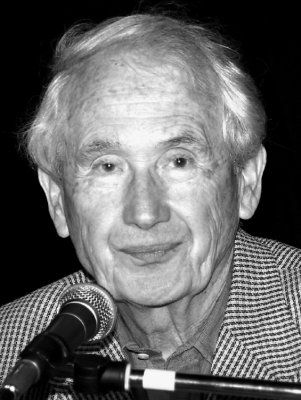
Frank McCourt

Teacher and memoirist; winner of the Pulitzer Prize for Biography or Autobiography

Recorded said elsewhere, not written here
The last teacher I had was a man named O’Halloran. But he was the only one who offered words of encouragement, who told us we were distinct, unique individuals with a right to think for ourselves. And that was just before we left Leamy’s National School. And he told me, “My boy, you are a literary genius.” And you can imagine what I had to put up with at the schoolyard with all the others. “Hey, McCourt, you’re a literary genius. Look at him. Look at the literary genius.

Academy of Achievement interview, Washington, D.C., 19 June 1999 source ↗

Others on this question

View all 42 →
Lynn Nottage Playwright; twice winner of the Pulitzer Prize for Drama
Well absolutely Sondheim was an influence, because he was in many ways this door into the world of theater and he is a phenomenal composer. He’s also a phenomenal mentor.
Recorded Academy of Achievement interview, New York City, 14 September 2019 source ↗
John Pawson Architect and designer known for minimalism
Well, I saw Mies van der Rohe and then I was introduced to Shiro Kuramata’s work and that brought me even further into this world. I’m interested in everything. I mean, Peter Zumthor is obviously very talented, he does interesting work — but I don’t study my contemporaries in architecture and design so much.
Recorded The Talks, published interview, 3 May 2023 source ↗
David Herbert Donald, Ph.D. Historian; twice winner of the Pulitzer Prize for Biography
Professor Randall was a great advisor and a great mentor. He taught me, I think, in the best possible way. He was not a brilliant lecturer. His courses were fairly pedestrian. I didn’t think his seminars were particularly interesting. But working with him on a one-to-one basis as his assistant, I think that’s the way one has to learn to be a historian. That is, he was writing, and if he needed some particular reference, I had to go find it and get it. If he was writing, he wanted everything checked meticulously over and over again. So I had to take the manuscript over to the library and check it all out. So that by working closely with him, I got to see, first of all, a lot of the library and its extensive holdings, but I got, even more important, to understand what a scholar is about. It is about care. It is about “pains-taking.” It is about judgment as well as it’s about very skillful writing. He was an excellent writer as well. So in that sense, Professor Randall and Mrs. Randall shaped my future career.
Recorded Academy of Achievement interview, Lincoln, Massachusetts, 19 October 2007 source ↗
Maya Angelou Poet, memoirist and civil rights activist
The music of the “I Have a Dream” speech is a replication of the music which comes out of the mouths of the African American preacher. Preacher, singer, blues singer, jazz singer, rap person, it is so catching, so hypnotic, so wonderful that, as a poet, I continue to try to catch it, to catch the music.
Recorded Academy of Achievement interview, High Point, North Carolina, 22 January 1997 source ↗

More from Frank McCourt

View profile →
Question What do you fear most? Identity & self
It was desperate because of certain things, ingredients like my father being an alcoholic, my mother having too many babies in too short a time, no work available in Ireland, and even when my father did get a job he drank the wages. Then there was the harsh kind of schooling we had with school masters who ruled with a stick and then because of the overwhelming presence of the church, which imbued us with fear all the time. So it was fear, dampness, poverty, alcoholism, fear of the church, fear of the school masters, fear in general.
Recorded Academy of Achievement, Academy of Achievement interview, Washington, D.C., 19 June 1999 source ↗
Question What became visible only after your working life slowed down or ended? Time & hindsight
The day I retired from teaching, again, was one of the most satisfying days of my life and it was sad, but when I — the day I retired, I went home and I was by myself and I was having a glass of wine. I was thinking about the lunch the teachers gave me that day. The retirement lunch. And I was able to look back on that life, that 30 years in the classroom, and say — I was able to congratulate myself. I'm glad I did that. That was good. I felt useful, that I don't think I would have felt if I had gone into business or something like that.
Recorded Academy of Achievement interview, Washington, D.C., 19 June 1999 source ↗

More on taste & recommendation

Also answered this

Amy Tan, David Lynch, Robert Wilson, Kiri Te Kanawa, Ferdinando Cito Filomarino, Sarah Paulson

Search the directory for somebody in particular.

Explore further

Report this answer