Those who are both loyal and can cook.
Originally asked
Vanity Fair, to its interview subject, The Proust Questionnaire
A fixed Vanity Fair Proust Questionnaire item asked across its three-decade archive, with independent variants in friendship and profile interviews.
You answer as yourself. Nobody on FLAPSS answers as anybody else.
Academy of Achievement interview source ↗
Others on this question
View all 65 →Compassion. Wisdom. Wit. The delicate balance of knowing when I need tough love and when I need support. Plus, call me crazy, but I’m also partial to friends who don’t surreptitiously record our calls.
They treat me as a regular person.
Laughter first and foremost, acceptance, and love.
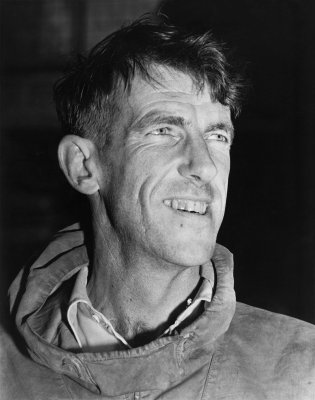
More from Edmund Hillary
View profile →Those years from 1953 to 1975 were extremely happy years for me. I did many adventurous activities. I got deeply involved in these aid programs for the people of the Himalayas. I had a nice family, we took our family into the out-of-doors, we camped and we swam and we clambered around the hills. For me, it was a very full and a very happy existence.
I always have, in my expeditions, people who are academically far cleverer than I am, and even technically, far more competent. So if you want to lead an expedition, in a sense, you’ve got to keep ahead of them. These bright, competent characters you have with you who are marvelous to have on the expedition. And I’ve always found you can do that by, each night, when you go to bed, just let your mind dwell on the likely things that may happen next day, and think out carefully the sort of decisions that might be necessary to make in order to have the program carried through. So next day, when something happens, you’re the one that’s thought about it and you’re the one who has the ideas.
But, of course, we had one problem that the modern mountaineer doesn’t have. That is, this psychological barrier. We really didn’t know whether it was humanly possible to reach the top of Mt. Everest. And even using oxygen as we were, if we did get to the top, we weren’t at all sure whether we wouldn’t drop dead or something of that nature. All the physiologists had warned us that the altitude at the summit of Everest was a very marginal altitude and might be extremely dangerous. So, one had this feeling in your mind all the time that maybe you were pushing things a bit beyond what humans were meant to do and you couldn’t ignore that feeling. But, because of strong motivation, you keep plugging on and you seem to be going okay and nothing seems to be going wrong, so you persist. And we persisted, of course, and ultimately, set foot on the summit.
I can always remember, when I was at high school we had a school sort of army battalion and because, at that time, I was one of the larger boys, I was appointed sergeant of the number one platoon, and I was always absolutely petrified that when I was meant to turn the platoon left or turn it right, I was really actually hopeless at knowing quite what to do. But fortunately, my platoon, who were really all the misfits in the school, the larger misfits, they stood by me, and some of them were quite good at knowing when to turn left or turn right. So whatever command I gave, they would do the right thing. We were a pretty good platoon as a consequence although, at the time, I felt an absolute idiot.
Well, then of course, came the disaster in 1975, when my wife and my youngest daughter were flying into the Nepal hills where I was building a hospital and their plane crashed and they were killed. And this certainly, for me, was an absolute disaster, really because the two people that meant most to me in life had been killed in one fell swoop. It did take me quite a number of years to get over it. I found the only way to deal with it was to carry on very energetically, doing the things that we had all been doing together, which was largely building schools and things for the mountain people. Although, people used to say to me, “Time is the great healer,” certainly for the first two years I simply didn’t accept this. But, time was a great healer and after the years passed, the memories still remain. But, I think quite a lot of the pain tends to fade a little bit, and life did become a little bit easier.
Well my memory for names is absolutely appalling, but I know I did pass through a phase of books like King Solomon’s Mines. H. Rider Haggard was the author, and he wrote these great romantic adventure stories. I used to enjoy Georgette Heyer, in which the hero was usually a rather middle-aged gentleman, a very good sword fighter, with a beautiful young lady and all the rest of it. Great sword fighting and all highly romantic, adventurous activity. I used to find these things quite entertaining. I even passed through a phase when I quite enjoyed Western stories. Nowadays, I find them a little on the naive side but, for a period, I found the Western stories quite entertaining light reading. They are very romanticized, as we all know. Later on, I became much more interested in reading biographies, particularly about people who had made their mark in the community. I still enjoy reading books of that nature.
More on relationships
Also answered this
Malala Yousafzai, Monica Lewinsky, Cecile Richards, Rachel Maddow, Amy Poehler, Mary Tyler Moore
Search the directory for somebody in particular.
Explore further
- All relationships questions
- The The Proust Questionnaire questionnaire — 5 questions from the same format
- Explore the archive — by field, age, era, and subject