You have to be intelligent, and be able to cope with stress. It is a stressful life, both mentally and physically. Those are the qualities to succeed as a surgeon.
What advice would you give your twenty-year-old self, and what should they ignore?
Question
How do you balance creative work with other responsibilities?
Daily life
Question
What is the hardest thing that has happened to you, and what did you carry out of it?
Failure & regret
Question
What is the thing you are best at that nobody watching can see?
Craft & work
Question
What is something you were told by a parent, teacher, or mentor that you still repeat to yourself?
Time & hindsight
Question
What problem are you still trying to solve?
Craft & work
Question
How close have you come to death?
Death & what remains
I would advise them to aim high. To set their sights at a pretty tough target and don’t be too worried if you’re not successful at first. Just keep persisting and keep improving your standards, getting better and better and ultimately, you’ve got a pretty fair chance at achieving your desired goal. ... But, I do think that virtually everybody that’s born has the ability to be very competent at doing something. I think that, in itself, is worthy of aiming towards, just to be competent at doing anything you particularly wish to do.
Academy of Achievement recorded interview, American Academy of Achievement, 16 November 1991 source ↗
Others on this question
View all 77 →
Denton Cooley
Cardiothoracic surgeon; founder of the Texas Heart Institute
Recorded
Academy of Achievement recorded interview, American Academy of Achievement, 11 April 1991
source ↗
Marina Abramović
Performance artist
Spend your time on something meaningful. Not on parties, and not on taking it easy. That’s not good enough. […] When you’re young, you think: Let’s party, do drugs, drink, waste it all, right? But as you get older, you look at what you’ve accomplished. And when you get old, you’ve run out of time. You have to ask yourself: Why am I here? Can I contribute anything to humanity, to society, my work?
Recorded
University Post, University of Copenhagen public talk, University Post (uniavisen.dk), University of Copenhagen
source ↗
Kiran Mazumdar-Shaw
Founder and executive chairperson of Biocon
One day, I spoke to him about my sense of shame. He looked me in the eyes and told me that brewing was a science; it was not about getting drunk. He did not stop there. He said: 'Do not make judgment on things, people, and issues with half information.' He said there is truth in everything you see around. So, look for everything in its entirety. That was a game-changing moment for me.
Norman Borlaug
Plant pathologist and agronomist; Nobel Peace Prize, 1970
Study broadly. Don’t specialize too early. Read history. Sooner or later, you’re going to have to specialize, but within the limits that you have to take obligatory courses to get a degree, keep your general education as broad as you can, because you never know what doors are going to open to new opportunities — ten, 15, 20 years down the road — because of changes in science and technology.
Recorded
Academy of Achievement recorded interview, American Academy of Achievement, 12 May 2008
source ↗
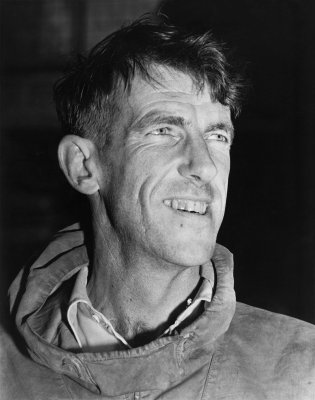
More from Edmund Hillary
View profile →In the first 33 years of my life which is up until I climbed Everest, I was a very restless and slightly unhappy sort of person. I really didn’t have a great deal of social life, but I’d become very interested in adventurous activities. Perhaps, I was, in some respects something of a loner. But after I got married, that certainly changed my life very considerably, indeed. I found that it was possible to mix having a family with continuing on with adventurous activities, but I think a great deal of that was having a suitable wife. My wife was very, long-suffering. She knew that there were certain things I wanted to do and she was happy that I should do them. She was prepared to put up with considerable periods of being alone with the kids. She, was marvelous, so it made it possible for me to do the things that I wanted to do as well.
Well, then of course, came the disaster in 1975, when my wife and my youngest daughter were flying into the Nepal hills where I was building a hospital and their plane crashed and they were killed. And this certainly, for me, was an absolute disaster, really because the two people that meant most to me in life had been killed in one fell swoop. It did take me quite a number of years to get over it. I found the only way to deal with it was to carry on very energetically, doing the things that we had all been doing together, which was largely building schools and things for the mountain people. Although, people used to say to me, “Time is the great healer,” certainly for the first two years I simply didn’t accept this. But, time was a great healer and after the years passed, the memories still remain. But, I think quite a lot of the pain tends to fade a little bit, and life did become a little bit easier.
I always have, in my expeditions, people who are academically far cleverer than I am, and even technically, far more competent. So if you want to lead an expedition, in a sense, you’ve got to keep ahead of them. These bright, competent characters you have with you who are marvelous to have on the expedition. And I’ve always found you can do that by, each night, when you go to bed, just let your mind dwell on the likely things that may happen next day, and think out carefully the sort of decisions that might be necessary to make in order to have the program carried through. So next day, when something happens, you’re the one that’s thought about it and you’re the one who has the ideas.
My mother used to say to me a thing which, when I look back on it, wasn’t terribly logical. — and I had a pretty hearty appetite, but when I had had a large meal put in front of me, and even I couldn’t get through it, she would say, “Edmund, remember the starving millions in Asia.” Now what possible use my consuming it would do for the starving millions in Asia, I don’t really know, but the fact remains that I was brought up to think about the starving millions in Asia. That meant I had to clean my plate up and not waste it. Later on, I got more involved with the starving millions in Asia, perhaps in a slightly more practical way: helping some of them with schooling and hospitaling and even in agriculture.
I think most of our major challenges are not going to be in the physical field at all. I think they’re going to be in the field of human relations, of getting on with each other, of contributing. People accepting that they have to contribute something, their thoughts, their ideas, maybe even their money, towards producing a world society that is perhaps a little bit more honest and reasonable than it is now.
I had one experience on the ice-fall with Tenzing. We were actually descending after having been further up the mountain, and it was getting close towards dark so we wanted to get through the ice-fall before darkness fell. We were roped together, but I was rushing down ahead in the lead. About halfway down there was a narrow crevasse. I guess it was about four feet wide, but just a bit too wide to step across. On the lower lip was a great chunk of ice stuck against the ice wall, and we’d used that as sort of a stepping stone to get over the gap. I came rushing down the hill without thinking too carefully. I just leapt in the air and landed on the chunk of ice, whereupon the chunk of ice broke off and dropped into the crevasse with me on top of it. It was interesting how everything seemed to start going slowly, even though I was free-falling into the crevasse. My mind, obviously, was working very quickly indeed. The great chunk of ice started tipping over and I realized, if I wasn’t careful, I’d be crushed between the ice and the wall of the crevasse. So I just sort of bent my knees and leapt in the air. I was still falling, but now I was a couple of feet clear of the chunk of ice. Time really seemed to pass even though I was falling clear, and I realized that unless the rope came tight fairly soon, I would come to a rather sticky end on the bottom of the crevasse. Up top, Tenzing had acted very quickly. He had thrust his ice axe into the snow, whipped the rope around it, and the rope came tight with a twang, and I was stopped and swung in against the ice wall. The great chunk of ice just carried on and smashed to smithereens at the bottom of the crevasse. Then really the rest was what I would have called a routine mountaineering matter. I had my ice axe and my crampons on my feet, so I chipped steps in the side. I was able to bridge the crevasse, and I worked my way up to the top and got safely out. I wouldn’t have said at any stage, because it all happened so quickly, fear really didn’t have much opportunity to emerge. My only idea was to get safely out of this unfortunate predicament. And of course, without Tenzing’s very competent mountaineer’s response, I certainly wouldn’t have made it. But once he had stopped me, then I was able to, using the techniques of mountaineering, to get myself safely to the top again.
More on time & hindsight
- When were you happiest? 577 answers
- What is the most important lesson life has taught you? 137 answers
- What scares you about getting older? 61 answers
- What is the best advice you have ever received? 28 answers
- If you could have a gigantic billboard anywhere, what would it say and why? 23 answers
- What is something you were told by a parent, teacher, or mentor that you still repeat to yourself? 22 answers
Also answered this
Margaret Thatcher, Andrew Young, Wendy Kopp, Óscar Arias Sánchez, Rosa Parks, Elie Wiesel
Search the directory for somebody in particular.
Explore further
- All time & hindsight questions
- Explore the archive — by field, age, era, and subject