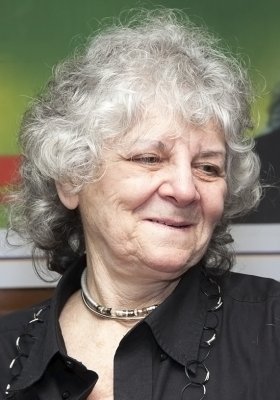
Structural biologist; Nobel laureate in Chemistry, 2009
I did not meet Franklin but admired her work and scientific attitude. I did meet Hodgkin and learned a lot from her.
Cristina Escandón, Principia interview, 16 March 2016 source ↗
The question
Which writers or artists most influenced your work?Originally asked
The Paris Review, to novelists and poets, The Art of Fiction
A durable Art of Fiction question asked through named literary influences and artistic models.
You answer as yourself. Nobody on FLAPSS answers as anybody else.
Structural biologist; Nobel laureate in Chemistry, 2009
I did not meet Franklin but admired her work and scientific attitude. I did meet Hodgkin and learned a lot from her.
Cristina Escandón, Principia interview, 16 March 2016 source ↗
I remember one teacher in particular. I was in a school in the third grade and they were thinking of skipping me, putting me in a higher grade. But then somebody said that would be bad psychologically. So, for that entire year, because I had learned all the lessons that year — the multiplication tables, whatever the reading was — this teacher let me go off by myself and draw pictures. So I had hours and hours of time where I was just left to my own devices, drawing pictures. And she would encourage me. That was a wonderful period in my life. I mean, I didn’t become an artist, but somebody let me do something I loved. What a luxury, to do something you love to do. I would still like to have that luxury, to be able to just sit and draw for hours and hours and hours. In a way, that’s what I do as a writer. I just sit by myself, being in my own mind, not being directed at what I should be doing moment-by-moment, not having a clear plan set out by anybody and just letting imagination enter into the blank page. So in that respect, I can thank Miss Grudoff of the third grade for allowing me that.
Jim Lawson. Jim Lawson was an unbelievable human being. Born in Ohio. He was a pacifist. He studied Gandhi. He was part of the Methodist Student Movement. He lived in India. He became an organizer for FOR, the Fellowship of Reconciliation.
We had the classics, published by Scribners, all the great stories by Robert Louis Stevenson and the rest which were illustrated by the great N.C. Wyeth. In those days, when childhood diseases were extended, you were home with the measles or mumps or chicken pox for two or three weeks at a time, and you were supposed to stay in bed. There wasn’t any television, there wasn’t much to do, so I would stare at those paintings in those books by the hour. I didn’t read them all. I loved to just look at those pictures and study every detail. I could sit down and draw most of those pictures right now without having to refresh my memory because they were so exciting to me.
I always suspected that she was the biggest influence on me. It seems unlikely, but I always suspected that. I used to say that in interviews, and people would think I was just being smart and evasive. But I reread Jane Eyre recently, and also Villette , her other great novel. I just came across episode after episode where I thought “Oh my goodness, I just ripped that off from this book!” Perhaps you wouldn’t recognize it, but I did. Certain kinds of techniques, certain moments when you understand that the narrator is crying, not because she tells you, but because somebody watching her makes a remark. All these little things that I thought, “Oh, I used that in that book,” or “Oh, that trick.” I think Charlotte Brontë had an enormous influence on me, and I think it’s something to do with that use of first-person and the evasiveness, the indirectness, of her first-person narrative. I mean this phrase, “the unreliable narrator,” has become very popular in creative writing. So it’s not quite that, but a very subtle use of the relationship between the writer and the book and the reader — something I tuned in on, I homed in on instantly, when I started to read Charlotte Brontë. But I’ll tell you, my favorite author — novelist — is somebody who you probably wouldn’t think had any relationship to me, which is Dostoyevsky. I’ve always loved Dostoyevsky, ever since I first read him. I think he’s one of the reasons I started to read, you know, when I read Crime and Punishment when I was about 17 or 18. Dostoyevsky and Chekhov for me remain like two poles in terms of a way to approach things. I love the messiness of Dostoyevsky, the improvised — I mean a lot of it is a mess, but I like the way that strange, unexpected things have obviously come tumbling out of him that he didn’t want to necessarily have come tumbling out. On the other hand, you know, Chekhov, another great Russian writer, exemplifies the calm, controlled, very carefully structured, understated kind of work. I aspire to them both. They’re two of my great heroes.
But you know that there are so many people that are equal to us or better that didn’t get the prize. You cannot go round the whole world and ask “are you better than me?”
people in power tend to take advantage of that power and this can be both men and women.
It is possible to be a good scientist, a good mother and have a family and even bake a cake.
When I was a child and interested in discoveries, the first book that made an impression on me was called “Discoveries of the World” but it wasn’t about geography, it was about Marie Curie! [laughs] And then there is a beautiful Italian story – from the mountains in Italy to the Pyrenees, a kid goes to look for a flower with a golden heart inside for his ill mother. This made a big impression on me. I also read lots of Isreali authors that you probably haven’t heard of.
I look for how to get out of it. I try to use here [points to her head]. I tried to read, I tried to talk to others. I tried my best to get out of it. I had lots of times climbing one Everest to find that there is a bigger Everest, but don’t you find your life like this too?
Oh ya, I doubted more than expected. I had doubts all the time. The way was extremely, extremely difficult. … At one point I had to describe what I am doing to a person who is a great intellectual but not a scientist, and I told him what we felt is that we are climbing mountains in order to reach the climax – and these mountains are like the Everest, the biggest most difficult to climb – only to find out that there is another mountain waiting behind it to be climbed afterwards. So every climbing was an achievement but there was a bigger problem behind it or above it. I had lots of minutes that I didn't expect, but I thought science in general and this science particularly is worth the effort – even if we would never get the ultimate result.
Charles H. Townes, Linus C. Pauling, Ph.D., Frances Arnold, Gertrude B. Elion, Marco Brambilla, David McCullough
Search the directory for somebody in particular.