Which writers or artists most influenced your work?

Originally asked

The Paris Review, to novelists and poets, The Art of Fiction

A durable Art of Fiction question asked through named literary influences and artistic models.

You answer as yourself. Nobody on FLAPSS answers as anybody else.

Recorded Amy Tan said elsewhere, not written here
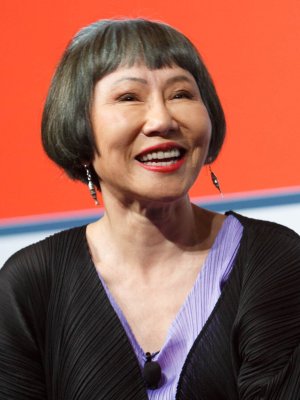
I remember one teacher in particular. I was in a school in the third grade and they were thinking of skipping me, putting me in a higher grade. But then somebody said that would be bad psychologically. So, for that entire year, because I had learned all the lessons that year — the multiplication tables, whatever the reading was — this teacher let me go off by myself and draw pictures. So I had hours and hours of time where I was just left to my own devices, drawing pictures. And she would encourage me. That was a wonderful period in my life. I mean, I didn’t become an artist, but somebody let me do something I loved. What a luxury, to do something you love to do. I would still like to have that luxury, to be able to just sit and draw for hours and hours and hours. In a way, that’s what I do as a writer. I just sit by myself, being in my own mind, not being directed at what I should be doing moment-by-moment, not having a clear plan set out by anybody and just letting imagination enter into the blank page. So in that respect, I can thank Miss Grudoff of the third grade for allowing me that.

Academy of Achievement interview, Sun Valley, Idaho, 28 June 1996 source ↗

Others on this question

View all 42 →
Adam Gopnik Staff writer at The New Yorker; essayist
Well, it certainly influences my manner of writing, because I always see Darwin as a model of the act of explanation and of argument; the morality, the ethics of explanation, maybe.
Recorded On Being, interviewed by Krista Tippett, 21 December 2017 source ↗
David McCullough Historian and biographer; twice winner of the Pulitzer Prize
We had the classics, published by Scribners, all the great stories by Robert Louis Stevenson and the rest which were illustrated by the great N.C. Wyeth. In those days, when childhood diseases were extended, you were home with the measles or mumps or chicken pox for two or three weeks at a time, and you were supposed to stay in bed. There wasn’t any television, there wasn’t much to do, so I would stare at those paintings in those books by the hour. I didn’t read them all. I loved to just look at those pictures and study every detail. I could sit down and draw most of those pictures right now without having to refresh my memory because they were so exciting to me.
Recorded Academy of Achievement interview, Williamsburg, Virginia, 3 June 1995 source ↗
Kazuo Ishiguro Novelist and screenwriter; Nobel laureate in Literature, 2017
I always suspected that she was the biggest influence on me. It seems unlikely, but I always suspected that. I used to say that in interviews, and people would think I was just being smart and evasive. But I reread Jane Eyre recently, and also Villette , her other great novel. I just came across episode after episode where I thought “Oh my goodness, I just ripped that off from this book!” Perhaps you wouldn’t recognize it, but I did. Certain kinds of techniques, certain moments when you understand that the narrator is crying, not because she tells you, but because somebody watching her makes a remark. All these little things that I thought, “Oh, I used that in that book,” or “Oh, that trick.” I think Charlotte Brontë had an enormous influence on me, and I think it’s something to do with that use of first-person and the evasiveness, the indirectness, of her first-person narrative. I mean this phrase, “the unreliable narrator,” has become very popular in creative writing. So it’s not quite that, but a very subtle use of the relationship between the writer and the book and the reader — something I tuned in on, I homed in on instantly, when I started to read Charlotte Brontë. But I’ll tell you, my favorite author — novelist — is somebody who you probably wouldn’t think had any relationship to me, which is Dostoyevsky. I’ve always loved Dostoyevsky, ever since I first read him. I think he’s one of the reasons I started to read, you know, when I read Crime and Punishment when I was about 17 or 18. Dostoyevsky and Chekhov for me remain like two poles in terms of a way to approach things. I love the messiness of Dostoyevsky, the improvised — I mean a lot of it is a mess, but I like the way that strange, unexpected things have obviously come tumbling out of him that he didn’t want to necessarily have come tumbling out. On the other hand, you know, Chekhov, another great Russian writer, exemplifies the calm, controlled, very carefully structured, understated kind of work. I aspire to them both. They’re two of my great heroes.
Recorded Academy of Achievement interview, London, England, 18 October 2017 source ↗
Ferdinando Cito Filomarino Film director and screenwriter
Actually, I started falling in love with the films of Brian De Palma. He was the first filmmaker I ever loved, he always made genre films. They touched me more, they felt warm, and human, and unsettling. There was always his vision behind them.
Recorded The Talks, published interview, 19 September 2021 source ↗

More from Amy Tan

View profile →

More on taste & recommendation

Also answered this

Adam Gopnik, Han Kang, Ernest J. Gaines, Ferdinando Cito Filomarino, Kazuo Ishiguro, Noah Baumbach

Search the directory for somebody in particular.

Explore further

Report this answer