The question

How do you tell when a piece of work is done?

Originally asked

The Creative Independent, to working artists, its interview series

A repeated process question in The Creative Independent, asked across visual art, music, writing, performance, and mixed media.

You answer as yourself. Nobody on FLAPSS answers as anybody else.

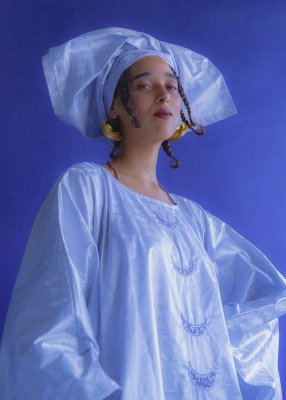
Tabita Rezaire

Video and new-media artist and yoga teacher

Recorded said elsewhere, not written here
Often it’s the deadline, to be really honest. Also, research is my favorite part. I could just research forever. But then I actually need to produce. Maybe that’s why the offering part is so beautiful, because each offering/performance is different because it’s a different time, it’s a different space, and I’m a different person. Each day you’re a different person, and because the people you’re doing this with are also different, the work changes. Maybe you’ve found something else that inspired you, so you add it and let the work grow. It grows infinitely, alongside you. With video, it’s set, so it’s harder to add to it even if sometimes you’re kind of like, “Oh my god, I would love to add this.” With embodied practice it’s easier. It grows with me. That’s something I love, especially because my research never ends. It’s ever evolving.

Brandon Stosuy, The Creative Independent, 16 February 2023 source ↗

Others on this question

View all 67 →
Neel Patel Short-story writer and novelist
For me a story is done when I can read it and not cringe. When I’m revising a story, I focus on what’s not working. I usually set something aside for a little bit, and if I come back to it and feel that it’s complete, I trust that sense. You kind of know.
Recorded Alec Niedenthal, New Routes in Fiction: NEEL PATEL with Alec Niedenthal, The Brooklyn Rail, 1 March 2019 source ↗
Angélica Negrón Puerto Rican composer
My pieces are never done, at least for me. It’s an open-ended inquiry process driven by curiosity. I might have a sense that a piece “is completed” for a premiere, or for a showcase, but there’s always the possibility of going back and revisiting it, and I think leaving it open-ended is also a way for me to keep my sanity.
Recorded Miriam Garcia, The Creative Independent interview source ↗
Regina Spektor American musician
They feel very, very different to finish. With a song, I end up playing it so, so, so much and shifting things while I’m writing so, so much. And then I play it and play it and play it, and through that process, I write it. Over and over and over—almost like when they’re polishing a stone and it’s just being thrown around inside that tumbler. The song rolls over, and it starts out as this very malleable thing. It’s the strangest experience where you start with absolutely arbitrary things—or so you think—and you’re making them up, apparently, but as you go, and through the process of repetition, things become so apparent to you.
Recorded Caitlin Wolper Phillips, The Creative Independent interview source ↗
Claire L. Evans American singer, writer and artist
That’s a really good question. I don’t think you ever know; you just have to make a call. Finishing is acknowledging that there’s no further progress to be made at the current juncture. If you sit on a song for 20 years and come back to it with all the wisdom of your life, you could probably write a better song, but objectively, you have to get it out into the world in order to continue to live as an artist. So, there’s a sense of: “well, this is as good as it’s gonna get for me at my level right now.” Sometimes you realize that early, but it can take a long time. I think deadlines were invented by God to make art possible. I don’t think I could finish anything without a deadline, self-imposed or external. With the book, it was just: these people at Penguin, they don’t know me. They have no idea that I can’t do this. I have to do it because otherwise they’ll know that I can’t do it.
Recorded Kailee McGee, The Creative Independent interview source ↗

More from Tabita Rezaire

View profile →
Question What belief do you hold that most people around you would reject or find surprising? Values & belief
I am interested in an eternal truth, in how people found language to express the same things. We go through the same things: the movement of planets, eclipses, the rising and falling of suns, like cultures, and the growth of trees and spirit. I am curious how we translated these into culture, into storytelling.
Recorded Leila Antakly, Antakly Projects, 12 February 2025 source ↗

More on craft & work

Also answered this

Neel Patel, Sandy Tran, Lars Jan, Natalie Mering, David Ostrowski, Loraine James

Search the directory for somebody in particular.

Explore further

Report this answer