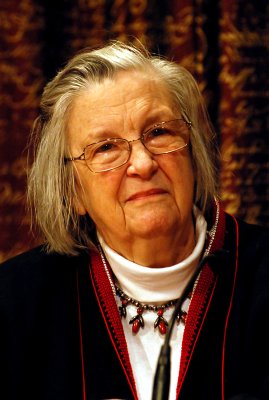
Elinor Ostrom

Political economist; laureate of the Sveriges Riksbank Prize in Economic Sciences, 2009

Recorded said elsewhere, not written here
Yes, we're showing that. But we're also showing a very important role for face-to-face or even written communication. So, the prediction was that nobody would self-monitor because that's a second level social dilemma, if you go to Game Theory. But, what we've found is that people will, but it can be … people can escalate into, 'I'll punish you, you punish him, mamamamamma,' and it gets worse and worse. So, with communication, where there's an agreement on what is going to be the … what we are going to do. The 'we' then being well-defined, then people can follow rules, be cooperative and, occasionally, sanction one another to help that continue.

Adam Smith, Telephone interview recorded immediately after the prize announcement, Nobel Prize Outreach, 12 October 2009 source ↗

Others on this question

View all 80 →
Tadao Ando Architect; Pritzker Prize laureate, 1995
The modern architecture that I have been weaned on also espouses (clear) function, (exposed) structure, and (raw) material as principles—characteristics that tend to be accessed only from realistic or substantive dimensions. Fictionality or imagination, the other dimension, is omitted entirely. However, Vitruvius emphasized venustas, in other words attraction or beauty as a necessity along with strength and function.
Recorded Grand Trianon Palace, Versailles, 22 May 1995, The Hyatt Foundation / The Pritzker Architecture Prize, 22 May 1995 source ↗
Steve Jobs Co-founder and chief executive of Apple; co-founder of NeXT; chief executive of Pixar
Design is a funny word. Some people think design means how it looks. But of course, if you dig deeper, it's really how it works. The design of the Mac wasn't what it looked like, although that was part of it. Primarily, it was how it worked.
Recorded Gary Wolf, Wired 4.02, February 1996 source ↗
John Hopfield American scientist
I’d read some of the things that Don Glaser wrote, for example, and they’re imaginative physics, they’re not quite such good biology. There was a consensus that said you had to be able to reach out from physics and get to some of these things you’d like to, but then you have to know enough about the biology that the whole thing makes sense. And you really have to present things in such a way that a community develops. I didn’t realize that at the time, but certainly one of the important things of what I did had to do with enabling people who came from physics, or who came from biology, become a community, working on not just one little problem or piece, but somehow collectively working together toward trying to get an understanding.
Recorded Adam Smith, Telephone interview recorded shortly after the prize announcement, Nobel Prize Outreach, 1 October 2024 source ↗
Esther Duflo Development economist; laureate of the Sveriges Riksbank Prize in Economic Sciences, 2019
I think it's … the profession is starting to realise that in part it's the general climate, and the way we treat each other is not conducive for having more women in the profession. It's not just about promotion but it's about the general environment and how people talk to each other and address each other in seminars and things like that, that we need to work on a culture that is more respectful and that will be more acceptable for many women who think that they don't want to play the games of shouting at each other.
Recorded Adam Smith, Telephone interview recorded shortly after the prize announcement, Nobel Prize Outreach, 14 October 2019 source ↗

More from Elinor Ostrom

View profile →
Question What bad recommendations do people in your field repeat too often? Craft & work
Yes, but not with a formula. So there are many, many efforts now to decentralize and they create a rigid formula and give people rules from on top and say, 'Now it's yours.' And that isn't worked very well either. … And, you think about the variety. If you look at a countryside, think of the variety out there in terms of the ecological variety. Well, if people are going to manage ecological variety, no single set of rules will work in a semi-arid versus a tropical-wet region. They have to be different.
Recorded Adam Smith, Telephone interview recorded immediately after the prize announcement, Nobel Prize Outreach, 12 October 2009 source ↗

More on values & belief

Also answered this

Richard Hamming, Daniel Kahneman, Andre Geim, Roger Penrose, Jocelyn Bell Burnell, Maryam Mirzakhani

Search the directory for somebody in particular.

Explore further

Report this answer