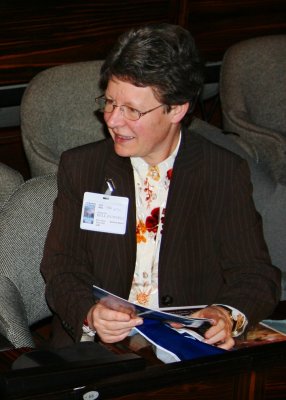
Managed profile Not claimed by Jocelyn Bell Burnell

Jocelyn Bell Burnell has not joined FLAPSS and has not endorsed it. This page is a reference record assembled from published interviews and public remarks. Every answer below is a direct quotation with the source and date shown next to it.

Is this you, or is something wrong?

JB

Jocelyn Bell Burnell

Radio astronomer; discoverer of pulsars

United Kingdom ยท b. 1943

Astrophysicist from Northern Ireland who identified the first radio pulsars in 1967 as a doctoral student at the University of Cambridge. The 1974 Nobel Prize in Physics for the discovery went to her supervisor Antony Hewish and to Martin Ryle. She received the Special Breakthrough Prize in Fundamental Physics in 2018 and the Royal Society's Copley Medal in 2021.

4 answers 0 followers reference

What is the thing you are best at that nobody watching can see?
I was very, very thorough, making sure I really understood how that telescope worked, and that it was working properly. I was quite convinced that I wasn't clever enough to be in Cambridge and would be thrown out at some stage. My policy was to work as hard as I could so that I'd know I'd done my best. We now label this as impostor syndrome, but we didn't recognise, and certainly didn't name it, back then.

Recorded Louise Walsh, University of Cambridge 'Journeys of Discovery' interview series, 1 January 2020 source

How has a failure, or apparent failure, set you up for later success? Do you have a favourite failure?
My contemporaries were more upset about the Nobel than I was not to be recognised. One of them labelled it the 'No-Bell' prize! But it was fine by me. There's no Nobel Prize in astronomy and I was really proud that it was my stars that had convinced the prize committee that there was good physics in astrophysics.

Recorded Louise Walsh, University of Cambridge 'Journeys of Discovery' interview series, 1 January 2020 source

What is something everyone in your world agrees about that you think is wrong?
The next generation of telescopes will see millions of events per night with computers that sift through huge amounts of data. If we had had access to a computer, we would never have programmed it to look for something so unexpected. How do you pick up the things you don't know exist, the things you can't tell it to look for? My project was to study quasars, and then we accidentally stumble over these things called pulsars. They were totally unexpected, totally unknown โ€“ and it's been huge fun.

Recorded Louise Walsh, University of Cambridge 'Journeys of Discovery' interview series, 1 January 2020 source

What is one of the best or most worthwhile investments you have ever made โ€” of money, time, or energy?
Yes, in 2018, I was awarded the Breakthrough Prize for the discovery. I was a bit dumbstruck, never expecting that kind of thing to happen. I was keen that the money should be used well and the best way to do that seemed to be to encourage a more diverse research student population from under-represented groups.

Recorded Louise Walsh, University of Cambridge 'Journeys of Discovery' interview series, 1 January 2020 source

Every quotation above is reproduced from the source shown beside it and has not been edited. Jocelyn Bell Burnell did not write these answers for FLAPSS. Request a correction or removal.