I started reading poetry in primary school—Victor Hugo, the romantics, and the Parnassians—they were part of the curriculum. In my grandfather’s library there were some anthologies of nineteenth-century poetry. Alfred de Vigny impressed me most; indeed I won a competition by reciting Vigny’s “Moses” with an enthusiasm that touched the examiner. In fact this poem and “La Maison du Berger” are among the most beautiful poems in the French language, unfairly neglected today.
What is something everyone in your world agrees about that you think is wrong?
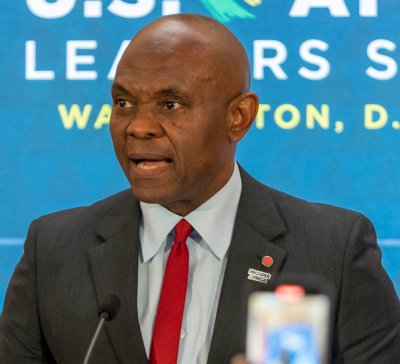
I will start by stating the obvious. No one here questions whether development is desirable. No one questions the inherent need to save lives and help others by giving. However, I believe that we need to rethink the ways in which we help others. We need to give from the perspective of empowering the recipient, instead of making them dependent on us.
Georgetown University, Washington DC, The Tony Elumelu Foundation, 12 May 2015 source ↗
Others on this question
View all 79 →
Yves Bonnefoy
Poet, essayist and translator
Richard Hamming
Mathematician and computer scientist; Turing Award, 1968
When you are famous it is hard to work on small problems. This is what did Shannon in. After information theory, what do you do for an encore? The great scientists often make this error. They fail to continue to plant the little acorns from which the mighty oak trees grow. They try to get the big thing right off. And that isn't the way things go. So that is another reason why you find that when you get early recognition it seems to sterilize you. In fact I will give you my favorite quotation of many years. The Institute for Advanced Study in Princeton, in my opinion, has ruined more good scientists than any institution has created, judged by what they did before they came and judged by what they did after.
Recorded
Bell Communications Research Colloquium Seminar, Morristown, New Jersey, Bell Communications Research Colloquium Seminar (transcription hosted by the University of Virginia Department of Computer Science), 7 March 1986
source ↗
Corazon Aquino
President of the Philippines, 1986–1992
My predecessor set aside democracy to save it from a communist insurgency that numbered less than 500. Unhampered by respect for human rights, he went at it with hammer and tongs. By the time he fled, that insurgency had grown to more than 16,000. I think there is a lesson here to be learned about trying to stifle a thing with a means by which it grows.
Recorded
U.S. Capitol Building, Washington, D.C., AmericanRhetoric.com, 18 September 1986
source ↗
Ralph Nader
Lawyer and consumer advocate; author of Unsafe at Any Speed
Too many people who go to the best schools, and get great grades, are confronted with a choice of trivial work that is very high paid, and has some sort of surface status, like senior partner in a law firm, or corporate executive, but most of the work can be done by anybody.
More on values & belief
- Which living person do you most admire, and why? 406 answers
- What is the trait you most deplore in others? 197 answers
- What are you unwilling to optimise? 30 answers
- What have you come to understand about what it means to be human? 14 answers
- What is the most overrated virtue? 10 answers
- What do you need to believe in order to get through the day? 9 answers
Also answered this
Satya Nadella, Mark Zuckerberg, John C. Bogle, Charlie Munger, Ngozi Okonjo-Iweala, Jacqueline Novogratz
Search the directory for somebody in particular.
Explore further
- All values & belief questions
- Explore the archive — by field, age, era, and subject