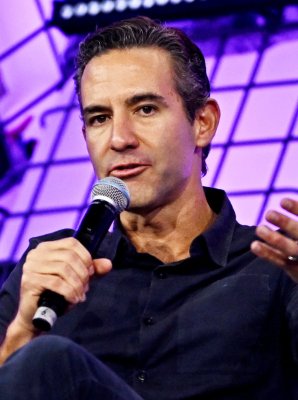
David Vélez

Co-founder and chief executive of Nubank

Recorded said elsewhere, not written here
I always say the Nubank story was very unlikely. It was a very low probability event. Again. We were going after these very big incumbent banks. Everybody told me, you know, you're Colombian. You have no idea what you're doing in Brazil. They're going to crush you. Like, don't. Just don't do it. And I did it mostly because everybody told me I couldn't do it. And so, if somebody tells me I can't do something, I want to go do it.

John Waldron, Goldman Sachs Talks, Goldman Sachs (official event transcript) source ↗

Others on this question

View all 80 →
Daron Acemoglu Economist; Nobel laureate in economic sciences for work on institutions and prosperity
It is simplistic in the following sense that you cannot institute democracy from above. It’s a very difficult process. And democracy is not the only dimension of institutions that matters. Although my work does emphasise that democracy by itself matters as well. But the problem is really alive today in the industrialised world, where you would think, and many political scientists have claimed that democracy is safe and secure and would never be under threat. It is under threat. Support for democracy is at an all time low, not just in the US, although really jarringly in the US but not just in the US, throughout the western world. So democracy is not easy to make work because democracy is about democratic citizenship. It’s about consensus, it’s about communication. It’s about accepting defeat, making compromises, talking and understanding the other side. All of those things are always difficult. They become more difficult during times of turbulence, which, you know, we are living through and they become harder when the infrastructure, for example, the communication infrastructure, makes this sort of democratic citizenship harder, which I think is not the only factor. But social media has certainly played that role.
Recorded Adam Smith, Telephone interview recorded shortly after the prize announcement, Nobel Prize Outreach, 1 October 2026 source ↗
Ngozi Okonjo-Iweala Director-General of the World Trade Organization from 2021; Finance Minister of Nigeria, 2003–2006 and 2011–2015
What I want to do this morning is share with you a couple of stories and talk about a different Africa. Already this morning there were some allusions to the Africa that you hear about all the time: the Africa of HIV/AIDS, the Africa of malaria, the Africa of poverty, the Africa of conflict, and the Africa of disasters. While it is true that those things are going on, there's an Africa that you don't hear about very much. And sometimes I'm puzzled, and I ask myself why. This is the Africa that is changing, that Chris alluded to. This is the Africa of opportunity. This is the Africa where people want to take charge of their own futures and their own destinies.
Recorded TED2007, 3 March 2007 source ↗
David Hockney Painter, draughtsman, printmaker and photographer
I thought I was a hedonist at the time, but when I look back I was always working. I am always working. I work every day. I never give parties; I never gave them.
Recorded The Guardian, Interview at his London home, The Guardian, 9 May 2015 source ↗
Frederick Douglass Abolitionist, orator, newspaper editor and U.S. diplomat; U.S. Marshal for the District of Columbia 1877–1881; U.S. Minister Resident to Haiti 1889–1891
I do not think much of the accident or good luck theory of self-made men. It is worth but little attention and has no practical value. An apple carelessly flung into a crowd may hit one person, or it may hit another, or it may hit nobody. The probabilities are precisely the same in this accident theory of self-made men. It divorces a man from his own achievements, contemplates him as a being of chance and leaves him without will, motive, ambition and aspiration. Yet the accident theory is among the most popular theories of individual success.
Recorded Lecture, delivered repeatedly 1859–1893, Teaching American History, reproducing Frederick Douglass Papers, Library of Congress Manuscript Division source ↗

More from David Vélez

View profile →
Question What would you most want to leave your children? Death & what remains
Queremos crear un ambiente familiar en donde no todo sea fácil, en donde no todo les caiga del cielo, sino que puedan construir su propio camino y tengan ese sentido de desesperación y esa hambre. Eso significa también que todo ese dinero no se les va a dejar a ellos. Se les dará muchísimo amor, como les damos, y muchas oportunidades de educación y de desarrollo, pero todo ese dinero no es para ellos.
Recorded Vicky Dávila, interview, Semana, 1 October 2022 source ↗
Question What makes you want to keep learning? Attention & the world
I wish I knew more about Clojure, which is the programming language we use most at Nubank. If I did, I could better understand some of the more complex problems we're trying to solve, and I think I could ask better questions when we're setting priorities. I'd like to be able to communicate at that level with the technical side of our team, and I think they would appreciate it, too.
Recorded questionnaire, Sequoia Capital, 15 August 2018 source ↗
Question What is the worst job you have ever had? Craft & work
Los diferentes trabajos en los que he estado, después de mi graduación, han sido de 100 y 120 horas a la semana, especialmente empezando con Nubank. Básicamente vivía en el lugar de trabajo. Empezamos la compañía en una casa de dos pisos. Mi cofundador vivía en el segundo piso. Yo básicamente dormía en el primer piso, o pasaba muchas noches en el primer piso. No salimos de esa casa por seis o 12 meses porque trabajábamos como locos.
Recorded Vicky Dávila, interview, Semana, 1 October 2022 source ↗

More on values & belief

Also answered this

Nithin Kamath, Marvin Minsky, Hiroshi Mikitani, Lisa Su, Mark Zuckerberg, Satya Nadella

Search the directory for somebody in particular.

Explore further

Report this answer