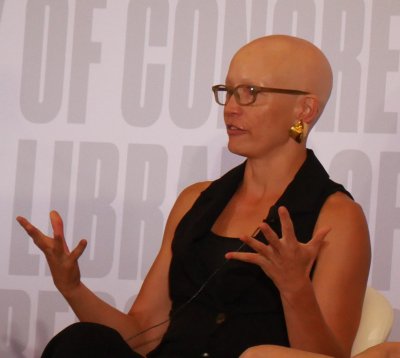
Obviously, it’s different for everyone. And actually there is a difference for each thing I do. But one way it happens is to just move. [ laughs ] I mean, obviously, you don’t just sort of randomly throw yourself around the room. You move with these ideas and sometimes I find that I’ve already got images in my head that I imagine my body in, or sometimes I have sequences in my head. I think a lot of time I’m listening to what comes next because sometimes the body will tell you that. Often I don’t document it too early in the process because sometimes if you forget stuff it’s worth knowing that the things that you forget maybe weren’t worth keeping. The things that have settled are the things that need to be kept because they seem most urgent. I don’t know. I mean, sometimes it’s about going to the studio and nothing happens for a long time and you just sit there and you’re not feeling it. That’s awful. It’s like when you’re writing and sometimes you go to the coffee shop and you’re like, “So, we’ll just see what happens.” And you end up on Facebook. I think the answer to this is… I really think the answer to this is I don’t know. [ laughs ]
Originally asked
The Paris Review, to novelists and poets, The Art of Fiction
A recurrent craft question in The Paris Review's Art of Fiction interviews; wording varies between character, theme, first sentence, image, and idea.
You answer as yourself. Nobody on FLAPSS answers as anybody else.
Maddie Crum, The Creative Independent interview, 10 July 2019 source ↗
Others on this question
View all 70 →It’s different every time. The physical or mental acts of composing are always kind of the same. It really involves, for me, turning off the more critical faculties of the brain and reaching a state where things just flow. It takes many days to get into that because normally you’re in this critical mode, this analytical mode where you’re structuring things and putting things in order. To create the material, to create the building blocks, you have to go into another state, which is much more receptive and much more intuitive.
It’s funny. Before, it used to be that I’d travel somewhere. I always had a storyline, some kind of grounding element. I used to go somewhere and just take over a space and go find things and find elements. That was how I used to do it. But since I had Cyrus I’ve had to do things only in the studio and shift it, so it’s very different for me now. I’m constantly writing in my book and coming up with things, mostly from things I read. I have all these ideas and I just write them and then some make it out. Most of them don’t. I was reading [Jorge Luis] Borges’ Labyrinths about six months ago. That really spoke to me, and that’s when I started doing the [painting series titled] Endless Sunsets. It’s like a labyrinth, something you can never get out of and there’s really no point in it, a brain maze kind of thing.
When I was this young assistant at the University of Groningen my responsibility was for four beds, or rather the patients in four beds. That was all I had to do. And, one of these patients was a young man, 22 years old, who slowly and miserably died from renal failure. He became blind, he vomited, and it was a miserable death. And I, as a very, very young physician, had to tell his mother, in a black dress and a little white cap like the farmers have, that her only son was going to die. I couldn’t do a damn thing about it. So, I began to think, “If I could just every day remove as much urea as this boy creates, which is about 20 grams, then the boy could live.” Well, he died, but I began to work on that.
More on craft & work
- What is the worst job you have done? 232 answers
- What do you consider your greatest achievement? 193 answers
- How do you know when a piece of work is finished? 69 answers
- What do you do when you feel creatively blocked or stuck? 69 answers
- How much rewriting or revision do you do? 51 answers
- What is the part of your job that people would be surprised is most of your job? 47 answers
Also answered this
Cheryl Strayed, André Aciman, Andrea Barrett, T.C. Boyle, Morgan Parker, John Banville
Search the directory for somebody in particular.
Explore further
- All craft & work questions
- The The Art of Fiction questionnaire — 3 questions from the same format
- Explore the archive — by field, age, era, and subject