Unfortunately. And it’s mostly a made-up story. It was incredible to see how it was created here. All over the news: Muslim rage or whatever. The rioting was not about being Muslim. These people have not been able to integrate. So if they have a crisis of identity, it’s forced upon them. If, after three generations of living in France, Arabs are still called Arabs and not French, then of course they will be angry. People ask why the Arabs don’t consider themselves French. Well, it’s because the French don’t consider them French. Then you had the Ministry of the Interior talking about cleaning the scum off the street. That doesn’t justify the violence—they don’t have the right to burn cities—but it explains what happened.
What is something everyone in your world agrees about that you think is wrong?
Question
If you could have a gigantic billboard anywhere, what would it say and why?
Time & hindsight
Question
What are bad recommendations you hear in your profession or area of expertise?
Craft & work
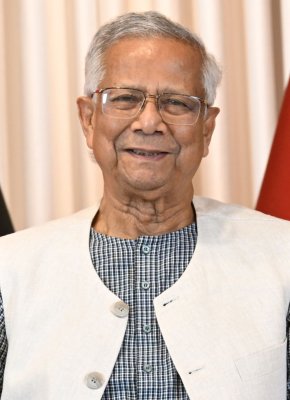
To me poor people are like bonsai trees. When you plant the best seed of the tallest tree in a flower-pot, you get a replica of the tallest tree, only inches tall. There is nothing wrong with the seed you planted, only the soil-base that is too inadequate. Poor people are bonsai people. There is nothing wrong in their seeds. Simply, society never gave them the base to grow on.
Nobel Peace Prize lecture, Oslo City Hall, The Nobel Foundation, 10 December 2006 source ↗
Others on this question
View all 79 →
Marjane Satrapi
Graphic novelist, cartoonist and film director
Recorded
Joshuah Bearman, A brasserie near her studio, Paris, The Believer, Issue 36, 1 August 2006
source ↗
Corazon Aquino
President of the Philippines, 1986–1992
My predecessor set aside democracy to save it from a communist insurgency that numbered less than 500. Unhampered by respect for human rights, he went at it with hammer and tongs. By the time he fled, that insurgency had grown to more than 16,000. I think there is a lesson here to be learned about trying to stifle a thing with a means by which it grows.
Recorded
U.S. Capitol Building, Washington, D.C., AmericanRhetoric.com, 18 September 1986
source ↗
Yehuda Amichai
Poet
Some people think that anti-Semitism didn’t really exist in Germany until 1933. I certainly don’t want to take anything away from Hitler’s guilt, but the anti-Semitism I grew up with predated Hitler. We were called names. We had stones thrown at us. And, yes, this created real sorrow. We defended ourselves as well as we could. Funny thing, the common name we were called was Isaac—the way Muslims are called Ali or Mohammed. They’d call out, Isaac, go back to Palestine, leave our home, go to your place. They threw stones at us and shouted, Go to Palestine. Then in Palestine we were told to leave Palestine—history juxtaposed can be very ironic.
Recorded
Lawrence Joseph, Cafés in Greenwich Village, New York, The Paris Review, Issue 122, Spring 1992, 1992
source ↗
Wisława Szymborska
Poet and essayist; Nobel laureate in Literature, 1996
But my answer is this: inspiration is not the exclusive privilege of poets or artists generally. There is, has been, and will always be a certain group of people whom inspiration visits. It’s made up of all those who’ve consciously chosen their calling and do their job with love and imagination. It may include doctors, teachers, gardeners – and I could list a hundred more professions. Their work becomes one continuous adventure as long as they manage to keep discovering new challenges in it. Difficulties and setbacks never quell their curiosity. A swarm of new questions emerges from every problem they solve. Whatever inspiration is, it’s born from a continuous “I don’t know.”
Recorded
Swedish Academy, Stockholm, 7 December 1996, The Nobel Foundation (nobelprize.org), 7 December 1996
source ↗
More from Muhammad Yunus
View profile →In a poverty-free world, the only place you would be able to see poverty is in the poverty museums. When school children take a tour of the poverty museums, they would be horrified to see the misery and indignity that some human beings had to go through. They would blame their forefathers for tolerating this inhuman condition, which existed for so long, for so many people.
Recorded
Nobel Peace Prize lecture, Oslo City Hall, The Nobel Foundation, 10 December 2006
source ↗
I am in favor of strengthening the freedom of the market. At the same time, I am very unhappy about the conceptual restrictions imposed on the players in the market. This originates from the assumption that entrepreneurs are one-dimensional human beings, who are dedicated to one mission in their business lives − to maximize profit.
Recorded
Nobel Peace Prize lecture, Oslo City Hall, The Nobel Foundation, 10 December 2006
source ↗
More on values & belief
- Which living person do you most admire, and why? 406 answers
- What is the trait you most deplore in others? 197 answers
- What are you unwilling to optimise? 30 answers
- What have you come to understand about what it means to be human? 14 answers
- What is the most overrated virtue? 10 answers
- What do you need to believe in order to get through the day? 9 answers
Also answered this
Mellody Hobson, Howard Marks, Dan Pallotta, Tony Elumelu, Halla Tómasdóttir, Warren Buffett
Search the directory for somebody in particular.
Explore further
- All values & belief questions
- Explore the archive — by field, age, era, and subject