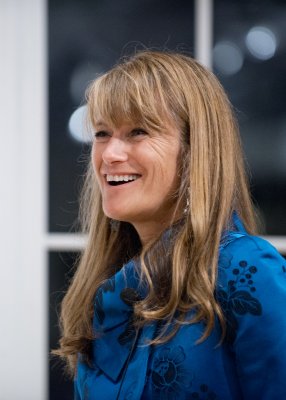
Founder and chief executive of Acumen
I think I did always want to change the world from the time I was six. And I guess that was part of both the positive and the pressure.
Tim Ferriss, The Tim Ferriss Show, 6 May 2021 source ↗
The question
What did you want to be when you were growing up?Originally asked
The Guardian, to a different person each week, The Q&A
This is a standing question in The Guardian's decades-long The Q&A and also recurs independently in career and life interviews.
You answer as yourself. Nobody on FLAPSS answers as anybody else.
Founder and chief executive of Acumen
I think I did always want to change the world from the time I was six. And I guess that was part of both the positive and the pressure.
Tim Ferriss, The Tim Ferriss Show, 6 May 2021 source ↗
Scotland’s rugby captain. My hero Gavin Hastings was captain when he came to our school for a training session when I was 10 or 11. I met him and was blown away.
Dancing was in my bones from when I started ballet at two.
I was hellbent on being a Thunderbird. I was devastated when my parents finally told me it was a fictional organisation. Ruined my 18th.
Did I have a dream job? I’m not sure. I remember making a little, two-page magazine like kids do, but I never intended to do that as a job, I just thought it was a way having a parallel life to school, doing something different. But I never had that in mind.
But the book I give right now in this time of so much despair is Viktor Frankl’s Man’s Search for Meaning, where he really looks at people in the Holocaust and asks himself, why did some just sort of crumple up and die and others stayed resilient and strong? And that at the end of the day, no one can take our dignity away from us.
That human beings are selfish. I don’t believe it. We have angels and monsters inside each of us. What we need to do better as a society is create systems and opportunities to bring out our most generous.
On the one hand, we have people that say the aid system is so broken we need to throw it out. And on the other we have people who say the problem is that we need more aid. ... Both sides are right. And the problem is that neither side is listening to the other. Even more problematic, they're not listening to poor people themselves.
One of the biggest lessons of my life, Krista, has been that we can’t separate the world into monsters and angels and that there’s nothing like loving people and knowing friends who played different roles in the genocide, including being perpetrators, that makes you have to confront that most raw element of what it means to be human. And the only conclusion I could make was that there are monsters and angels in each of us and that those monsters really are our broken parts — they’re our insecurities; they’re our fears; they’re our shames — and that in times of insecurity, it becomes really easy for demagogues to prey on those broken parts and sometimes make us do terrible things to each other.
My ability to connect with people. I think I can see people and they feel it.
Eleanor Roosevelt. She represents a woman of great privilege, who never shied away from that privilege. She used her privilege to help the most vulnerable, the voices unheard.
Kiran Mazumdar-Shaw, Angela Hartnett, Tom Kerridge, Mellody Hobson, Gino D'Acampo, Derek Sivers
Search the directory for somebody in particular.