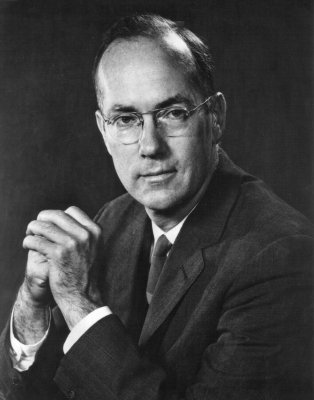
Professor Randall was a great advisor and a great mentor. He taught me, I think, in the best possible way. He was not a brilliant lecturer. His courses were fairly pedestrian. I didn’t think his seminars were particularly interesting. But working with him on a one-to-one basis as his assistant, I think that’s the way one has to learn to be a historian. That is, he was writing, and if he needed some particular reference, I had to go find it and get it. If he was writing, he wanted everything checked meticulously over and over again. So I had to take the manuscript over to the library and check it all out. So that by working closely with him, I got to see, first of all, a lot of the library and its extensive holdings, but I got, even more important, to understand what a scholar is about. It is about care. It is about “pains-taking.” It is about judgment as well as it’s about very skillful writing. He was an excellent writer as well. So in that sense, Professor Randall and Mrs. Randall shaped my future career.
Originally asked
The Paris Review, to novelists and poets, The Art of Fiction
A durable Art of Fiction question asked through named literary influences and artistic models.
You answer as yourself. Nobody on FLAPSS answers as anybody else.
Academy of Achievement interview, Berkeley, California, 18 March 1991 source ↗
Others on this question
View all 42 →The last teacher I had was a man named O’Halloran. But he was the only one who offered words of encouragement, who told us we were distinct, unique individuals with a right to think for ourselves. And that was just before we left Leamy’s National School. And he told me, “My boy, you are a literary genius.” And you can imagine what I had to put up with at the schoolyard with all the others. “Hey, McCourt, you’re a literary genius. Look at him. Look at the literary genius.
Well, my mom had me at 22 and my sister at 24. When I think about her trying to raise these two young girls in Manhattan, having grown up in an incredibly conservative family and her having a more progressive calling for a more liberal life… It was my mother’s bravery, and my mother’s pursuit of her creative life that made it possible for me to have the one I currently have.
Well, there were, you know, several poses that was known for everybody, that is known for certain poses. And to me it was the three-quarter back pose. And it was a very difficult pose to do, to twist your body and to show the small waist and to show at the same time your wide shoulders, your back. And you also see the front and you see the abs and you see the calf and the thighs and all of those things. But it was a difficult pose to do. Very few bodybuilders could master it. I copied basically Reg Park, who was my idol and who won three times the Mr. Universe competition. And he was known for that pose in a kneeling position and in a standing position. And so because he was my idol, I was, you know, absolutely fanatic to copy his poses and then to kind of improve on that. And that's exactly what I did.
More from Charles H. Townes
View profile →I suppose it’s easy to say, and it may be true, that my role in the development of the laser is perhaps the most important to society. Certainly in terms of applications, and the direct effects on humans, that has been quite important. On the other hand, there are other things which most people don’t know about, and in the scientific area, that I could argue are really quite important, the discoveries there.
People tell me that I work hard. I never feel that I do particularly, because it’s fun. I always say, “Well, I’ve never worked hard in my life.” I’m busy, but most of what I do is enjoyable. It isn’t that it’s not tedious to some people, and so on, and of course I have routine to do, but I don’t mind it. I just don’t feel that I’m put upon. I spend a lot of time, but it’s fun. It’s a very intensive hobby. I would say it’s my most serious hobby. I have lots of hobbies, but the one permanent one is science, physics. So yes, I spend a lot of time, and I would agree with Edison, you have to work very hard and intensively.
More on taste & recommendation
Also answered this
Linus C. Pauling, Ph.D., Frances Arnold, Gertrude B. Elion, David McCullough, Marco Brambilla, Gore Vidal
Search the directory for somebody in particular.
Explore further
- All taste & recommendation questions
- The The Art of Fiction questionnaire — 3 questions from the same format
- Explore the archive — by field, age, era, and subject