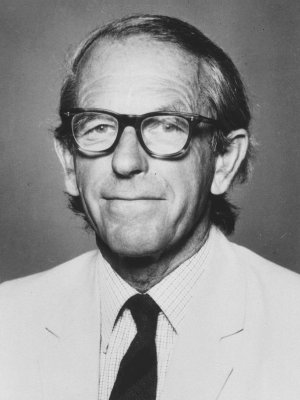
In fact, what I usually say to people, “Probably some of the most successful scientists are the ones that know how to deal with failure well.” Because it’s easy to feel good when you succeed. That’s an easy thing. But you’re probably going to fail in science a lot more than you succeed, so you really have to learn how to deal with it and not let it beat you.
How has a failure, or apparent failure, set you up for later success? Do you have a favourite failure?
Question
What advice would you give your twenty-year-old self, and what should they ignore?
Time & hindsight
They’re not failures, you try something and it doesn’t work, and some people, you know, get fed up with this, and I’ve known some of my friends and colleagues who have just decided to give up science because they can’t stand it, but I’ve always decided, you know, if it doesn’t work, forget it and start planning the next experiment, and that’s always exciting.
Academy of Achievement interview, 28 October 2000 source ↗
Others on this question
View all 63 →
Robert S. Langer
Biomedical engineer; Institute Professor at MIT
Susan Butcher
Dog musher; four-time winner of the Iditarod Trail Sled Dog Race
I feel that because I challenge myself so often, sometimes I will fail. This is, to me, the essence of competition — that there will be both winners and losers. But I have great faith in myself that I will turn this loss into something positive.
Howard Schultz
Chief executive of Starbucks, 1987–2000, 2008–2017 and 2022–2023
But in 2007, the music stopped. We had lost sight of our shared purpose and our guiding principles, in which growth and success began to cover up mistakes and a disease set into Starbucks. That disease, hubris. We lost our way and believe it or not, we almost lost the entire company.
Francis Collins
American physician-scientist
about 95% of the experiments we do are total failures, and that’s because we’re out there on the leading edge of what’s possible, and most of the time it isn’t quite possible.
Recorded
Academy of Achievement, Academy of Achievement interview, Bethesda, Maryland, 1 April 2000
source ↗
More from Frederick Sanger
View profile →Get on with it. But make sure you do want to do it. I think that’s the important thing, to be something that you would enjoy. If you only just go into science to get rich or to win gold medals, then I wouldn’t bother, but if you really want to enjoy yourself in the lab, then do it.
More on failure & regret
- What has been your biggest disappointment? 366 answers
- Who most deserves an apology from you, and why? 209 answers
- If you could edit your past, what would you change? 203 answers
- What is the worst thing anyone has said to you? 122 answers
- Which moment embarrassed you most? 122 answers
- What is the hardest thing that has happened to you, and what did you carry out of it? 36 answers
Also answered this
Robert S. Langer, Michael Rosbash, Richard Leakey, Paul Farmer, Christiane Nüsslein-Volhard, Venkatraman Ramakrishnan
Search the directory for somebody in particular.
Explore further
- All failure & regret questions
- Explore the archive — by field, age, era, and subject