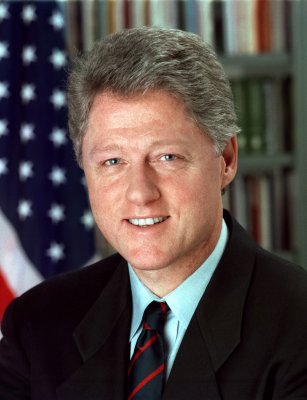
Bill Clinton

42nd President of the United States, 1993–2001

Recorded said elsewhere, not written here
My job was basically to be a delivery boy for all kinds of things, but they also — because I was at Georgetown and studying international affairs, I was assigned to read six newspapers a day and clip the most relevant articles. This is the technology we used. You couldn’t scan articles. There was no “online.” There was nothing, right? So I would read the newspapers, clip the articles I thought they ought to read, put them on a routing slip, which had on it the names of the senior staff of the committee and all the senators who were committee members. And I would send it to the senior staff, and they would decide whether to send any of them on, but I don’t think I’d have won a Rhodes Scholarship if I hadn’t been a clerk on the Foreign Relations Committee. Nobody else I was competing with read six newspapers a day, and they actually paid me good money to read The Washington Post, The New York Times, The Washington Star, which existed then, The Baltimore Sun , The St. Louis Post Dispatch , and then we alternated — and — oh, and The Wall Street Journal . We read them every day. Those were the six papers we read. I did, and then that’s what the senators got.

Academy of Achievement interview source ↗

Others on this question

View all 42 →
Sachin Tendulkar India Test and one-day international cricketer, 1989–2013
In the last 24 years that I have played for India I have made new friends, and before that I have had friends from my childhood. They have all had a terrific contribution. As and when I have called them to come and bowl to me at the nets, they have left their work aside to come and help me. Be it joining me on holidays and having discussions with me on cricket, or how I was a little stressed and wanting to find a solution so I can perform better. All those moments my friends were with me. Even for when I was injured, I would wake up in the morning because I couldn't sleep and thought that my career was over because of injuries, that is when my friends have woken up at 3 o'clock in the morning to drive with me and make me believe that my career was not over. Life would be incomplete without all those friends.
Recorded Farewell address, Wankhede Stadium, Mumbai, ESPNcricinfo, 16 November 2013 source ↗
Shinya Yamanaka Stem cell biologist; Nobel laureate in Physiology or Medicine, 2012
However, it was very natural that a failed surgeon with little experience in molecular biology had a hard time finding a position. A turning point came when I got a fax from Thomas Innerarity at the Gladstone Institute of Cardiovascular Diseases in San Francisco. After a short telephone conversation, Tom was brave enough to give me a postdoctoral position in his lab! Working at Gladstone was one of the best decisions I ever made in my life.
Recorded Laureate-written autobiography for Les Prix Nobel, Nobel Prize Outreach, 1 December 2012 source ↗
Malala Yousafzai Education campaigner; co-founder of the Malala Fund; United Nations Messenger of Peace
Her story is why I dedicate the Nobel Peace Prize money to the Malala Fund, to help give girls quality education, everywhere, anywhere in the world and to raise their voices. The first place this funding will go to is where my heart is, to build schools in Pakistan—especially in my home of Swat and Shangla.
Recorded Oslo City Hall, The Nobel Foundation, 10 December 2014 source ↗
Yves Bonnefoy Poet, essayist and translator
I was not much taken by their poems, but I liked Leconte de Lisle’s translation of Homer, especially his Iliad, which brought me the classical world. I have often felt a great difference between myself and the next generation, those who were twenty in 1950, although it is only a few years, because I had read in my grandfather’s library books that were later less accessible. The next generation was reading Michaux, Prévert, Éluard—twentieth-century authors. I’m glad to have read the Greek classics, and French ones too—writers like Racine and Corneille.
Recorded Shusha Guppy, The Paris Review, Issue 131, Summer 1994, 1994 source ↗

More from Bill Clinton

View profile →
Question What fills you with the most pride? Identity & self
I’m most proud of the fact that we produced broad-based prosperity, where the incomes of the bottom 20% rose more percentage-wise than the incomes of the top 20%, about the same as the incomes of the top 5%. That was across all racial groups, all regional groups, and all income groups, and that we did it while eliminating 600 billion dollars in national debt. And I put America on a path to be debt free so that we’d be able to embrace the challenges of the 21st century, and I think that at a time of yawning inequality, having inclusive prosperity is very important to building support for inclusive societies.
Recorded Academy of Achievement interview, London, England, 18 October 2017 source ↗
Question What has life taught you about being human? Values & belief
There is always an impulse to degrade people who are different from you, to diminish them, to demean them, and it never seems to go away, even when there is ample evidence that when we work together, we do better. It’s not about material progress or personal comfort. It’s about personal identity, and there are still so many forces at work in the human psyche that lead some people to think that their identity requires them to have someone to look down on or to demean or to feel that they’re superior to, and I think that that’s at the root of all this. It’s the only story in human society. Who is the other? Who is one of yours? Cain and Abel.
Recorded Academy of Achievement interview source ↗
Question What thought won't let you sleep? Daily life
Now that’s what happens when people go crazy, where the only thing that matters is whose camp are you in, whose side are you on, what tribe do you belong to — where facts and discussions become irrelevant. And it made me wonder whether the way I was raised and all the listening and storytelling skills I learned as a boy would even be relevant today. They’d be good if you’re in. They’re still really important to getting anything done, but if you live in an environment where everything is a litmus test and everything is a-hundred-to-nothing, and the only thing that matters is feeding your resentment, and anger blinds you to answers, and being very sanctimonious somehow proves your sincerity and authenticity, it’s really hard to get anything done. It’s a whole new challenge now, and that’s why — and the Russians knew that. You know, that’s when they get in here and start fooling with all these politics. They realize you just sort of load it up because once people take sides based on what tribe they’re in then there’s no difference in facts and fiction. There’s no difference in truth and lies. It’s just, does this confirm what side you’re on? And you can’t run a democracy that way. It is utterly impossible to preserve democracy.
Recorded Academy of Achievement interview source ↗
Question What does everyone in your world seem to agree on that you think is wrong? Values & belief
If I had to make the welfare decision again tomorrow, I’d sign it again tomorrow. We had a 60 percent reduction in the welfare rolls. We had an enormous percentage of poor people move into the workforce, start middle-class lifestyles, and when we had a brief tech recession of six months in 2001, after I left office, people who had moved from welfare to work were less likely to be laid off than the general working population. So I would do it again.
Recorded Academy of Achievement interview source ↗
Question What do you need to believe in order to get through an ordinary day? Values & belief
Yeah, there were a lot of brave people who stood up. Then, you know, it cost Martin Luther King and Medgar Evers and the three civil rights workers in Philadelphia, Mississippi, and Viola Liuzza and a lot of the others their lives, but they were on the right side of history, and they believed if they made this sacrifice that it would work out. And whenever I get discouraged about everything they stood against rising up again, I realize there just are no public, or permanent, victories. You have to keep fighting for freedom.
Recorded Academy of Achievement interview source ↗
Question What is the biggest professional obstacle you have faced? Craft & work
I do think my mother had a lot to do with that. I mean, after all, you know her — it was not near as bad as having your husband die in a car wreck after — he survives World War II. They had a great life planned, and he gets killed in a car wreck, not because of a concussion, but because in a fluke, the tire blows out on his car. He’s thrown out of the car. He lands in a ditch in a field, and the ditch is full of water, and he can’t get out of the ditch before he drowns. There’s — it made it look a little whiny for me to be all bent out of shape about losing an election, and I realized that it was a weird deal. It was 1980. It was Reagan’s election. It was a period not unlike now, widespread resentment over the stagnant economy, the Iran hostage crisis, and I bet I had a hundred people coming to — I’m not exaggerating — coming to me and saying, “God, Bill, I didn’t know you were going to lose. I just voted against you to because I didn’t like some of the things you’d done.” And I remember once — one of the funniest things that ever happened to me. I was driving over to see my mother. I lived in Little Rock, and she lived in Hot Springs 50 miles away, and in the middle of the trip was a little country store owned by a guy who ran the elections in that area and was real smart, so I went in to get a Coke, and started talking to him. And this little boy came up to me in overalls, and he said, “You’re Bill Clinton, aren’t you?” I said, “Yes.” He said, “I helped to beat you. I cost you 11 votes, and it was no accident.” I said, “You did?” He said, “Yeah.” He said, “It was me, my wife, our two boys and their wives, and five of my friends. We just decked you.” I said, “Why’d you do it?” He said, “I had to because you raised my car tax. The car license.” And so we’re standing on the interstate. I said, “Look over there. You remember when I was governor? That highway broke wide open, and even big trucks were off in the ditch, and I had to send the National Guard down here to clean it up, and we had to fix it.” He said, “Yeah, I remember. I don’t care. I still didn’t want to pay it.” So I was laughing at the guy, and I said, “Let me ask you something.” I said, “If I ever ran again, would you vote for me?” He said, “Absolutely.” I said, “You would?” He said, “Sure. We’re even now.” And I went — and there were no cell phones, so I had a dime. I went and put it in the payphone, and I called Hillary, and I said, “You know, I’m not dead yet. We might have to run again.
Recorded Academy of Achievement interview source ↗

More on money & investment

Also answered this

Indra Nooyi, Mario Molina, Charlie Munger, Derek Sivers, Ahmed Zewail, Demis Hassabis

Search the directory for somebody in particular.

Explore further

Report this answer