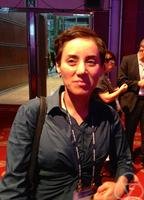
Maryam Mirzakhani

Mathematician; Fields Medallist, 2014

Recorded said elsewhere, not written here
However, I should say that the education system in Iran is not the way people might imagine here. As a graduate student at Harvard, I had to explain quite a few times that I was allowed to attend a university as a woman in Iran. While it is true that boys and girls go to separate schools up to high school, this does not prevent them from participating say in the Olympiads or the summer camps.

Clay Mathematics Institute annual report interview, Clay Mathematics Institute Annual Report 2008, 1 January 2008 source ↗

Others on this question

View all 80 →
Dan Pallotta Founder of Pallotta TeamWorks; founder of the Charity Defense Council
Now, this ideology gets policed by this one very dangerous question, which is, "What percentage of my donation goes to the cause versus overhead?" There are a lot of problems with this question. I'm going to just focus on two. First, it makes us think that overhead is a negative, that it is somehow not part of the cause. But it absolutely is, especially if it's being used for growth.
Recorded TED2013, 1 March 2013 source ↗
John C. Bogle Founder of The Vanguard Group, 1974
Over the past two centuries, our nation has moved from being an agricultural economy, to a manufacturing economy, to a service economy, and now to a predominantly financial economy. But our financial economy, by definition, subtracts from the value created by our productive businesses. Think about it: while the owners of business enjoy the dividend yields and earnings growth that our capitalistic system creates, those who play in the financial markets capture those investment gains only after the costs of financial intermediation are deducted. Thus, while investing in American business is a winner's game, beating the stock market before those costs is a zero-sum game. But after intermediation costs are deducted, beating the market—for all of us as a group—becomes a loser's game.
Recorded Georgetown University commencement, Georgetown University / johncbogle.com, 18 May 2007 source ↗
Yves Bonnefoy Poet, essayist and translator
I started reading poetry in primary school—Victor Hugo, the romantics, and the Parnassians—they were part of the curriculum. In my grandfather’s library there were some anthologies of nineteenth-century poetry. Alfred de Vigny impressed me most; indeed I won a competition by reciting Vigny’s “Moses” with an enthusiasm that touched the examiner. In fact this poem and “La Maison du Berger” are among the most beautiful poems in the French language, unfairly neglected today.
Recorded Shusha Guppy, The Paris Review, Issue 131, Summer 1994, 1994 source ↗
Jessye Norman Operatic soprano and recitalist
I went to the opera practically every night. I went to something practically every night, just learning and seeing and absorbing, and what I noticed is that there were singers that were only sort of slightly older than I whose voices sounded as though they were many decades older than that, and didn’t sound pretty, and I needed to understand what was happening. I mean there were singers that were 28 or 30 years old or something, and I would speak to them afterwards to say, “Was your voice tired tonight? Tell me what’s happening,” because I didn’t understand it. Their voices should have sounded fresh and blooming and wonderful, but instead they sounded different, and it was because they were singing a different opera every night, and singing whatever was offered, and I didn’t understand and needed to understand — because no one was telling me these things — why they just didn’t say no. Why didn’t they just say, “Oh no, I don’t think I should.”
Recorded Academy of Achievement (achievement.org) source ↗

More from Maryam Mirzakhani

View profile →
Question What part of your job would surprise outsiders because it takes up so much of your time? Craft & work
Of course, the most rewarding part is the "Aha" moment, the excitement of discovery and enjoyment of understanding something new, the feeling of being on top of a hill, and having a clear view. But most of the time, doing mathematics for me is like being on a long hike with no trail and no end in sight! I find discussing mathematics with colleagues of different backgrounds one of the most productive ways of making progress.
Recorded Clay Mathematics Institute annual report interview, Clay Mathematics Institute Annual Report 2008, 1 January 2008 source ↗

More on values & belief

Also answered this

Willem Kolff, Sylvia Earle, Elinor Ostrom, Jennifer Doudna, Shinya Yamanaka, Mario Molina

Search the directory for somebody in particular.

Explore further

Report this answer