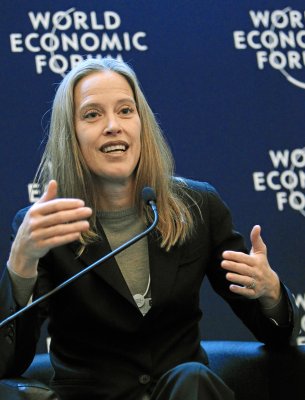
Spend your time on something meaningful. Not on parties, and not on taking it easy. That’s not good enough. […] When you’re young, you think: Let’s party, do drugs, drink, waste it all, right? But as you get older, you look at what you’ve accomplished. And when you get old, you’ve run out of time. You have to ask yourself: Why am I here? Can I contribute anything to humanity, to society, my work?
What advice would you give your twenty-year-old self, and what should they ignore?
Question
How has a failure, or apparent failure, set you up for later success? Do you have a favourite failure?
Failure & regret
Question
Which teacher, parent, coach or friend most made you who you are, and what did you learn from them?
Relationships
Question
Which book changed the way you think, and what did it change?
Taste & recommendation
And the most fulfilled, centered, grounded, happy people I know are people who made the choice to be part of an effort to actually make the world a better place. ... I would say, to me, the path of least regrets is to at least make a short-term commitment to say, “Let me work to make a real difference in the world.” The worst that could happen is you decide to move into something else later, but you’ll always take with you what you’ve given and what you’ve gained through that experience.
Academy of Achievement recorded interview, American Academy of Achievement, 17 September 2013 source ↗
Others on this question
View all 77 →
Marina Abramović
Performance artist
Recorded
University Post, University of Copenhagen public talk, University Post (uniavisen.dk), University of Copenhagen
source ↗
Richard Leakey
Palaeoanthropologist and conservationist; head of the Kenya Wildlife Service
It’s very hard to give people advice, because you don’t know their personality. Personality is a big part of that. Everybody is faced with passing opportunities. Many people watch the opportunity come and watch it go. I say, if an opportunity comes and you have got the self-confidence, grab it. Ride it for a bit. If it’s not the right opportunity, do something else, but be positive about opportunities.
Recorded
Academy of Achievement recorded interview, American Academy of Achievement, 21 June 2007
source ↗
Whitney Wolfe Herd
Founder and chief executive of Bumble
I think fear and fear of the unknown and perceived failure is what holds people back. For me, I am more scared of complacency than having something not work out. I'd rather take a leap of faith and fall than stand on the edge forever.
Eleanor Roosevelt
First Lady of the United States 1933–1945; United States Delegate to the United Nations General Assembly 1945–1952; Chair of the UN Commission on Human Rights 1946–1951
Courage is more exhilarating than fear and in the long run it is easier. We do not have to become heroes overnight. Just a step at time, meeting each thing that comes up, seeing it is not as dreadful as it appeared, discovering we have the strength to stare it down.
Recorded
You Learn by Living (1960), Eleanor Roosevelt Papers Project, The George Washington University, 1960
source ↗
More from Wendy Kopp
View profile →I applied to one firm in every sector. This was the most half-hearted job search. “I’ll apply for that management consulting firm and this investment bank…” and I applied for five jobs altogether, because my heart wasn’t in it. And thankfully… I’m so glad I didn’t get any of those big jobs! Because that made this decision easier.
Recorded
Academy of Achievement recorded interview, American Academy of Achievement, 17 September 2013
source ↗
There were definitely teachers who made a huge impact. I think about a woman whose name was Mrs. Fish who was my seventh grade English Language Arts teacher. What I remember about her was just how hard she pushed. I thought I was a perfectly strong student at this point, but she just pushed everyone to their limits. That was very instrumental for me. In fact, all the teachers I remember had that same thing: they just had such high expectations and wouldn’t stop pushing. I think she just conveyed the idea that good wasn’t good enough, and I think the skill development and critical thinking skills that that year developed were also instrumental. But I also think, I don’t know, there’s something about that year that probably instilled within me that ethic that you just have to keep pushing to get better and better, and that if you work hard enough it will pay off.
The Fountainhead , I think, pretty much saved me in the initial years of Teach For America. I loved that book, but I’m not sure books were the seminal thing that guided my path. ... I think it was sort of about “the creator against the world,” and I was probably feeling at that point that I was up against lots of boulders, to pull off the big idea of Teach For America.
Recorded
Academy of Achievement recorded interview, American Academy of Achievement, 17 September 2013
source ↗
More on time & hindsight
- When were you happiest? 577 answers
- What is the most important lesson life has taught you? 137 answers
- What scares you about getting older? 61 answers
- What is the best advice you have ever received? 28 answers
- If you could have a gigantic billboard anywhere, what would it say and why? 23 answers
- What is something you were told by a parent, teacher, or mentor that you still repeat to yourself? 22 answers
Also answered this
Óscar Arias Sánchez, Margaret Thatcher, Andrew Young, Desmond Tutu, Rosa Parks, Elie Wiesel
Search the directory for somebody in particular.
Explore further
- All time & hindsight questions
- Explore the archive — by field, age, era, and subject