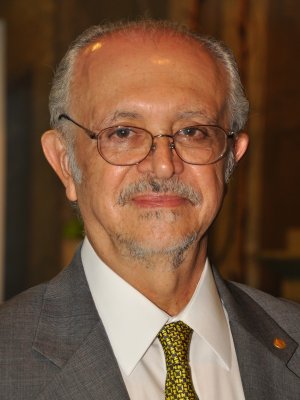
I would hope that most of you will in fact strive for leadership in a principled manner with values, because that would be the foundation that this country needs to have if it is to take its place in the world. I would hope that each of you would lead by example and that each of you would live by the principles that you espouse.
What advice would you give your twenty-year-old self, and what should they ignore?
Question
Which book changed the way you think, and what did it change?
Taste & recommendation
Question
What is the biggest obstacle you have faced professionally?
Craft & work
Question
What is the most important lesson life has taught you?
Time & hindsight
Question
Which living person do you most admire, and why?
Values & belief
Question
How has a failure, or apparent failure, set you up for later success? Do you have a favourite failure?
Failure & regret
Question
What inspires you to learn?
Attention & the world
The advice that I would give is try to find something that you like. Try to devote your energies to being very good at it. Try to achieve excellence. Don’t necessarily have as a goal success or getting prizes or whatever, but just doing very good work. And work hard. Keep working at it. Be patient. Realize that you don’t always see the benefits of what you’re doing, short-term. But in the end, the activities that I do, for example, scientific research, can be extremely rewarding. It’s really a very fascinating career.
Academy of Achievement interview, Sun Valley, Idaho, 29 June 1996 source ↗
Others on this question
View all 77 →
Ratan Tata
Chairman of Tata Sons, 1991–2012
Recorded
Indian School of Business, Hyderabad — graduation address, Rediff Business, 11 June 2010
source ↗
Whitney Wolfe Herd
Founder and chief executive of Bumble
I think fear and fear of the unknown and perceived failure is what holds people back. For me, I am more scared of complacency than having something not work out. I'd rather take a leap of faith and fall than stand on the edge forever.
Jenny Diski
Novelist and essayist
One thing I state as soon as we’re out of the door: ‘Under no circumstances is anyone to say that I lost a battle with cancer. Or that I bore it bravely. I am not fighting, losing, winning or bearing.’ I will not personify the cancer cells inside me in any form. I reject all metaphors of attack or enmity in the midst, and will have nothing whatever to do with any notion of desert, punishment, fairness or unfairness, or any kind of moral causality.
Frederick Sanger
Biochemist; twice a Nobel laureate in Chemistry, 1958 and 1980
Get on with it. But make sure you do want to do it. I think that’s the important thing, to be something that you would enjoy. If you only just go into science to get rich or to win gold medals, then I wouldn’t bother, but if you really want to enjoy yourself in the lab, then do it.
More from Mario Molina
View profile →It was probably a series of biographies of scientists like Pasteur, or even earlier ones — Leeuwenhoek inventing the microscope and Madame Curie. I forget how many others, but it was really just, for me, a fascination to learn about these great heroes. At that time, of course, they were totally inaccessible, almost non-human, to me. It became very interesting to me.
In terms of this issue of these industrial gases affecting the environment, at the beginning the road was not easy, because we were suggesting that society had to change, that industries had to do something different than they were doing at that time. And of course, initially we did not meet with a good reception to these ideas from industry. And even from the scientific community — even though our ideas were well received in the small group of specialists in what we were doing — it was not necessarily well received by the scientific community at large. So we really had to continue doing as good a science as we could, and at the same time trying to well communicate our conviction that it was something important, something that had to change in the way society was functioning.
So achievement, to me, is something that just comes with this attitude of doing your work the best you can in a passionate way. It’s not something that you have to expect. It’s something that’s a consequence of what you do, but it’s certainly important.
there are really very many. Again, as a child, it was obviously those scientists which had lived in the past that had made such an important mark in science history.
Recorded
Academy of Achievement interviewer, Academy of Achievement interview, 1996, 1996
source ↗
At first the research did not seem to be particularly interesting – I carried out a systematic search for processes that might destroy the CFCs in the lower atmosphere, but nothing appeared to affect them. We knew, however, that they would eventually drift to sufficiently high altitudes to be destroyed by solar radiation. The question was not only what destroys them, but more importantly, what the consequences are.
Recorded
Laureate-written autobiography, provided by the laureate in November 2007, Nobel Prize Outreach, 1 November 2007
source ↗
I have also benefited from teaching; as I try to explain my views to students with critical and open minds, I find myself continually being challenged to go back and rethink ideas. I now see teaching and research as complementary, mutually reinforcing activities.
Recorded
Laureate-written autobiography, provided by the laureate in November 2007, Nobel Prize Outreach, 1 November 2007
source ↗
More on time & hindsight
- When were you happiest? 577 answers
- What is the most important lesson life has taught you? 137 answers
- What scares you about getting older? 61 answers
- What is the best advice you have ever received? 28 answers
- If you could have a gigantic billboard anywhere, what would it say and why? 23 answers
- What is something you were told by a parent, teacher, or mentor that you still repeat to yourself? 22 answers
Also answered this
Richard Feynman, Frederick Sanger, Norman Borlaug, George Schaller, Paul Farmer, Christiane Nüsslein-Volhard
Search the directory for somebody in particular.
Explore further
- All time & hindsight questions
- Explore the archive — by field, age, era, and subject