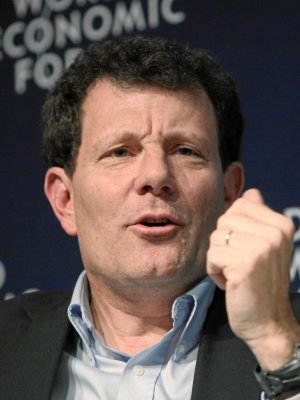
Nicholas Kristof

Journalist and columnist, The New York Times; two-time Pulitzer Prize winner

Recorded said elsewhere, not written here
And in the end they robbed us, but they did let us go. But I think that that was a very useful lesson early in my journalism career, that things can go very badly wrong. At one moment you can be going down a road and things are perfect, and the next moment you’ve got some drunk soldiers who just may kill you. That fear that I felt when they were holding us for maybe 45 minutes or so in the jungle, that has never entirely left me.

Academy of Achievement recorded interview, American Academy of Achievement, 3 July 2008 source ↗

Others on this question

View all 35 →
Albie Sachs Anti-apartheid lawyer; Justice of the Constitutional Court of South Africa
And into the darkness I said, “What happened?” and a woman’s voice said, “It was a car bomb,” and I collapsed into darkness again, but with a sense of euphoria. I’d survived.
Recorded Academy of Achievement interview, 3 July 2009 source ↗
Kate Bowler Historian of American Christianity; professor at Duke Divinity School
To so many people, I am no longer just myself. I am a reminder of a thought that is difficult for the rational brain to accept: that the elements that constitute our bodies might fail at any moment. When I originally got my diagnosis at age 35, all I could think to say was, “But I have a son.” It was the best argument I had. I can’t end. This world can’t end. It had just begun. A tragedy is like a fault line. A life is split into a before and an after, and most of the time, the before was better.
Recorded The New York Times, Sunday Review, 26 January 2018 source ↗
Athol Fugard Playwright, director and actor
I don’t think I could. Of course I’m saying this on American soil. I’m facing a few more months of work in this city, but at the end of it, I will be returning to South Africa. I would like to believe that if for some reason the situation deteriorated to the point where I was told, “If you leave South Africa, you can never come back,” I’d stay there. There were periods in my life when I could have been seduced away. I am incredibly fortunate that the government took away my passport at the point when I was most open to seduction. With my passport gone, I could have left on a one-way ticket. But the issue was so starkly highlighted that I had no problem in saying, “No.”
Recorded Lloyd Richards, Interview conducted in front of an audience at the Poetry Center of the 92nd Street YMHA, New York, The Paris Review, Issue 111, Summer 1989, 13 October 1985 source ↗
George H. W. Bush 41st President of the United States, 1989–1993
If you really want to make a difference, whether it’s in helping other people, or whether it’s in fighting for your country, or whether it’s in the political arena, or journalism, or physics, you’ve got to persevere. You’ve got to understand that there are going to be some enormous bumps in the road.
Recorded Academy of Achievement interview, Williamsburg, Virginia, 2 June 1995 source ↗

More from Nicholas Kristof

View profile →
Question What part of your job would surprise outsiders because it takes up so much of your time? Craft & work
I have a bunch of rules for myself. You stop at every village, you ask what the situation is like between this village and the next village, you look for fresh tire tracks. If there are any land mines in the area, then you always want to make sure you go on fresh tire tracks to reduce the risk of mines. You carry a certain amount of money so that if some soldiers with guns want to rob you — no fuss — you give them a decoy wallet or some other money to make them happy, and you just learn to kind of be soothing with unpleasant people.
Recorded Academy of Achievement recorded interview, American Academy of Achievement, 3 July 2008 source ↗

More on failure & regret

Also answered this

George H. W. Bush, Lynsey Addario, Malala Yousafzai, Bill Clinton, Rosa Parks, Elie Wiesel

Search the directory for somebody in particular.

Explore further

Report this answer