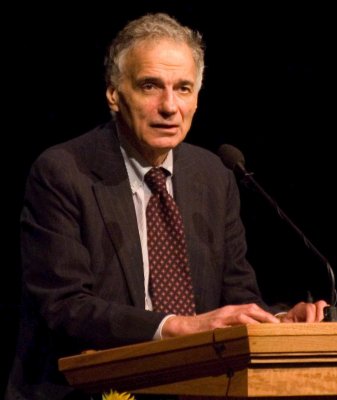
Yes, and, I'll turn your comment around and say it's fairly close to the biological ratio of men and women. It's all the other fields that are aberrant. … This is the normal field, right? Because it is a much more even distribution between men and women, absolutely.
What is something everyone in your world agrees about that you think is wrong?
Question
What are you most proud of?
Identity & self
Question
What is something you were told by a parent, teacher, or mentor that you still repeat to yourself?
Time & hindsight
Question
Which teacher, parent, coach or friend most made you who you are, and what did you learn from them?
Relationships
Too many people who go to the best schools, and get great grades, are confronted with a choice of trivial work that is very high paid, and has some sort of surface status, like senior partner in a law firm, or corporate executive, but most of the work can be done by anybody.
Academy of Achievement interview, 16 February 1991 source ↗
Others on this question
View all 82 →
Elizabeth Blackburn
Molecular biologist; Nobel laureate in Physiology or Medicine, 2009
Recorded
Adam Smith, Telephone interview recorded immediately after the prize announcement, Nobel Prize Outreach, 5 October 2009
source ↗
Willem Kolff
Physician and inventor; builder of the first practical artificial kidney
I’ve been mortally opposed to the so-called life-and-death committees that were instituted. When there were many more patients that needed to be dialyzed, and not enough artificial kidneys available, you had the institution of the life-and-death committees. ... Depending on the answer to these questions, he could be dialyzed. Otherwise, he could go to hell. I’ve been mortally opposed to that. When I set up a dialysis center here with a grant from some government agency, I was forced to put in a life-and-death committee, but it never met.
David Hockney
Painter, draughtsman, printmaker and photographer
I thought I was a hedonist at the time, but when I look back I was always working. I am always working. I work every day. I never give parties; I never gave them.
Jessye Norman
Operatic soprano and recitalist
I went to the opera practically every night. I went to something practically every night, just learning and seeing and absorbing, and what I noticed is that there were singers that were only sort of slightly older than I whose voices sounded as though they were many decades older than that, and didn’t sound pretty, and I needed to understand what was happening. I mean there were singers that were 28 or 30 years old or something, and I would speak to them afterwards to say, “Was your voice tired tonight? Tell me what’s happening,” because I didn’t understand it. Their voices should have sounded fresh and blooming and wonderful, but instead they sounded different, and it was because they were singing a different opera every night, and singing whatever was offered, and I didn’t understand and needed to understand — because no one was telling me these things — why they just didn’t say no. Why didn’t they just say, “Oh no, I don’t think I should.”
More from Ralph Nader
View profile →I think three things. One is the great advances in auto safety. I mean, there are tens of thousands of people being saved every year because cars are safer, and millions of people over a decade, injuries prevented. I think that’s a good example of the need to make technology more humane. We may benefit from a lot of technologies, but they exact a cost. Emphysema, cancer, soil contamination, contaminated water, death and injury on the highway. We’ve got to put more effort on making them more humane.
But if it did well, I’d remember what my parents told me, which was the hardest thing is not attaining success, it’s being able to endure it.
We used to converse at dinner time around the table. Parents and children. We talked about all kinds of issues. From local, neighborhood issues to world issues. It was back and forth, very lively, and very critical. During our early years my mother would relate historical sagas to us for five or ten minutes every lunch hour, when we would come home from school, and it would be continued the next day. I think that built into us a sense that freedom involves responsibility. It isn’t just waving flags and saying, “Look how free we are,” while people’s rights are being trampled sometimes overtly, sometimes beyond their control.
More on values & belief
- Which living person do you most admire, and why? 410 answers
- What is the trait you most deplore in others? 202 answers
- What are you unwilling to optimise? 33 answers
- What have you come to understand about what it means to be human? 21 answers
- What do you need to believe in order to get through the day? 16 answers
- What important truth do very few people agree with you on? 15 answers
Also answered this
Eleanor Roosevelt, Mikhail Gorbachev, Barack Obama, Desmond Tutu, Wangari Maathai, Bill Clinton
Search the directory for somebody in particular.
Explore further
- All values & belief questions
- Explore the archive — by field, age, era, and subject