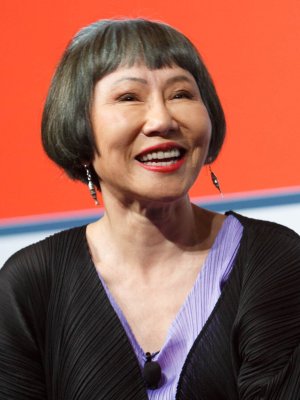
How has a failure, or apparent failure, set you up for later success? Do you have a favourite failure?
Recorded Amy Tan said elsewhere, not written here
I didn’t fear failure. I expected failure. I think I’ve always been somebody, since the deaths of my father and brother, who was afraid to hope. So, I was more prepared for failure and for rejection than success. The success took me by surprise and it frightened me.

Academy of Achievement interview, 28 June 1996 source ↗

Others on this question

View all 69 →
Nora Ephron Journalist, essayist, screenwriter and film director
I wish I had learned more from failure than just mortification. I don’t think you learn much from success, and I don’t think you learn much from failure, unfortunately. It’s one of the sad things. You certainly learn that it’s more fun to have a hit than a flop.
Recorded Academy of Achievement interview, 21 June 2007 source ↗
Paula Scher Graphic designer
When you’re working and you make mistakes, particularly when you’re young, you make discoveries because you do things that are inappropriate and wrongheaded, but within the wrongheadedness you find an unexpected way to go. These things are truly the breakthroughs.
Recorded Debbie Millman, Psychology Today, 'Brainstorm' column, 1 May 2009 source ↗
Cal Ripken Jr. Baseball player; holder of the record for consecutive games played
No. I mean if you fail 70 percent of the time, you had a great year. You're dealing with failure seven out of ten times as a hitter.
Recorded Academy of Achievement interviewer, Academy of Achievement interview, Washington, D.C., 18 August 2020 source ↗
Twyla Tharp Choreographer, dancer and author
You called it vision, I call it analyzing what my strengths were. It just so happened there was no market whatsoever for my strength, unless I was interested in becoming a show dancer, for which I tried, but I’m not tall enough. Also, when I auditioned for the Radio City Rockettes, they said, “We love your fouettés, but can’t you smile?” And things of that nature transpired between me and a commercial future. So, I managed to find a way of subsisting in the beginning by doing odd jobs, Kelly Girl temp work, selling perfume at Macy’s, and any and everything to be able to sustain studying and beginning a career with a group of dancers who were willing to devote five years, really, of their lives to me, working very seriously, with complete commitment, for not a penny.
Recorded Academy of Achievement (achievement.org), 1993 source ↗

More from Amy Tan

View profile →
Question Which writers or artists most influenced your work? Taste & recommendation
I remember one teacher in particular. I was in a school in the third grade and they were thinking of skipping me, putting me in a higher grade. But then somebody said that would be bad psychologically. So, for that entire year, because I had learned all the lessons that year — the multiplication tables, whatever the reading was — this teacher let me go off by myself and draw pictures. So I had hours and hours of time where I was just left to my own devices, drawing pictures. And she would encourage me. That was a wonderful period in my life. I mean, I didn’t become an artist, but somebody let me do something I loved. What a luxury, to do something you love to do. I would still like to have that luxury, to be able to just sit and draw for hours and hours and hours. In a way, that’s what I do as a writer. I just sit by myself, being in my own mind, not being directed at what I should be doing moment-by-moment, not having a clear plan set out by anybody and just letting imagination enter into the blank page. So in that respect, I can thank Miss Grudoff of the third grade for allowing me that.
Recorded Academy of Achievement interview, Sun Valley, Idaho, 28 June 1996 source ↗

More on failure & regret

Also answered this

Twyla Tharp, Kurt Vonnegut, Chimamanda Ngozi Adichie, Joan Didion, August Wilson, Francis Ford Coppola

Search the directory for somebody in particular.

Explore further

Report this answer