Which teacher, parent, coach or friend most made you who you are, and what did you learn from them?
Recorded Joyce Carol Oates said elsewhere, not written here
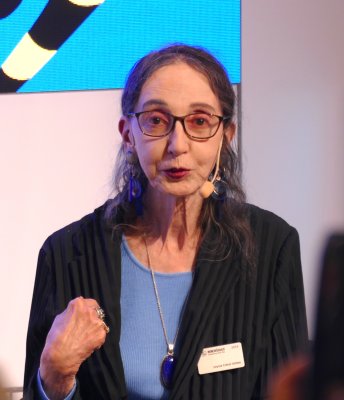
My parents inspired me by their example. They both grew up in the Depression, and both of them had to quit school when they were quite young to work, because there actually was no choice. So, though they’re intelligent people — and my father in particular is interested in books and has subsequently, since his retirement, attended classes at the University of Buffalo — nonetheless, they didn’t have any opportunity to be educated. So they’ve always impressed me with their resilience, their good spirits, their courage. It wasn’t an easy life, and I won’t go into details, but there were a lot of problems. And yet they were never defeated. Somebody else might have been defeated. Someone else might have been really depressed, or become an alcoholic or something, because there were personal problems and economic crises. But I just remember them carrying on and just doing their lives. They really made a strong impression on me.

Academy of Achievement interview source ↗

Others on this question

View all 73 →
Pete Rozelle Commissioner of the National Football League, 1960–1989
My dad certainly, and coaches I had that I was very close to. They took a big part in my developing an interest in sports, actually. One has passed away I was very close to. His name was Bill Slybaum. He was my coach in junior high school for tennis and then he moved up the ladder academically and went to the high school about the time I got there. He was my high school coach in basketball. I became very close to him. Later on, when I came back after the service, I went to Compton Junior College near Los Angeles, and he was the junior college basketball coach. I was very close to him.
Recorded Academy of Achievement interview source ↗
James Cameron Filmmaker and deep-sea explorer
There was. The critical moment for me was in the 11th grade. My biology teacher, Mr. McKenzie, decided that what our school needed was a theater arts program and we didn’t have it. There was wrestling, basketball, football, it was a very jock oriented school and there was no theater program whatsoever. So we started a theater program from scratch. We bootstrapped it. He taught it, and I think he might have done it for nothing. We had to build the props and the scenery and the costumes and do everything ourselves. We had to turn the stage into a proper working stage. It took a year, but we started putting on our own productions. I think that was really a pivotal moment. My biology teacher was our muse at that time. And I think the fact that we were having to do everything, that it wasn’t handed to us, may have created a kind of a work ethic that paid off then in independent film production because it’s the same thing. You know, you’re finding scraps and bits and pieces, and putting it all together and putting on a show. And it’s that sense of being able to create some moment of glory, some showmanship — out of nothing, out of baling wire — that is maybe a lesson that was learned there as a result of this man who just decided to have a theater arts program.
Recorded Academy of Achievement interview source ↗
Ernest J. Gaines Novelist; winner of the National Medal of Arts
My great aunt was probably the greatest influence in my life. She was crippled. She never walked in her life. She crawled over the floor all her life. When my mother had to go out into the fields when we were smaller children, and then later go to California, she left us with my aunt, and my aunt could do everything except walk. She cooked the food for us, would bring everything to the stove. We had an old wood-burning stove. She cooked the food for us. She washed our clothes on this old washboard. We had to bring all the stuff there, the water, the soap, the washboard itself. She also disciplined us. So we had to break our own switch to get our punishment if we did something wrong. So we’d go out and break our own switch and come back and take our punishment.
Recorded Academy of Achievement interview source ↗
John Wooden Basketball coach at UCLA, 1948-1975; winner of ten NCAA championships
My wife, Nellie, my high school sweetheart. She helped me in so many ways. I suppose people today might say it’s hard to believe, but I was an extremely shy person. Maybe being raised in the country had something to do with it. She got me to go to take public speaking classes, which I probably wouldn’t have done. I know that was of great help to me. And then, in so many other ways. She was a year behind me in high school. I’ve got a picture of us when she was 15 and I was 16. I don’t know why but, when we met, it was just love at first sight. She is the only girl I ever went with. I was a year ahead of her and I went away to college. Then, she graduated from high school and worked, and we didn’t get to see each other that much because times were hard. Even though it’s only 70 or 80 miles from Lafayette to Burnsville, the bus might have been 10 or 15 cents. I didn’t have it and she didn’t either. We didn’t get together much but we knew as soon as I graduated and got a job, we would get married and we did. She was a tremendous influence in so many ways. I’d say that my college coach, Piggie Lambert, is one of the most principled persons I’ve ever known. He had a lot of effect on my life. The head of the English Department at Purdue University, Dr. Creek, took a liking to me and tried to get me to forget sports completely and just concentrate on becoming a college English professor. There was some sort of a scholarship that he could get me for graduate school, but, I wanted to get married and get a job. So, I’d say that my father and mother, I don’t want to neglect my mother, and my wife and Piggie Lambert, my college coach at Purdue, probably had more influence on what I became as a teacher. That’s all I was: a teacher. That’s all I was as a basketball coach, just a teacher.
Recorded Academy of Achievement interview source ↗

More from Joyce Carol Oates

View profile →
Question Which trait do you most dislike in yourself? Identity & self
If I had a trait that I truly deplored, I would work to erase or modify it…Probably, a lack of discipline. (Though people think that I write quickly, & don’t revise, quite the reverse is true.) To myself, I work very slowly & painstakingly, & am often frustrated by accomplishing so little. My friend Margaret Atwood has said that in the late afternoon she is likely to be overcome by a feeling of desperation that she has accomplished so little that day, & this is a feeling I share, often. It seems that I waste most of my time gazing out the window here at my (overgrown) garden; & when I am in Berkeley, where I spend about one-third of the year, I am forever gazing out the window toward the San Francisco Bay & a continually changing, always-beautiful sky.
Recorded Vanity Fair, The Proust Questionnaire, Vanity Fair, November 2018 source ↗
Question Which living person do you most admire, and why? Values & belief
“Most admiring” an individual may depend upon knowing her—or him—only at a distance. Public personalities may be the easiest to admire, for obvious reasons. Michelle Obama has seemed to me enormously admirable, like President Obama. And—of course!—Oprah, a great American original. Among people whom I know personally, & have known for some time, Gloria Vanderbilt is most admirable. There are too many things to say about Gloria to fit this space—& indeed I have said a good deal about Gloria in the past—but she is one of the most remarkable persons of my acquaintance. Equally admirable, among my friends who are “known” to the public, whom nonetheless I know as individuals, is Steve Martin, remarkable also for the diversity of his talent(s). But what is most impressive about Steve is that, greatly gifted as he is in comedy, his comic vision is essentially unifying—radiantly goofy, never injurious to anyone. It has become a rare comedy that doesn’t trade upon marginalizing & insulting others & it is really quite remarkable how through his long career Steve has never insulted, hurt, or objectified anyone else for the sake of laughter.
Recorded Vanity Fair, The Proust Questionnaire, Vanity Fair, November 2018 source ↗
Question How has a failure, or apparent failure, set you up for later success? Do you have a favourite failure? Failure & regret
And so I finally felt that I’d given up. ... And towards the morning, I started thinking, “Well, failure is actually what most people experience in boxing.” ... And I found a way to write about the whole sport by way of beginning with failure, with the image of failure.
Recorded Academy of Achievement interview, 20 May 1997 source ↗
Question What is the trait you most deplore in others? Values & belief
Amid so much blatant cruelty in our political situation, such shocking indifference to the lives & welfare of those living at the margins of an affluent society, I think it must be this institutionalized cruelty, & the hypocrisy that surrounds it. “Making America great again”—for whom? Wealthy white people? The word “deplore” is particularly relevant here.
Recorded Vanity Fair, The Proust Questionnaire, Vanity Fair, November 2018 source ↗

More on relationships

Also answered this

John Grisham, Bob Woodward, Tom Wolfe, Ernest J. Gaines, Cheryl Strayed, Nora Ephron

Search the directory for somebody in particular.

Explore further

Report this answer