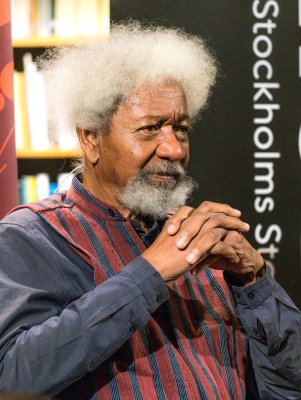
The early influence in my life I think was my father. That’s the earliest influence. He and his circle of friends. Usually, in our society, children are supposed to be neither seen nor heard. When elders are around, they’re supposed to very respectfully leave them alone. But I was curious. I just loved their debates. They used to get excited over issues, and so somehow I was allowed to eavesdrop, unlike the other children. And I picked up some of the ideas that they had, and I would ask questions. I was known as the questioner. Afterwards, I would ask questions, and my father would indulge me by trying to explain things to me. So that’s one of the reasons I consider him the earliest influence. And also, he had a small library, and I used to go into his library and try and read the books which I found there. Later on, as my circle of adult acquaintances increased, I think the next influence on me was my uncle, the Reverend I.O. Ransome-Kuti, who was another very erudite person, a great educationist. I used to visit them in Igbein, where he lived with his wife and they ran a school. So on weekends sometimes I would go there. And of course it was the usual story. I wanted to listen to them discussing and so on. Don’t misunderstand me. I was also very playful. I loved disappearing by myself, climbing trees, all that I did. But additionally, I was just fascinated by the whole discourse. Exchange of ideas between adults just used to fascinate me for some reason. I was never tired of listening to them. So my uncle was my next great influence.
Not claimed by Wole Soyinka
Wole Soyinka has not joined FLAPSS and has not endorsed it. This page is a reference record assembled from published interviews and public remarks. Every answer below is a direct quotation with the source and date shown next to it.
Wole Soyinka
Playwright, poet and novelist; Nobel laureate in Literature, 1986
Nigeria · b. 1934
Arts and letters
About
Wole Soyinka is a Nigerian playwright, poet and essayist and the first African writer to receive the Nobel Prize in Literature, awarded in 1986. He was imprisoned for twenty-two months, much of it in solitary confinement, during the Nigerian civil war.
5 answers
I just say, “Follow your instincts.” Don’t feel you have to follow the paths of others, because you may not be temperamentally fitted for it. And so you’ll just harm yourself and your cause and others. But just follow your instinct, and don’t ever pretend to be what you’re not.
Writing became a therapy. First of all, it meant I was reconstructing my own existence. It was also an act of defiance. I wasn’t supposed to write. ... I evolved all kinds of mental exercises, even went back to those subjects which I said I hated in school, in particular mathematics. ... You know, anything to keep the mind alive.
That’s a very good question. I think I’m a very lazy writer and by that I mean that I do not battle, I don’t struggle too hard against it. If I have difficulties in the writing, I just go and do other things. I don’t feel a compulsion to write. Of course, when I start writing then it becomes a compulsive activity, because I’ve begun something and I want to continue, want to finish it. … I know there are other writers who sit down religiously every morning, they take their espresso, they put a clean sheet of paper there and they sit looking at that paper until they’ve finished or covered at least a number of those pages. No, I’m not like that. I have to be ready. It has to gestate it for quite a while and then it’s ready to burst forth.
Yes, I do. I do, but I were part company with certain schools of writers that I do not believe that it is necessarily the duty of the writer. I don’t believe that. If a writer is true to his vocation, to his or her vocation, the very process of creativity enlarges these human horizons. It provides insights, even when you’re not writing, when your writing’s not dealing with a concrete political situation.
Every quotation above is reproduced from the source shown beside it and has not been edited. Wole Soyinka did not write these answers for FLAPSS. Request a correction or removal.