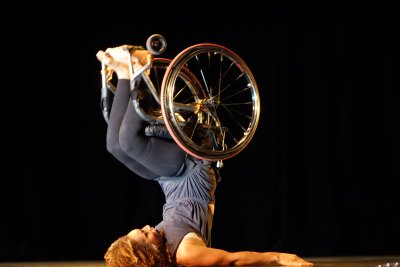
How does a new work begin for you?

Originally asked

The Paris Review, to novelists and poets, The Art of Fiction

A recurrent craft question in The Paris Review's Art of Fiction interviews; wording varies between character, theme, first sentence, image, and idea.

You answer as yourself. Nobody on FLAPSS answers as anybody else.

Recorded Alice Sheppard said elsewhere, not written here
Obviously, it’s different for everyone. And actually there is a difference for each thing I do. But one way it happens is to just move. [ laughs ] I mean, obviously, you don’t just sort of randomly throw yourself around the room. You move with these ideas and sometimes I find that I’ve already got images in my head that I imagine my body in, or sometimes I have sequences in my head. I think a lot of time I’m listening to what comes next because sometimes the body will tell you that. Often I don’t document it too early in the process because sometimes if you forget stuff it’s worth knowing that the things that you forget maybe weren’t worth keeping. The things that have settled are the things that need to be kept because they seem most urgent. I don’t know. I mean, sometimes it’s about going to the studio and nothing happens for a long time and you just sit there and you’re not feeling it. That’s awful. It’s like when you’re writing and sometimes you go to the coffee shop and you’re like, “So, we’ll just see what happens.” And you end up on Facebook. I think the answer to this is… I really think the answer to this is I don’t know. [ laughs ]

T. Cole Rachel, The Creative Independent interview, 7 March 2018 source ↗

Others on this question

View all 84 →
Thomas Mars French singer
It’s a funny contradiction because when we started playing instruments as kids, the thing we didn’t want to do was jam. We wanted to have an idea. We wanted structure. Jamming was like this way of sharing the spotlight, where everyone got their own solo, every individual got their own moment to shine. When we were growing up, that’s how we thought of it. Eventually we embraced this more freeform approach. I wouldn’t call it jamming, but maybe it’s more about exploring.
Recorded T. Cole Rachel, The Creative Independent interview source ↗
Danny Elfman Film composer and songwriter; founder of Oingo Boingo
No, they are three completely different processes. In film, I try to really blank out my mind when I see the film for the first time so that I have no preconceptions. Early on in my career, I tried to do all this prep or even read the script and write music, but none of it ever survived. And I realized the best way to go at it was to be as blank as I can possibly be. When I’m writing classical music, it’s much more nerve-wracking because I’m starting with nothing! And I don’t have a picture to drive me on. I am wired now, for 38 years, that I see a moving picture, I hear music, you know what I mean? But with classical, I got nothing, and at first that was totally terrifying. But I forced myself into it, and then something develops, and it becomes very liberating. With the rock music, it’s a whole different process. I mean, I can’t do anything until I get the message.
Recorded The Talks interview, 12 August 2022 source ↗
Alan Cumming Scottish actor, producer, director, writer and presenter
No, I would never say that. I would never say that I do something just in order to put a fresh spin on it or do something different with it. I am drawn to certain plays because I think there’s something about them in the story that I want to tell, or that I think is relevant—something that strikes me. With Macbeth, I’m not doing this because I want to do a crazy interpretation or production.
Recorded Gerry Visco, Interview Magazine, 19 April 2013 source ↗
Theresa Chromati American painter
The starting process has changed over time. I go back and forth from knowing exactly where I want to place the central figure and doing that first and committing to her and then building the world around her. But more recently, between the body of work I did last year and what I’m working on now, I’ve started to commit to building up the background layers slowly. Putting a wash down and building up a lot of different transparent layers that have their own energies, and then starting to rip that energy apart to then create a new form or a new structure. That language, in general, is also what this is about. Ripping and expanding, shedding and rebuilding, that push and pull of building the surface so that she has this foundation and that it feels like a more consonant structure. I’m liking that relationship to the work.
Recorded Annie Bielski, The Creative Independent interview source ↗

More on craft & work

Also answered this

Ja’Tovia Gary, Andy Serkis, David Lynch, Robert Wilson, Noah Baumbach, Sam Mendes

Search the directory for somebody in particular.

Explore further

Report this answer