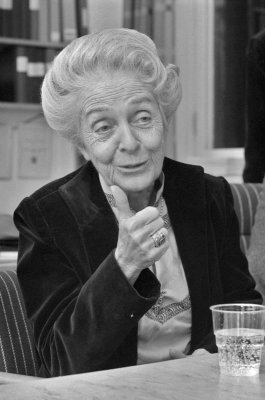
Rita Levi-Montalcini

Neurobiologist; Nobel laureate in Physiology or Medicine, 1986

Recorded said elsewhere, not written here
Ever since adolescence, [my elder sister Anna] has been an enthusiastic admirer of the great Swedish writer, the Nobel Laureate Selma Lagerlöf, and she infected me so much with her enthusiasm that I decided to become a writer and describe Italian saga "à la Lagerlöf". But things were to take a different turn.

Laureate-written autobiography for Les Prix Nobel, Nobel Prize Outreach, 1 December 1986 source ↗

Mentioned in this answer

Others on this question

View all 82 →
Marco Canora American chef
Yeah. At work every year, I kind of give my line cooks and my management team books as gifts around the holidays. So This is Water by David Foster Wallace is one I commonly give because it’s so short and the message is so perfect in my opinion. So I’ve given that a lot. And then for cookbooks, I got to say, the Marcella Hazan Essentials is just, I adore that woman. I adore her simple approach. It is like, she’s the OG of Italian grandma cooking. And so those are the two books.
Recorded Tim Ferriss, The Tim Ferriss Show podcast, 10 November 2021 source ↗
Alice Little Irish-American sex worker and YouTuber
Definitely. I would say the top three books that I tend to give as gifts, the first one would be a book that’s written by Dennis Hoff called The Art of the Pimp . It, literally, talks about his journey, how he ended up getting the Bunny Ranch, and a lot of the intimate details in relationship to sex in Nevada. For anybody that’s interested in what I do, wanting to learn a little bit more about the industry, that is always the first book I give is this is kind of your handbook, as it were, to the world of legal sex in Nevada. The second book that I give out most frequently is to my co-workers. It would be The 48 Laws of Power . A lot of the ladies haven’t had the opportunity or haven’t been exposed to that book. And so, I think that it’s a great tool to get into the hands of women and get that positive thinking going, that energy that that book really tends to encapsulate. And the third book is kind of an interesting one. It’s a book called Memoirs of a Geisha . It speaks as to the life of a woman who ended up being a geisha in Japan during the World War II era who was kind of purchased from her family and unwillingly brought into this very foreign world that could not be any more different than what her life was like. The reason why I tend to recommend this book for other people is that there’s this incredibly beautiful, humanistic element in the way that she describes. The author uses language that is very, very rich and colorful. And it sits you into that time and place where you smell the fish in front of you. You hear the sound of the shamisen that she’s playing. You can really immerse yourself into that world and kind of get a sense of what things were like, at that time.
Recorded Tim Ferriss, The Tim Ferriss Show podcast, 3 February 2018 source ↗
Brian Grazer Film and television producer; co-founder of Imagine Entertainment
The book that I gift most to people, because it has had a lasting impact on my psyche, is The Warrior Within: The Philosophies of Bruce Lee. I admire Bruce Lee for his physicality, of course, but more so for his deep philosophy, known as “Jeet Kune Do” or “the way of the intercepting fist.” The key element of Jeet Kune Do is its “formless form.” Bruce Lee rejected the rigid rules and structures of Kung Fu and other traditional fighting styles. Instead, he borrowed from several styles to create his own fluid, rapidly efficient technique that was all his. In The Warrior Within, John Little explains how Bruce Lee’s philosophy helped him overcome tremendous challenges and pain to become a man whose originality, intense belief, and commitment I’ve long admired.
Recorded Tim Ferriss, Tribe of Mentors guest post, The Blog of Author Tim Ferriss, 9 September 2019 source ↗
M. Sanjayan Conservation scientist; chief executive of Conservation International
Yeah. Tim and I have talked about this a little bit. So, for me, books are all about the moment and the emotion that I’m in and the person I’m giving it to is in. and so, I can’t tell you that there’s one book that has predominated how I give because I love books, and I love to give books. And I carry books around. Even today, I brought two books for you to autograph that I’m giving away. So, there’s an act of giving. And a book is a wonderful way to convey something to another person. Books that I’ve loved giving away, Norman McClain’s A River Runs Through It . I read that book in so many different ways, in so many pieces. It totally influenced my life in terms of fly fishing and finding magic in words and that quiet space. He also wrote that book when he was 71 years old. Kind of only the really big book he wrote. It was at 71. And you think about all of this sort of bullshit about creative genius being in the young and all of that. As you get older, you start appreciating it. If Norman could do it at 71, maybe I could do it not quite at 71 yet. Another book I really liked, a more recent book, is Stanley McChrystal’s Team of Teams . Completely different reason. Just a really clever, smart book about how to organize businesses and enterprises for today’s world. And he takes this experiential army in Afghanistan and brings it over to sort of your life or my life and makes it kind of relevant and meaningful. I found it very influential. I’ve given away quite a few copies of James Nester’s book, The Deep, which you might have read, right. You’ve read his book.
Recorded Tim Ferriss, The Tim Ferriss Show podcast, 4 February 2018 source ↗

More from Rita Levi-Montalcini

View profile →
Question What is the hardest thing that has happened to you, and what did you carry out of it? Failure & regret
The two alternatives left then to us were either to emigrate to the United States, or to pursue some activity that needed neither support nor connection with the outside Aryan world where we lived. My family chose this second alternative. I then decided to build a small research unit at home and installed it in my bedroom. My inspiration was a 1934 article by Viktor Hamburger reporting on the effects of limb extirpation in chick embryos. My project had barely started when Giuseppe Levi, who had escaped from Belgium invaded by Nazis, returned to Turin and joined me, thus becoming, to my great pride, my first and only assistant.
Recorded Laureate-written autobiography for Les Prix Nobel, Nobel Prize Outreach, 1 December 1986 source ↗

More on taste & recommendation

Also answered this

Amartya Sen, Andrew Weil, Tu Youyou, Shinya Yamanaka, Katalin Karikó, M. Sanjayan

Search the directory for somebody in particular.

Explore further

Report this answer