The question

What do you do when you feel creatively stuck?

Originally asked

The Creative Independent, to working artists, its interview series

A recurring Creative Independent question whose wording distinguishes a lasting block from a temporary impasse.

You answer as yourself. Nobody on FLAPSS answers as anybody else.

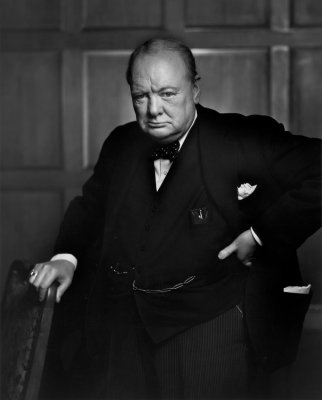
Winston Churchill

Prime Minister of the United Kingdom, 1940–1945 and 1951–1955; Member of Parliament 1900–1964

Recorded said elsewhere, not written here
At that moment the loud approaching sound of a motor-car was heard in the drive. From this chariot there stepped swiftly and lightly none other than the gifted wife of Sir John Lavery. 'Painting! But what are you hesitating about? Let me have a brush—the big one.' Splash into the turpentine, wallop into the blue and the white, frantic flourish on the palette—clean no longer—and then several large, fierce strokes and slashes of blue on the absolutely cowering canvas. Anyone could see that it could not hit back. No evil fate avenged the jaunty violence. The canvas grinned in helplessness before me. The spell was broken. The sickly inhibitions rolled away. I seized the largest brush and fell upon my victim with Berserk fury. I have never felt any awe of a canvas since.

Essay first published in the Strand Magazine in 1921–22 and collected in Amid These Storms, 1932, Winston S. Churchill, Painting as a Pastime, Project Gutenberg Canada, 1932 source ↗

Others on this question

View all 63 →
Trenton Doyle Hancock Painter and printmaker
I think once an artist or musician reaches a certain level of mastery, you can just do it on autopilot. My hand can keep moving and I can be making things, and on the outside I can be like, “This looks really cool” but I’m really just bored with it. I can draw this face or an eyeball or whatever in my sleep, and it’s not interesting to me. A creative block to me just means getting bored with myself. Those are those moments where you have to shake it up or do some introspection, or simply take a break. Sometimes I read a book or go to the movies, have my favorite meal, or go on a trip.
Recorded Katy Henriksen, The Creative Independent, 31 August 2017 source ↗
Bill "Blinky" Sellanga Kenyan musician/producer
I have a DJ side that I’ve developed, and so when creative blocks hit me I tend to spin a lot more than usual. Also, just trying my hand in other fields. I’m looking at sewing classes the next time I have a creative block.
Recorded Brandon Stosuy, The Creative Independent interview source ↗
Lynn Fainchtein Music supervisor for film
No, but sometimes I don’t find the right song, so I need to go to sleep and find the song the next day. But I have so much music, that if I need inspiration, I just push play and there’s always a song waiting for me.
Recorded Miriam Garcia, The Creative Independent, 31 May 2019 source ↗
Stephen O'Malley American musician
I think there’s two different things. There’s creative block and then there’s being busy. Sometimes they’re happening at the same time. You could be busy with a lot of concerts, improvised work, or collaborations and still have the creative block. There’s a point, though, where it’s like why keeping so busy becomes a question. Is it just about convincing yourself that you are constantly creative? Then, the question becomes maybe those ideas are not going to be as interesting as something I can come up with if I sat in the mountains for six months trying to write something by myself, you know?
Recorded Brandon Stosuy, The Creative Independent interview source ↗

More from Winston Churchill

View profile →
Question What one change would most improve the quality of your daily life? Daily life
The cultivation of a hobby and new forms of interest is therefore a policy of first importance to a public man. But this is not a business that can be undertaken in a day or swiftly improvised by a mere command of the will. The growth of alternative mental interests is a long process. The seeds must be carefully chosen; they must fall on good ground; they must be sedulously tended, if the vivifying fruits are to be at hand when needed. To be really happy and really safe, one ought to have at least two or three hobbies, and they must all be real.
Recorded Essay first published in the Strand Magazine in 1921–22 and collected in Amid These Storms, 1932, Winston S. Churchill, Painting as a Pastime, Project Gutenberg Canada, 1932 source ↗
Question What side project are you most glad you pursued? Craft & work
Painting is complete as a distraction. I know of nothing which, without exhausting the body, more entirely absorbs the mind. Whatever the worries of the hour or the threats of the future, once the picture has begun to flow along, there is no room for them in the mental screen. They pass out into shadow and darkness. All one's mental light, such as it is, becomes concentrated on the task. Time stands respectfully aside, and it is only after many hesitations that luncheon knocks gruffly at the door.
Recorded Essay first published in the Strand Magazine in 1921–22 and collected in Amid These Storms, 1932, Winston S. Churchill, Painting as a Pastime, Project Gutenberg Canada, 1932 source ↗
Question What are you best at that nobody watching would notice? Craft & work
Mr. Somervell—a most delightful man, to whom my debt is great—was charged with the duty of teaching the stupidest boys the most disregarded thing—namely, to write mere English. He knew how to do it. He taught it as no one else has ever taught it. Not only did we learn English parsing thoroughly, but we also practised continually English analysis. Mr. Somervell had a system of his own. He took a fairly long sentence and broke it up into its components by means of black, red, blue and green inks. Subject, verb, object: Relative Clauses, Conditional Clauses, Conjunctive and Disjunctive Clauses! Each had its colour and its bracket. It was a kind of drill. We did it almost daily. ... I learned it thoroughly. Thus I got into my bones the essential structure of the ordinary British sentence—which is a noble thing.
Recorded Chapter of his autobiography, written at Chartwell in 1930, Winston S. Churchill, My Early Life (Thornton Butterworth, 1930), Project Gutenberg Canada, October 1930 source ↗
Question In the last five years, what have you become better at saying no to? Daily life
I hope not too much on them. Well, really, we have to concentrate on the grim emergencies, and when we have solved them, we shall be in a position to deal with the future of the world in a manner to give the best results, and the most lasting results, for the common peoples of all the lands. But one has only a certain amount of life and strength, and only so many hours in the day, and other emergencies press upon us too much to be drawn into those very, very complicated, tangled, and not in all cases attractive jungles.
Recorded An unnamed correspondent at the White House press conference, Joint press conference with President Franklin D. Roosevelt, the White House, The American Presidency Project, 23 December 1941 source ↗
Question What do you believe happens when we die? Death & what remains
I cannot pretend to feel impartial about the colours. I rejoice with the brilliant ones, and am genuinely sorry for the poor browns. When I get to heaven I mean to spend a considerable portion of my first million years in painting, and so get to the bottom of the subject. But then I shall require a still gayer palette than I get here below. I expect orange and vermilion will be the darkest, dullest colours upon it, and beyond them there will be a whole range of wonderful new colours which will delight the celestial eye.
Recorded Essay first published in the Strand Magazine in 1921–22 and collected in Amid These Storms, 1932, Winston S. Churchill, Painting as a Pastime, Project Gutenberg Canada, 1932 source ↗
Question When you need counsel, who is the first person you call? Relationships
My mother made the same brilliant impression upon my childhood's eye. She shone for me like the Evening Star. I loved her dearly—but at a distance. My nurse was my confidante. Mrs. Everest it was who looked after me and tended all my wants. It was to her I poured out my many troubles, both now and in my schooldays.
Recorded Chapter of his autobiography, written at Chartwell in 1930, Winston S. Churchill, My Early Life (Thornton Butterworth, 1930), Project Gutenberg Canada, October 1930 source ↗

More on craft & work

Also answered this

Marya Hornbacher, William Villalongo, Katie Tupper, Michael Schenker, J'Kerian Morgan, Tegan Quin

Search the directory for somebody in particular.

Explore further

Report this answer