The question

What happens when we die?

Originally asked

The Guardian, to a different person each week, The Q&A

A recurring late-stage question in The Guardian Q&A, with materially different answers on publisher-hosted pages.

You answer as yourself. Nobody on FLAPSS answers as anybody else.

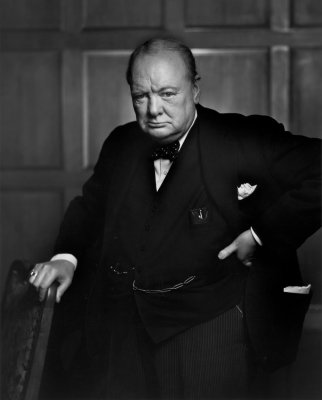
Winston Churchill

Prime Minister of the United Kingdom, 1940–1945 and 1951–1955; Member of Parliament 1900–1964

Recorded said elsewhere, not written here
I cannot pretend to feel impartial about the colours. I rejoice with the brilliant ones, and am genuinely sorry for the poor browns. When I get to heaven I mean to spend a considerable portion of my first million years in painting, and so get to the bottom of the subject. But then I shall require a still gayer palette than I get here below. I expect orange and vermilion will be the darkest, dullest colours upon it, and beyond them there will be a whole range of wonderful new colours which will delight the celestial eye.

Essay first published in the Strand Magazine in 1921–22 and collected in Amid These Storms, 1932, Winston S. Churchill, Painting as a Pastime, Project Gutenberg Canada, 1932 source ↗

Others on this question

View all 57 →

More from Winston Churchill

View profile →
Question What inspires you to learn? Attention & the world
At this school I was allowed to learn things which interested me: French, History, lots of Poetry by heart, and above all Riding and Swimming. The impression of those years makes a pleasant picture in my mind, in strong contrast to my earlier schoolday memories.
Recorded Chapter of his autobiography, written at Chartwell in 1930, Winston S. Churchill, My Early Life (Thornton Butterworth, 1930), Project Gutenberg Canada, October 1930 source ↗
Question Which book changed the way you think, and what did it change? Taste & recommendation
In history I decided to begin with Gibbon. Someone had told me that my father had read Gibbon with delight; that he knew whole pages of it by heart, and that it had greatly affected his style of speech and writing. So without more ado I set out upon the eight volumes of Dean Milman's edition of Gibbon's Decline and Fall of the Roman Empire . I was immediately dominated both by the story and the style. All through the long glistening middle hours of the Indian day, from when we quitted stables till the evening shadows proclaimed the hour of Polo, I devoured Gibbon. I rode triumphantly through it from end to end and enjoyed it all.
Recorded Chapter of his autobiography, written at Chartwell in 1930, Winston S. Churchill, My Early Life (Thornton Butterworth, 1930), Project Gutenberg Canada, October 1930 source ↗
Question What is the thing you are best at that nobody watching can see? Craft & work
Mr. Somervell—a most delightful man, to whom my debt is great—was charged with the duty of teaching the stupidest boys the most disregarded thing—namely, to write mere English. He knew how to do it. He taught it as no one else has ever taught it. Not only did we learn English parsing thoroughly, but we also practised continually English analysis. Mr. Somervell had a system of his own. He took a fairly long sentence and broke it up into its components by means of black, red, blue and green inks. Subject, verb, object: Relative Clauses, Conditional Clauses, Conjunctive and Disjunctive Clauses! Each had its colour and its bracket. It was a kind of drill. We did it almost daily. ... I learned it thoroughly. Thus I got into my bones the essential structure of the ordinary British sentence—which is a noble thing.
Recorded Chapter of his autobiography, written at Chartwell in 1930, Winston S. Churchill, My Early Life (Thornton Butterworth, 1930), Project Gutenberg Canada, October 1930 source ↗
Question What single thing would improve the quality of your life? Daily life
The cultivation of a hobby and new forms of interest is therefore a policy of first importance to a public man. But this is not a business that can be undertaken in a day or swiftly improvised by a mere command of the will. The growth of alternative mental interests is a long process. The seeds must be carefully chosen; they must fall on good ground; they must be sedulously tended, if the vivifying fruits are to be at hand when needed. To be really happy and really safe, one ought to have at least two or three hobbies, and they must all be real.
Recorded Essay first published in the Strand Magazine in 1921–22 and collected in Amid These Storms, 1932, Winston S. Churchill, Painting as a Pastime, Project Gutenberg Canada, 1932 source ↗
Question What are you most proud of? Identity & self
When I think of the fate of poor old women, so many of whom have no one to look after them and nothing to live on at the end of their lives, I am glad to have had a hand in all that structure of pensions and insurance which no other country can rival and which is especially a help to them.
Recorded Chapter of his autobiography, written at Chartwell in 1930, Winston S. Churchill, My Early Life (Thornton Butterworth, 1930), Project Gutenberg Canada, October 1930 source ↗
Question What is your favourite side project? Craft & work
Painting is complete as a distraction. I know of nothing which, without exhausting the body, more entirely absorbs the mind. Whatever the worries of the hour or the threats of the future, once the picture has begun to flow along, there is no room for them in the mental screen. They pass out into shadow and darkness. All one's mental light, such as it is, becomes concentrated on the task. Time stands respectfully aside, and it is only after many hesitations that luncheon knocks gruffly at the door.
Recorded Essay first published in the Strand Magazine in 1921–22 and collected in Amid These Storms, 1932, Winston S. Churchill, Painting as a Pastime, Project Gutenberg Canada, 1932 source ↗

More on death & what remains

Also answered this

Jon Sopel, Jon Snow, Adrian Scarborough, Kate Humble, Nuala McGovern, Bobbi Brown

Search the directory for somebody in particular.

Explore further

Report this answer