What are you most proud of?

Originally asked

Vogue, to one guest at a time, on camera, 73 Questions

Vogue's 73 Questions repeatedly asks respondents to select the work, relationship, or achievement that makes them proudest.

You answer as yourself. Nobody on FLAPSS answers as anybody else.

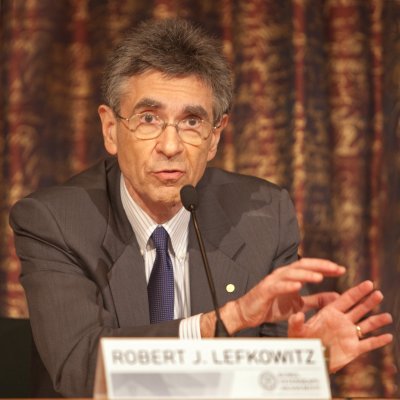
Recorded Robert J. Lefkowitz said elsewhere, not written here
That’s easy, my trainees. In my field, receptor biology, the field is dominated by people that I trained. Kobilka is one example. I would say I have, for years — in all due modesty — I led the field. I passed that mantle to Kobilka. He has the newest technologies and this and that. But he’s just the limit case. There are dozens and dozens of people who trained with me that, if you go to any meeting on receptor biology and you look at the program, I don’t know, 30 to 40 percent of all the speakers will have either trained with me or trained with people who trained with me. They’re in the lineage. So that’s what I’m most proud of.

Academy of Achievement interview, San Francisco, California, 13 September 2014 source ↗

Others on this question

View all 116 →
Bintou Keita UN Special Representative of the Secretary-General; head of the UN peacekeeping mission in the Democratic Republic of the Congo
I'm very proud of the fact that, in spite of everything, the core mandate in terms of the protection of civilians is really flying very high everywhere in the mission. Everywhere. And I'm very hopeful with the young people of DRC and the women.
Recorded Melissa Fleming, Awake at Night podcast, series 12, United Nations, 2025 source ↗
Peyton Manning American football quarterback
Obviously having my family and being able to hold my kids a month ago with that Super Bowl trophy was one that you'll always remember.
Recorded Retirement press conference, DenverBroncos.com, 7 March 2016 source ↗
Alejandro González Iñárritu Mexican film director; winner of Academy Awards for Birdman and The Revenant
I don’t regret having done it at all. I think everything that I went through was worth it. I am very proud. But I would not do it again.
Recorded The Talks interview, 27 January 2016 source ↗
Norman Schwarzkopf United States Army general; commander of coalition forces in the 1991 Gulf War
A man does not get to write his own epitaph. But if I were to write mine it would say the following: He loved his family, and he loved his troops, and they loved him — period.
Recorded Academy of Achievement interview, Las Vegas, Nevada, 26 June 1992 source ↗

More from Robert J. Lefkowitz

View profile →
Question Which teacher, parent, coach or friend most made you who you are, and what did you learn from them? Relationships
One in particular, Mrs. Gordon. I hated her. I took AP English. The AP courses were just starting in the ’50s. And you could take a maximum of two. I took Chemistry and AP English. Today, the kids come into Duke, they have ten, 12, 15 AP courses. They start taking AP courses in their first year of high school. It’s absolutely amazing. Mrs. Gordon taught AP English. And she took a disliking to me for some reason early on, and she didn’t like the way I wrote, so she gave me very bad grades on all my essays. She pounded into me about how to write clear, effective, succinct English. And I learned those lessons well. But what I remember — and I pay her a tremendous tribute for that because there’s no more important skill, certainly for a scientist, but really for almost any profession, than to be able to express yourself clearly and succinctly. And I think she really taught me that.
Recorded Academy of Achievement interview source ↗
Question What is the best advice you have ever received? Time & hindsight
I often repeat to them something that — not my mentor, but a senior scientist at the NIH — said to me once. We were having lunch together. I was despondent, despondent because nothing had worked. I had been there a year. And this guy said to me, “Look,” he said, “do you know the difference, Bob, between an average scientist and a world class scientist?” I said no. He said, “Here’s what it is.” He said, “For the average scientist, maybe one percent of their experiments work. But for the world class guy, the world beater, it could be as high as one-and-a-half or two percent.” And then that really stuck with me because it’s really true.
Recorded Academy of Achievement interview, San Francisco, California, 13 September 2014 source ↗

More on identity & self

Also answered this

Victor Ambros, Kei May Lau, Bert Sakmann, Frances Arnold, Arthur Ashkin, Nicolaas Bloembergen

Search the directory for somebody in particular.

Explore further

Report this answer