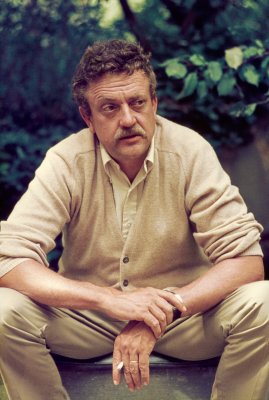
Kurt Vonnegut

Novelist and essayist

Recorded said elsewhere, not written here
I would try to write my war story, whether it was interesting or not, and try to make something out of it. I describe that process a little in the beginning of Slaughterhouse Five; I saw it as starring John Wayne and Frank Sinatra. Finally, a girl called Mary O’Hare, the wife of a friend of mine who’d been there with me, said, “You were just children then. It’s not fair to pretend that you were men like Wayne and Sinatra, and it’s not fair to future generations, because you’re going to make war look good.” That was a very important clue to me.

George Plimpton, David Hayman, David Michaelis and Richard Rhodes, The Paris Review, issue 69, Spring 1977, 1 January 1977 source ↗

Others on this question

View all 69 →
Anthony Romero American lawyer; executive director of the American Civil Liberties Union
We have failed seven times up at bat, and we strike out, and I think, "How can I learn from that failure? What went wrong? What could I have done differently?" You have to take it apart to understand your failures. Failures teach you much more than your successes. Sometimes it is better just to pause on a setback, on a failure, on a screw-up, and say, "What did I learn from this?" You learn how to do it better and you recommit yourself.
Recorded Academy of Achievement interviewer, Academy of Achievement interview, New York, New York, 1 April 2005 source ↗
Daniel Kahneman Psychologist; laureate of the Sveriges Riksbank Prize in Economic Sciences, 2002
I got quite nice results in my one-question studies, but never wrote up any of the work, because I had set myself impossible standards: in order not to pollute the literature, I wanted to report only findings that I had replicated in detail at least once, and the replications were never quite perfect. I realized only gradually that my aspirations demanded more statistical power and therefore much larger samples than I was intuitively inclined to run. This observation also came in handy some time later.
Recorded Laureate-written autobiography for Les Prix Nobel, Nobel Prize Outreach, 1 December 2002 source ↗
Mohamed ElBaradei Director General of the International Atomic Energy Agency, 1997-2009; Nobel Peace Prize 2005
Unfortunately, in the case of Iraq, I believe we could have done that through an inspection process. I was calling for a few months more to complete our work. We hadn’t seen indications of weapons of mass destruction. We hadn’t seen indications of nuclear weapons. ... Unfortunately, it didn’t work that way. There was faulty intelligence. There were lots of other considerations that made a decision to go to war tempting, to get rid of Saddam Hussein.
Recorded Academy of Achievement interview, 2006 source ↗
Joan Didion American writer
Yeah. It’s a grandiose reaction. You are claiming you could really control this, but you failed.
Recorded Academy of Achievement, Academy of Achievement interview, New York, New York, 1 April 2005 source ↗

More from Kurt Vonnegut

View profile →

More on failure & regret

Also answered this

John Updike, Chimamanda Ngozi Adichie, Twyla Tharp, Joyce Carol Oates, Amy Tan, August Wilson

Search the directory for somebody in particular.

Explore further

Report this answer