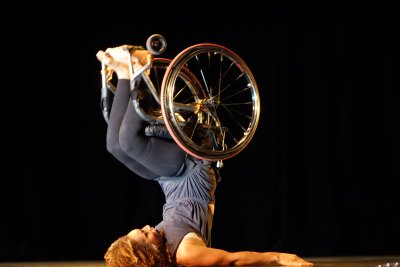
Laurel and I collaborated with director Katherine Helen Fisher and other talented artists on the dance film REVEL IN YOUR BODY and that continues to screen all over the world
Nicole Smith, VSA International Network, 4 September 2019 source ↗
The question
What is your favourite side project?Originally asked
Lifehacker, to people about their working day, How I Work
Lifehacker repeatedly used this exact prompt in its named How I Work questionnaire.
You answer as yourself. Nobody on FLAPSS answers as anybody else.
Laurel and I collaborated with director Katherine Helen Fisher and other talented artists on the dance film REVEL IN YOUR BODY and that continues to screen all over the world
Nicole Smith, VSA International Network, 4 September 2019 source ↗
Thanks for asking, this is a bit of a cool side project for me. The main thing that motivated me to start it was just a general feeling that I had more than I needed and that I should give back. I donate money through a charitable foundation (rather than just through personal checks) in the hope that it will inspire others to consider supporting causes that they believe in.
Beyond that, editing an anthology gives me a chance to find a few new readers for my colleagues’ excellent work.
I became interested in the United Way, because, in our contract with the television networks, we had a certain amount of promo time for ourselves. It was so much money, about $40 million a year. We had a couple of extra minutes on each tape, on each network. We used them for a while on relatively self-serving things, and I thought, rather than have that time be spent on saying “the NFL is great,” we should try to use it for some good. That’s when we bound our relationship with the United Way.
I had nothing to do, so I start to figure out the motion of the rotating plate. I discover that when the angle is very slight, the medallion rotates twice as fast as the wobble rate—two to one. It came out of a complicated equation! Then I thought, “Is there some way I can see in a more fundamental way, by looking at the forces or the dynamics, why it’s two to one?”
I do not consider Kinetic Light’s work radical. It is not radical to imagine a disabled audience as primary and to make the work accessible to that audience. It is not radical to situate a work within disability history, culture, and traditions. Non-disabled artists do that all the time.
What I think you’re asking is, “Does it change the movements on stage if you have people come and watch it?” I would say, yes it can, but not always. Not every comment will lead me to go back to the stage and change something… but it can. Often you don’t know how stuff is landing, so it can be helpful to get a viewer’s perspective. Since I’m in the piece, I’ll never be able to see what it looks like from the outside.
I understand my definition does not meet most people’s definition of disability.
I have reached the point in my career where I can choose my collaborators and the artists I want to create with. My Kinetic Light partners, Laurel Lawson and Michael Maag, are my dream collaborators, and Kinetic Light is the place, time, and people with whom I am making some of the most creative and meaningful work of my life.
I’m reading an odd collection of books that should not go together, but of course they do. Georgina Kleege: What Blindness Brings To Art; Fred Moten: Black and Blur; Theri Pickens: Black Madness :: Mad Blackness.
Everything. Theatres are ready for disabled audiences, more or less, but they aren’t ready for disabled artists. An example I always give is: theatres don’t always have an accessible toilet backstage, so you can’t pee before the show, or if you do you’re halfway through make-up and you have to run to the front where the audience is. The main issue is physical access, but it is improving.
Andy Serkis, François Ozon, Adrian Scarborough, Alan Cumming, Ada Yonath, Richard Feynman
Search the directory for somebody in particular.