The question

What is the biggest obstacle you have faced professionally?

Originally asked

The American Academy of Achievement, to its honourees, its oral-history interviews

The Academy of Achievement repeatedly asks honorees to identify a major professional obstacle or challenge and describe confronting it.

You answer as yourself. Nobody on FLAPSS answers as anybody else.

Alice Sheppard

Dancer, Choreographer

Recorded said elsewhere, not written here
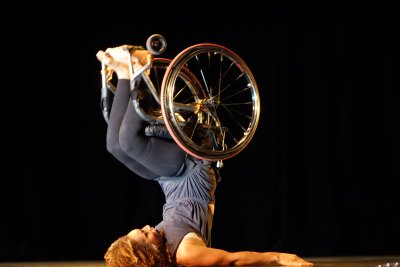
Everything. Theatres are ready for disabled audiences, more or less, but they aren’t ready for disabled artists. An example I always give is: theatres don’t always have an accessible toilet backstage, so you can’t pee before the show, or if you do you’re halfway through make-up and you have to run to the front where the audience is. The main issue is physical access, but it is improving.

Sophie Griffiths, DIVA, 9 April 2020 source ↗

Others on this question

View all 39 →
Steve Jobs Co-founder and chief executive of Apple; co-founder of NeXT; chief executive of Pixar
At Pixar when we were making Toy Story, there came a time when we were forced to admit that the story wasn't great. It just wasn't great. We stopped production for five months.... We paid them all to twiddle their thumbs while the team perfected the story into what became Toy Story. And if they hadn't had the courage to stop, there would have never been a Toy Story the way it is, and there probably would have never been a Pixar.
Recorded Betsy Morris, Fortune interview, Kona, Hawaii, 7 March 2008 source ↗
Ephraim Asili Filmmaker, Educator, and DJ
I tried to get funding to shoot this film and couldn’t—nobody wanted to touch it, you know?
Recorded Merawi Gerima, Filmmaker Magazine, 10 March 2021 source ↗
David Herbert Donald, Ph.D. Historian; twice winner of the Pulitzer Prize for Biography
I have generally had few setbacks and few obstacles. I have been very fortunate in that things have been handed to me rather than my going out after them. There are a few roads that I didn’t take that I maybe could have. When I was a graduate student, maybe a second-year graduate student, I worked frequently at the Illinois State Library in Springfield, and one day, the director of that library called me into his office and said, “I have some news to tell you that is still very hush-hush, but I’m resigning from this job. I’m going to the Chicago Historical Society, and I’m going to recommend that you be appointed in my place.
Recorded Academy of Achievement, Academy of Achievement interview, Cambridge, Massachusetts, 1 April 2005 source ↗
I realized that the biggest obstacle was my mind. It was the biggest obstacle, and if I could get out of the way of myself, I would grow. So every time I had that attitude, I changed it, and I’d say, “You can. Today you can, and take it one day at a time, and today, I’m going to get up and I’m not going to think about the other six days of this week. I’m going to get up right now, and I’m going to go to the gym, and I’m going to learn about my boxing, and I’m going to be in the moment.” You know, in anything, you hit a wall, and then you have to break through it, and I just had to get out of my own way.
Recorded Academy of Achievement, Academy of Achievement interview, Los Angeles, California, 1 April 2006 source ↗

More from Alice Sheppard

View profile →
Question How much rewriting or revision do you do? Craft & work
What I think you’re asking is, “Does it change the movements on stage if you have people come and watch it?” I would say, yes it can, but not always. Not every comment will lead me to go back to the stage and change something… but it can. Often you don’t know how stuff is landing, so it can be helpful to get a viewer’s perspective. Since I’m in the piece, I’ll never be able to see what it looks like from the outside.
Recorded T. Cole Rachel, The Creative Independent, 7 March 2018 source ↗
Question What is something everyone in your world agrees about that you think is wrong? Values & belief
I do not consider Kinetic Light’s work radical. It is not radical to imagine a disabled audience as primary and to make the work accessible to that audience. It is not radical to situate a work within disability history, culture, and traditions. Non-disabled artists do that all the time.
Recorded Ailís Ní Ríain, Disability Arts Online, 7 September 2022 source ↗

More on craft & work

Also answered this

Hilary Swank, Andy Serkis, David Lynch, François Ozon, Ephraim Asili, Geoffrey Rush

Search the directory for somebody in particular.

Explore further

Report this answer