The question

How much rewriting or revision do you do?

Originally asked

The Paris Review, to novelists and poets, The Art of Fiction

A recurring Art of Fiction craft question, sometimes asked about daily rewriting and sometimes about the number of drafts.

You answer as yourself. Nobody on FLAPSS answers as anybody else.

Alice Sheppard

Dancer, Choreographer

Recorded said elsewhere, not written here
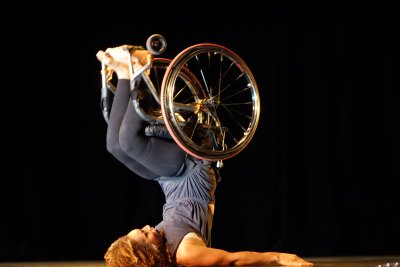
What I think you’re asking is, “Does it change the movements on stage if you have people come and watch it?” I would say, yes it can, but not always. Not every comment will lead me to go back to the stage and change something… but it can. Often you don’t know how stuff is landing, so it can be helpful to get a viewer’s perspective. Since I’m in the piece, I’ll never be able to see what it looks like from the outside.

T. Cole Rachel, The Creative Independent, 7 March 2018 source ↗

Others on this question

View all 60 →
I revise the book, and then a few other people read it, and then there is a master document listing all of the things that have to be revised. And then those are broken out, and the book is printed out in various ways. I don’t know if you’ve ever used that function on the printer, where you can do four pages to a sheet or six pages to a sheet. I’ll often read things I write in very small font, to get an overview of them. And then I’ll print them out in really big font, and look at them that way.
Recorded Maddie Crum, The Creative Independent interview, 8 July 2021 source ↗
Ahmed Zewail Chemist; Nobel laureate in Chemistry, 1999
It is known about me that I’m serious and that when you write a paper I like, I will sometimes have you go up to ten or twelve versions of the paper.
Recorded Heidi Aspaturian, Caltech Oral History Project, Caltech Archives Oral History Project, 2015 source ↗
Kristen Radtke American writer and illustrator
It’s arduous and time consuming. A sentence can be revised ad nauseam forever. If you know what needs to happen in a scene, you may be revising that for a while to get the language right, but you’re creating the whole time. With drawing it’s different. If I storyboard something and I know, for example, that in this picture I’m going to draw myself with my feet up on my desk, talking on the phone, as I am now, I can see that exactly in my mind. Then I just have to spend the hours to put it on the paper… but that takes much longer than revising the sentences.
Recorded T. Cole Rachel, The Creative Independent interview source ↗
Khaled Hosseini Afghan-American novelist
So I use the first draft purely as a frame on which to build the actual story. So a lot of my writing is done through rewriting. And I don’t become discouraged by the notion that my first draft is not going to win any prizes or that it’s not going to be — I understand that it’s going to be lousy, but I want all of the essential elements to be there. The heart of the story has to be in that first draft, and then I can use that to create something and discover things about the story. When I wrote, for instance, The Kite Runner , there were a lot of things in that first draft that stayed, but some things in that first draft were tossed, and the transformation in some passages were very dramatic. I wrote an entire draft where the two kids were not brothers, and it really wasn’t until a subsequent draft when I realized that the kids, suddenly the idea came — well, what if the kids are brothers, and that changed the whole tone of the story. And when I rewrote it, writing it with that knowledge, it changed everything. And so you can get discouraged. Writing is largely about rewriting, and I abhor writing the first draft. I love writing subsequent drafts because that’s when I can see the story getting closer and closer to what I intended and what my original hopes for it were.
Recorded Academy of Achievement interview, 2008 source ↗

More from Alice Sheppard

View profile →
Question What is something everyone in your world agrees about that you think is wrong? Values & belief
I do not consider Kinetic Light’s work radical. It is not radical to imagine a disabled audience as primary and to make the work accessible to that audience. It is not radical to situate a work within disability history, culture, and traditions. Non-disabled artists do that all the time.
Recorded Ailís Ní Ríain, Disability Arts Online, 7 September 2022 source ↗
Question How does a new work begin for you? Craft & work
Obviously, it’s different for everyone. And actually there is a difference for each thing I do. But one way it happens is to just move. [ laughs ] I mean, obviously, you don’t just sort of randomly throw yourself around the room. You move with these ideas and sometimes I find that I’ve already got images in my head that I imagine my body in, or sometimes I have sequences in my head. I think a lot of time I’m listening to what comes next because sometimes the body will tell you that. Often I don’t document it too early in the process because sometimes if you forget stuff it’s worth knowing that the things that you forget maybe weren’t worth keeping. The things that have settled are the things that need to be kept because they seem most urgent. I don’t know. I mean, sometimes it’s about going to the studio and nothing happens for a long time and you just sit there and you’re not feeling it. That’s awful. It’s like when you’re writing and sometimes you go to the coffee shop and you’re like, “So, we’ll just see what happens.” And you end up on Facebook. I think the answer to this is… I really think the answer to this is I don’t know. [ laughs ]
Recorded T. Cole Rachel, The Creative Independent interview, 7 March 2018 source ↗

More on craft & work

Also answered this

Taika Waititi, Ja’Tovia Gary, Devin Kelly, François Ozon, Leelee Kimmel, Ephraim Asili

Search the directory for somebody in particular.

Explore further

Report this answer