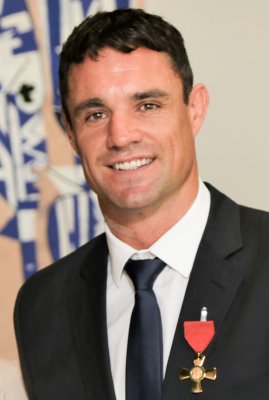
I don't think I could go for another three years. I'm leaving it at the right time, I love it, I've absolutely had a wonderful competition and I've loved every minute of it.
What made you decide to stop something you were known for, and how did you know it was time?
Question
What is one of the best or most worthwhile investments you have ever made — of money, time, or energy?
Money & investment
But I'm ready for what's next after rugby. Being able to not just say that, but to truly feel it, is a privilege. Ultimately, getting to leave your sport on your own terms is all you can really hope for as an athlete.
Retirement letter, The Players' Tribune, 20 February 2021 source ↗
Others on this question
View all 14 →
Ellie Simmonds
British Paralympic swimmer, 2008–2021
Recorded
Channel 4, Poolside, Tokyo Aquatics Centre, after the S6 400m freestyle final, BBC Sport, 2 September 2021
source ↗
Roger Federer
Swiss professional tennis player, 1998–2022
As many of you know, the past three years have presented me with challenges in the form of injuries and surgeries. I've worked hard to return to full competitive form. But I also know my body's capacities and limits, and its message to me lately has been clear. I am 41 years old. I have played more than 1,500 matches over 24 years. Tennis has treated me more generously than I ever would have dreamt, and now I must recognize when it is time to end my competitive career.
Juana Molina
Singer, songwriter and former television comedian
No, I think they were two totally different careers, because when I was acting, I was always impersonating different people, so it was never me—it was never myself. When I started to sing, I suddenly felt naked. I mean, I knew that was going to happen, because that’s the reason why I couldn’t do it before—when I was a teenager, I just couldn’t play in front of anyone at all—it was impossible, my hands started to shake, my voice was gone, and I was so self-conscious of what people would think about what I was doing. Because I didn’t know how to play songs that anybody knew—all I knew how to play were my own songs, and so I had this feeling of having my own chords and my own things that weren’t—I was afraid of being judged as doing nonsense music. But then maybe what the acting did to me was that I got more courage to do what I really wanted to do, even though I had all these fears that were still inside me.
Jessye Norman
Operatic soprano and recitalist
As a very young singer, I was invited to the opera house in Berlin by the then-director of the opera house, Egon Seefehlner, and I had one opera to my name that I knew. He felt that there was a lot that I could learn there, which was very true, and I was so lucky to be able to have this opportunity. The thing that was happening is that I kept being offered operas that I knew that I wasn’t ready to sing, just from an experience point of view, as well as being 24 years old. So I was always asked to sing things that I thought, “Well no, I really don’t think I should sing that now. I need to sing that maybe in five years, or maybe in 10 years, but not right now. Couldn’t I please sing something else?” And that became a difficulty for me. And after being at the opera house for three years, and singing Elsa and Elisabeth — the Wagner roles that are not sort of the heavy Wagner roles — and then Mozart operas that suited my voice at the time, I was continually invited to sing things that I just felt I shouldn’t. So I took it upon myself to go to speak with the artistic director to say that I thought I should leave the opera house, and come back in some years when my maturity sort of chronologically would have caught up with the invitations that I was being offered. Of course, considering that he’d taken me into the opera house when I knew one role, he wasn’t all that happy. I thought he’d say, “Oh, what a smart girl. Oh yes, absolutely. That’s what we’ll do.” No, no. He was absolutely furious.
More from Dan Carter
View profile →When I started getting my first fan letters, I made a point to try to respond to every single one. The wins always felt that much more special because I knew I was making so many people happy. And losses hurt that much worse because I truly was invested in not wanting to disappoint those who supported my side. But more than anything, I always appreciated the fact so many fans invested their emotions in my performance.
More on time & hindsight
- When were you happiest? 577 answers
- What is the most important lesson life has taught you? 137 answers
- What advice would you give your twenty-year-old self, and what should they ignore? 78 answers
- What scares you about getting older? 61 answers
- What is the best advice you have ever received? 28 answers
- If you could have a gigantic billboard anywhere, what would it say and why? 23 answers
Also answered this
Li Na, Ellie Simmonds, Roger Federer, Sir Roger Bannister, Serena Williams, Kobe Bryant
Search the directory for somebody in particular.
Explore further
- All time & hindsight questions
- Explore the archive — by field, age, era, and subject