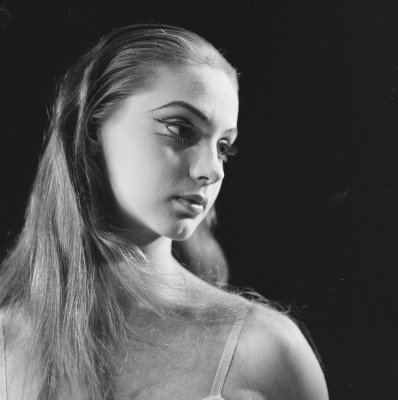
What made you decide to stop something you were known for, and how did you know it was time?
Recorded Suzanne Farrell said elsewhere, not written here
By the time I admitted that I needed a hip operation, I had denied it for so long that it was a breakthrough to suddenly say, “I need this.” I knew I would probably never dance again, but I had no choice. By that time, I just wanted to be normal. I wanted to walk down the street without limping. I couldn’t tie my shoes. I couldn’t put slacks on. I was the farthest thing from a person who ever could dance and do all those extremely incredible extensions and contortions that we do.

Academy of Achievement (achievement.org) source ↗

Others on this question

View all 14 →
Juana Molina Singer, songwriter and former television comedian
No, I think they were two totally different careers, because when I was acting, I was always impersonating different people, so it was never me—it was never myself. When I started to sing, I suddenly felt naked. I mean, I knew that was going to happen, because that’s the reason why I couldn’t do it before—when I was a teenager, I just couldn’t play in front of anyone at all—it was impossible, my hands started to shake, my voice was gone, and I was so self-conscious of what people would think about what I was doing. Because I didn’t know how to play songs that anybody knew—all I knew how to play were my own songs, and so I had this feeling of having my own chords and my own things that weren’t—I was afraid of being judged as doing nonsense music. But then maybe what the acting did to me was that I got more courage to do what I really wanted to do, even though I had all these fears that were still inside me.
Recorded Josh Kun, Conducted by telephone, The Believer, Issue 35, 5 April 2006 source ↗
Ellie Simmonds British Paralympic swimmer, 2008–2021
I don't think I could go for another three years. I'm leaving it at the right time, I love it, I've absolutely had a wonderful competition and I've loved every minute of it.
Recorded Channel 4, Poolside, Tokyo Aquatics Centre, after the S6 400m freestyle final, BBC Sport, 2 September 2021 source ↗
Serena Williams United States professional tennis player, 1995–2022
I have never liked the word retirement. It doesn't feel like a modern word to me. I've been thinking of this as a transition, but I want to be sensitive about how I use that word, which means something very specific and important to a community of people. Maybe the best word to describe what I'm up to is evolution. I'm here to tell you that I'm evolving away from tennis, toward other things that are important to me.
Recorded First-person essay, Vogue September 2022 issue, 9 August 2022 source ↗
Desmond Tutu Anglican Archbishop of Cape Town; chair of South Africa’s Truth and Reconciliation Commission; Nobel Peace Prize, 1984
I stopped being a teacher when the South African Government introduced a deliberately inferior education for blacks called Bantu education, and I felt I wasn’t ready to collaborate with this apology for an educational system. Our children, the 1976 kids who revolted against apartheid in Soweto, called it “gutter education,” and it was gutter education. I left teaching. Of course, I didn’t have too many option, and mercifully, the Bishop of Johannesburg at that time accepted me for training for the priesthood. So I came to the priesthood, as it were, by default.
Recorded Academy of Achievement recorded interview, American Academy of Achievement, 12 June 2004 source ↗

More from Suzanne Farrell

View profile →
Question Do you rely on inspiration or discipline to make work? Craft & work
No, never. Strangely enough, being such a tomboy, and being so—as my mother says—spoiled as a child, once I started dancing and in a way growing up, I was not the spoiled brat or the rebellious child that I was when I really had no reason to be as a child. When you work, it’s a laboratory. The dance studio, when we were working together, was the place where you experiment. I’m not intimidated by failure or making a mistake, because you learn from those situations. You don’t learn from a situation where you do something well. You enjoy it and you give yourself credit, but you don’t really learn from that. You learn from trial and error, trial and error, all the time. When you fail, maybe you failed in that particular instance, but you have discovered something else. A lot of the ballets that we went on to do were built around mistakes that we had made in the classroom. So you never throw anything out. Rebelling takes up energy. As a dancer, you don’t have that kind of energy to throw away.
Recorded Academy of Achievement interview, New York City, 16 December 1990 source ↗
Question What is the hardest thing that has happened to you, and what did you carry out of it? Failure & regret
Well, I’ve had injuries, but I’d always get out on stage because I think the body is a wonderful thing, and you have to treat it with respect. We haven’t even reached our potential for what we can do as human beings. I went through a period where I had hip trouble. I thought it was just a typical pulled muscle, so I used liniment, and warmed up more than I thought was necessary, all the things we learn to do when you have a typical dance-related injury or sore muscle. Over the months, it didn’t go away. In fact, it got worse. Eventually I realized that I had a very serious problem, and it was the first time that dance had let me down. What had been my salvation and my security with my body was abandoning me. This was emotionally and physically devastating.
Recorded Academy of Achievement (achievement.org) source ↗
Question What is something you were told by a parent, teacher, or mentor that you still repeat to yourself? Time & hindsight
I think he was a great philosopher. He had a wonderful theory that you live in the “now,” which I think is important. Along with living in the moment, you also have to assume the responsibility that goes along with it, and you don’t take your position lightly. But it also means that you get the full value of the moment that you are living, so you don’t look back on your life and say, “If only I hadn’t wasted time, if only I had done this.” You do the best you can. It was wonderful to be able to go home after a performance, and think, well it wasn’t maybe so good, but it was the best I could be at that time.
Recorded Academy of Achievement (achievement.org) source ↗
Question Which writers or artists most influenced your work? Taste & recommendation
That’s an easy question. It was, of course, George Balanchine. He came from Russia via Europe and settled in America in 1933. He started a little company which was not very successful, so he had to start over and over again. Ultimately, he founded the New York City Ballet. I happened to be born at the right time, came to the right place, and had the fortune to audition for him, and work with him, because he is the genius of the century of ballet. I learned how to dance with him.
Recorded Academy of Achievement interview, New York City, 16 December 1990 source ↗

More on time & hindsight

Also answered this

Juana Molina, Roger Federer, Derek Sivers, Sir Roger Bannister, Sonny Rollins, Li Na

Search the directory for somebody in particular.

Explore further

Report this answer