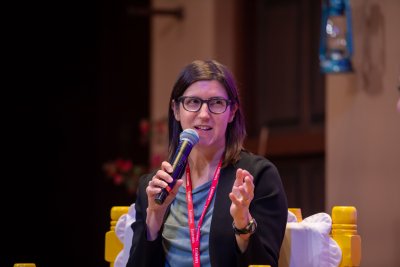
I think that’s an instinct.
Scarlett Harris, The Creative Independent interview source ↗
The question
How do you tell when a piece of work is done?Originally asked
The Creative Independent, to working artists, its interview series
A repeated process question in The Creative Independent, asked across visual art, music, writing, performance, and mixed media.
You answer as yourself. Nobody on FLAPSS answers as anybody else.
I think that’s an instinct.
Scarlett Harris, The Creative Independent interview source ↗
If I could go back and remake anything I’ve ever made, I would do it. I could tell you at least three things about anything that I would change in a rehearsal today. I sometimes fantasize about where I would start if I went back to that piece. There’s always some problem to be sorted out. Problems are just engines. That’s what kicks the engine into gear. If you don’t have a problem, then you don’t have a reason to make the work.
Well, I feel it. If I don’t feel it just the way I want it, then I’d rather destroy it than to keep it.
My mind is nearly like an infinite tunnel of potential ideas, but the ideas are all a part of what is already there. In my imagination, I always think there are more parts to record. Then when I work it through, I make it to a certain point and I’m like, “Actually, that’s enough.” Some of the extra bits that I’m thinking of are suggested anyway by interaction with what is already there, and it gets to a point where to add anything more would just be too much. I often imagine recording parts that people actually do hear, but are not actually there. By the time I’m done with the main guitar and other elements, [more parts] don’t capture anything else with all those suggested things. If I try to realize them, it’s less effective. I think that’s why people have often said they hear different things depending on how they listen to [our music].
The White Album is a project that we performed in Pittsburgh. We did it at the Wexner in Ohio. We did it at BAM. We’re going to perform it at the Center for the Art of Performance in Los Angeles, which is co-represented by Center Theater Group. And I still don’t feel like the piece is totally finished. I don’t feel like I had nearly enough time to actually develop the work. I feel like I threaded a needle and got it to a certain point that I’m proud of, but I still haven’t had enough time to play with all of the components involved in the work to get them to harmonize in the way that I want.
In my own life I think there are times when I’m not in the mood to write, but I don’t consider that to be writer’s block. If I really don’t want to enter my own book in progress, I’ll try to think about why and find a way around that. So I start from the beginning cleaning it up. Almost treat it like it’s a messy room and clean it up. Or if there’s a scene that I don’t want to write because it bums me out, maybe I’ll just work on a different scene and come back to it. Or I’m having trouble writing because I haven’t done enough research. So I go do the research. I try to troubleshoot, or figure out what the underlying reason is.
At first I’ll think of stuff in my head for a while. The more I think of an idea, the more promising it is— it just naturally occupies space in my brain. Then I start making notes with pen and paper. If it’s a story, it’s more like a moment, or just it’s kind of a more fleeting idea. And if it’s a novel, it’s something that I can see approaching in a lot of different ways, and sticking with for two or three years. I might write a scene or two and just kind of see how it feels. Then I will type an outline. That’s when I really feel like I have a path forward, even though I don’t feel like I have to stick to the outline, but it is very reassuring to me to have it.
Matthew Gavin Frank, António Lobo Antunes, Boris Fishman, Tania James, Marissa Zappas, Willa Bennett
Search the directory for somebody in particular.