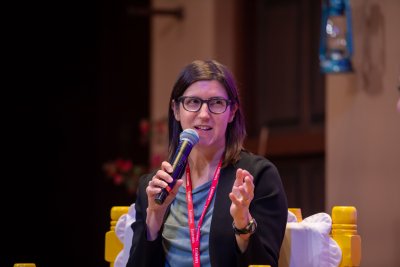
If I start to feel bored or blocked or frustrated with something, I’m comfortable walking away. When I was younger, I pushed through or forced it… but in the last five or six years, I’ll literally close a session and be like, “I’ll go back to this in a day or in a week or two weeks.” The second I give it space, I tend to feel more motivated to go back into it.
Originally asked
The Creative Independent, to working artists, its interview series
A recurring Creative Independent question whose wording distinguishes a lasting block from a temporary impasse.
You answer as yourself. Nobody on FLAPSS answers as anybody else.
Scarlett Harris, The Creative Independent interview source ↗
Others on this question
View all 80 →Keep you uncorked, keep you unstuck, keep it flowing, keep the ideas going, keep the feedback, keep you in communication with your potential future customers for the book. I think it's a great idea.
I imagine people with writer’s block feeling unable to think of something to write about. I haven’t had that problem, but I’ve had something where I have too many things I want to write about and I feel unable to focus on one for sustained periods, and it feels like writer’s block in that I feel stuck. I keep becoming interested in one of the other things and my motivation keeps changing or disappearing and it usually takes something major from outside, like a book contract, for me to finally focus on one thing.
I think most of the ways we get stuck are self-imposed, but I also think most of our problems are in how we respond to the world or our situations. So I can’t say it’s false. I can’t say it’s not a thing. I think what it is is a broad term for the experience of being creatively stalled, or not being able to align your vision with your practice. The points where I’ve found myself stuck have been points where I could imagine what I wanted to write, and did not have the skill, or did not have the tools, or did not have the bandwidth, or did not have the space, or the money, or the time. That writer’s block. I will also say, as an addendum to that, I think a lot of what people call writer’s block right now is such a profound level of distraction that it isn’t actually writer’s block, it’s a block of [having too much] online and screen time.
More from Curtis Sittenfeld
View profile →I think that’s an instinct.
At first I’ll think of stuff in my head for a while. The more I think of an idea, the more promising it is— it just naturally occupies space in my brain. Then I start making notes with pen and paper. If it’s a story, it’s more like a moment, or just it’s kind of a more fleeting idea. And if it’s a novel, it’s something that I can see approaching in a lot of different ways, and sticking with for two or three years. I might write a scene or two and just kind of see how it feels. Then I will type an outline. That’s when I really feel like I have a path forward, even though I don’t feel like I have to stick to the outline, but it is very reassuring to me to have it.
More on craft & work
- What is the worst job you have done? 236 answers
- What do you consider your greatest achievement? 202 answers
- How does a new work begin for you? 81 answers
- How do you know when a piece of work is finished? 75 answers
- How much rewriting or revision do you do? 58 answers
- What is the part of your job that people would be surprised is most of your job? 54 answers
Also answered this
Natalie Diaz, JJJJJerome Ellis, Ramona Ausubel, Tao Lin, Cheryl Strayed, Chad Hartigan
Search the directory for somebody in particular.
Explore further
- All craft & work questions
- The The Creative Independent questionnaire — 4 questions from the same format
- Explore the archive — by field, age, era, and subject