There was a teacher at school who was fun. I don’t know if he had a big impact on my thinking, but he was a lot of fun. His name was Dow Bunyan Bean, and he had a Doctor of Divinity degree, from some place in the South. I think he came from Georgia. And he had lost his faith and he had lost his interest in religion, and had become a secular high school teacher. Everybody called him Doc Bean. He was marvelous. He was full of animation. He was relatively old at that time. At least we kids considered him relatively old. But he was very lively, jumping around, raising his voice, lowering his voice in all sorts of interesting ways, with a racy line of talk about whatever he was discussing, and suddenly stopping and asking somebody a question to make sure the person was listening. Writing down some little grain in his book. He was lively, and it was marvelous. And if he didn’t know something, then he would immediately send whoever asked the question to the library to see what was known on the subject. I thought that was particularly splendid. Not that, of course, everything is available in a library. Lots of things are simply not known, or maybe unavailable in a high school library. But the fact that he wanted to push every inquiry as far as it could be pushed with the local resources, that really impressed me. I thought that was great.
Which teacher, parent, coach or friend most made you who you are, and what did you learn from them?
Question
What advice would you give your twenty-year-old self, and what should they ignore?
Time & hindsight
Question
What is something everyone in your world agrees about that you think is wrong?
Values & belief
Question
How does a new work begin for you?
Craft & work
Question
What are you most proud of?
Identity & self
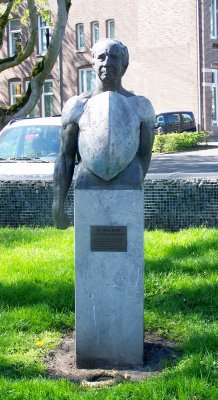
In my early years it was undoubtedly my father. My father was director of a sanatorium for pulmonary tuberculosis, and at that time there were no antibiotics, tuberculosis was a terrible disease. And, he and I would walk in the woods around that sanatorium and he would discuss his worries about his patients. And from him, I certainly inherited this extreme concern about the well-being of patients. I’ve seen him very happy when he succeeded after months and months of rest and other things to have these people go home cured. I’ve also seen him crying and desperate after trying for a long time and a patient did not get well, and went home to die.
Academy of Achievement interview source ↗
Others on this question
View all 57 →
Murray Gell-Mann
Theoretical physicist; Nobel Prize in Physics 1969
Tom Wolfe
Journalist and novelist; a founder of New Journalism
Yes, there were. In kindergarten, there was a teacher named Miss Shackleford, as I always called her. I honestly cannot remember her first name, although I saw her years later. She took a special interest in me very early, which made me feel very special. Maybe I can really do things with these words, and so on, and ended up combining my kindergarten and first grade into one year. Which I don’t really advocate, because you end up being smaller, a year younger than the people you’re competing with. But anyway, she got me off to a good start.
John Grisham
American writer and lawyer
I had the benefit of some very good high school English teachers. One in particular when I was a senior in high school. I was a jock, okay. I was not a student. Although I enjoyed reading, that was about it as far as academics. But she forced us to read good books and good writers, particularly good American writers. We weren’t too thrilled to do it initially, but she taught us how to do it. Through that, I discovered some of my favorite authors, particularly John Steinbeck. Once I had gone through all of Steinbeck’s books, I realized that I had had a wonderful experience.
Ray Kurzweil
Inventor and futurist; developer of the first omni-font optical character recognition system
There were some high school teachers. I remember a math teacher, Mr. Ewen — actually a math teacher in eighth grade, Mrs. Matwell, who got excited about my ideas and wanted to listen to them. My mother actually was kind of a fan of my ideas and would listen to them. Marvin Minsky I actually communicated with in high school and came to visit him, came up to Boston, and to my delight, took me, a high school student, as seriously as he would take a professor. I mean, that is his approach. He treats everybody the same. I think he really doesn’t care if somebody’s a professor or a high school student. He’s very excited with ideas and very honest with his reactions. But that encouragement was important to me.
More from Willem Kolff
View profile →By the way, the guys with very high grades are not necessarily the people that are the most successful in later life. They may be the ones that can regurgitate gracefully, and they get very high grades. But if the guys that have to work for it and do not have such good grades can do something extra, and prove that they can perform, they may have a chance.
I’ve been mortally opposed to the so-called life-and-death committees that were instituted. When there were many more patients that needed to be dialyzed, and not enough artificial kidneys available, you had the institution of the life-and-death committees. ... Depending on the answer to these questions, he could be dialyzed. Otherwise, he could go to hell. I’ve been mortally opposed to that. When I set up a dialysis center here with a grant from some government agency, I was forced to put in a life-and-death committee, but it never met.
When I was this young assistant at the University of Groningen my responsibility was for four beds, or rather the patients in four beds. That was all I had to do. And, one of these patients was a young man, 22 years old, who slowly and miserably died from renal failure. He became blind, he vomited, and it was a miserable death. And I, as a very, very young physician, had to tell his mother, in a black dress and a little white cap like the farmers have, that her only son was going to die. I couldn’t do a damn thing about it. So, I began to think, “If I could just every day remove as much urea as this boy creates, which is about 20 grams, then the boy could live.” Well, he died, but I began to work on that.
No. You see immediately what your next task will be. I’ve been asked all kinds of silly questions, like “Aren’t you proud? Aren’t you this? Aren’t you that?” I have no time for that, because the next project is upon me.
More on relationships
Also answered this
Richard Feynman, Michael DeBakey, Edward Teller, Robert S. Langer, Christiane Nüsslein-Volhard, Paul Farmer
Search the directory for somebody in particular.
Explore further
- All relationships questions
- Explore the archive — by field, age, era, and subject