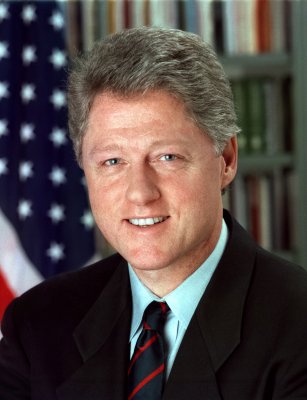
What is the thing you are best at that nobody watching can see?
Recorded Bill Clinton said elsewhere, not written here
Well, it wasn’t a game to me. We were taught, interestingly enough, given the current state of political affairs, that you should try not to hate anyone, that hatred was a sickness and a weakness, and that there were very few people who were completely evil, so you should go out of your way to figure out what makes them tick and see if you can find some way to communicate with them. I learned that more with my family — even before I was old enough to know what I was doing —when I was eating meals, my grandmother’s brother and his family had — they had four kids, and they always fed a lot of people, and we ate there a lot, and they would talk about whatever had happened that week. And the kids could talk, but they had to prove they could listen first, so before I could tell a story I had to recount what I had just heard, because if you weren’t listening, nobody wanted to listen to you. And it was like a primer in human nature, and I was fortunate in having people all along the way who tried to help explain other people to me, and I developed an obsessive interest in doing it.

Academy of Achievement interview source ↗

Others on this question

View all 26 →
Roger Penrose Mathematical physicist; Nobel laureate in Physics, 2020
Well, yes, no, I certainly visualise … it was really … I had to have a very good idea of the geometry – that was crucial. Spacetime geometry so it's not three dimensions, you have to think of the whole four dimensional spacetime, and I get sort of used to thinking about four dimensions and using various tricks to get the picture properly. I do most of my thinking in visual terms, and I'm a very visual thinker rather than writing down equations.
Recorded Adam Smith, Telephone interview recorded shortly after the prize announcement, Nobel Prize Outreach, 6 October 2020 source ↗
Eliud Kipchoge Kenyan marathon runner
When I have a lot of pain, I try to confuse my mind to forget about the pain and think about the distance. I don't want pain to be in my mind, because I'd really lose focus on running. After winning, you won't have that pain, but it comes later. The marathon is hard; the second day, you don't go up or down stairs.
Recorded Address and Q&A at the Oxford Union Society, November 2017, Outside, 10 February 2018 source ↗
Haruki Murakami Novelist, short-story writer and translator
I want my readers to laugh sometimes. Many readers in Japan read my books on the train while commuting. The average salaryman spends two hours a day commuting and he spends those hours reading. That’s why my big books are printed in two volumes: They would be too heavy in one. Some people write me letters, complaining that they laugh when they read my books on the train! It’s very embarrassing for them. Those are the letters I like most. I know they are laughing, reading my books; that’s good. I like to make people laugh every ten pages.
Recorded John Wray, The Paris Review, issue 170, Summer 2004, 1 January 2004 source ↗
Orhan Pamuk Novelist; Nobel laureate in Literature, 2006
For me, to be a writer is to acknowledge the secret wounds that we carry inside us, the wounds so secret that we ourselves are barely aware of them, and to patiently explore them, know them, illuminate them, to own these pains and wounds, and to make them a conscious part of our spirits and our writing. A writer talks of things that everyone knows but does not know they know.
Recorded Swedish Academy, Stockholm, 7 December 2006, The Nobel Foundation (nobelprize.org), 7 December 2006 source ↗

More from Bill Clinton

View profile →
Question What do you need to believe in order to get through the day? Values & belief
Yeah, there were a lot of brave people who stood up. Then, you know, it cost Martin Luther King and Medgar Evers and the three civil rights workers in Philadelphia, Mississippi, and Viola Liuzza and a lot of the others their lives, but they were on the right side of history, and they believed if they made this sacrifice that it would work out. And whenever I get discouraged about everything they stood against rising up again, I realize there just are no public, or permanent, victories. You have to keep fighting for freedom.
Recorded Academy of Achievement interview source ↗
Question What is the biggest obstacle you have faced professionally? Craft & work
I do think my mother had a lot to do with that. I mean, after all, you know her — it was not near as bad as having your husband die in a car wreck after — he survives World War II. They had a great life planned, and he gets killed in a car wreck, not because of a concussion, but because in a fluke, the tire blows out on his car. He’s thrown out of the car. He lands in a ditch in a field, and the ditch is full of water, and he can’t get out of the ditch before he drowns. There’s — it made it look a little whiny for me to be all bent out of shape about losing an election, and I realized that it was a weird deal. It was 1980. It was Reagan’s election. It was a period not unlike now, widespread resentment over the stagnant economy, the Iran hostage crisis, and I bet I had a hundred people coming to — I’m not exaggerating — coming to me and saying, “God, Bill, I didn’t know you were going to lose. I just voted against you to because I didn’t like some of the things you’d done.” And I remember once — one of the funniest things that ever happened to me. I was driving over to see my mother. I lived in Little Rock, and she lived in Hot Springs 50 miles away, and in the middle of the trip was a little country store owned by a guy who ran the elections in that area and was real smart, so I went in to get a Coke, and started talking to him. And this little boy came up to me in overalls, and he said, “You’re Bill Clinton, aren’t you?” I said, “Yes.” He said, “I helped to beat you. I cost you 11 votes, and it was no accident.” I said, “You did?” He said, “Yeah.” He said, “It was me, my wife, our two boys and their wives, and five of my friends. We just decked you.” I said, “Why’d you do it?” He said, “I had to because you raised my car tax. The car license.” And so we’re standing on the interstate. I said, “Look over there. You remember when I was governor? That highway broke wide open, and even big trucks were off in the ditch, and I had to send the National Guard down here to clean it up, and we had to fix it.” He said, “Yeah, I remember. I don’t care. I still didn’t want to pay it.” So I was laughing at the guy, and I said, “Let me ask you something.” I said, “If I ever ran again, would you vote for me?” He said, “Absolutely.” I said, “You would?” He said, “Sure. We’re even now.” And I went — and there were no cell phones, so I had a dime. I went and put it in the payphone, and I called Hillary, and I said, “You know, I’m not dead yet. We might have to run again.
Recorded Academy of Achievement interview source ↗
Question What is one of the best or most worthwhile investments you have ever made — of money, time, or energy? Money & investment
My job was basically to be a delivery boy for all kinds of things, but they also — because I was at Georgetown and studying international affairs, I was assigned to read six newspapers a day and clip the most relevant articles. This is the technology we used. You couldn’t scan articles. There was no “online.” There was nothing, right? So I would read the newspapers, clip the articles I thought they ought to read, put them on a routing slip, which had on it the names of the senior staff of the committee and all the senators who were committee members. And I would send it to the senior staff, and they would decide whether to send any of them on, but I don’t think I’d have won a Rhodes Scholarship if I hadn’t been a clerk on the Foreign Relations Committee. Nobody else I was competing with read six newspapers a day, and they actually paid me good money to read The Washington Post, The New York Times, The Washington Star, which existed then, The Baltimore Sun , The St. Louis Post Dispatch , and then we alternated — and — oh, and The Wall Street Journal . We read them every day. Those were the six papers we read. I did, and then that’s what the senators got.
Recorded Academy of Achievement interview source ↗
Question What is the hardest thing that has happened to you, and what did you carry out of it? Failure & regret
And because Fulbright was the chairman of the committee he had an automated — some sort of automated device that allowed the Pentagon to send him, every day, a list of the people who’d been killed in Vietnam from Arkansas. So I would go check it every day. Four of my high school classmates were killed, including, as I said, the son of my guy who was my Sunday school teacher for nine years. And I also knew, because I had to carry the stuff around, that not everything the government was claiming about the progress on the battlefield was true, and it’s kind of a crazy burden for a kid my age. I felt guilty I wasn’t there, and it felt futile to go. It was an awful feeling.
Recorded Academy of Achievement interview source ↗
Question What keeps you awake at night? Daily life
Now that’s what happens when people go crazy, where the only thing that matters is whose camp are you in, whose side are you on, what tribe do you belong to — where facts and discussions become irrelevant. And it made me wonder whether the way I was raised and all the listening and storytelling skills I learned as a boy would even be relevant today. They’d be good if you’re in. They’re still really important to getting anything done, but if you live in an environment where everything is a litmus test and everything is a-hundred-to-nothing, and the only thing that matters is feeding your resentment, and anger blinds you to answers, and being very sanctimonious somehow proves your sincerity and authenticity, it’s really hard to get anything done. It’s a whole new challenge now, and that’s why — and the Russians knew that. You know, that’s when they get in here and start fooling with all these politics. They realize you just sort of load it up because once people take sides based on what tribe they’re in then there’s no difference in facts and fiction. There’s no difference in truth and lies. It’s just, does this confirm what side you’re on? And you can’t run a democracy that way. It is utterly impossible to preserve democracy.
Recorded Academy of Achievement interview source ↗
Question What have you come to understand about what it means to be human? Values & belief
There is always an impulse to degrade people who are different from you, to diminish them, to demean them, and it never seems to go away, even when there is ample evidence that when we work together, we do better. It’s not about material progress or personal comfort. It’s about personal identity, and there are still so many forces at work in the human psyche that lead some people to think that their identity requires them to have someone to look down on or to demean or to feel that they’re superior to, and I think that that’s at the root of all this. It’s the only story in human society. Who is the other? Who is one of yours? Cain and Abel.
Recorded Academy of Achievement interview source ↗

More on craft & work

Also answered this

Barack Obama, Fei-Fei Li, Jocelyn Bell Burnell, Brian Eno, Terence Tao, Edmund Hillary

Search the directory for somebody in particular.

Explore further

Report this answer