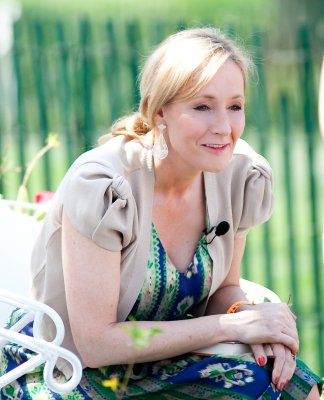
J.K. Rowling

Novelist and screenwriter

Recorded said elsewhere, not written here
So why do I talk about the benefits of failure? Simply because failure meant a stripping away of the inessential. I stopped pretending to myself that I was anything other than what I was, and began to direct all my energy into finishing the only work that mattered to me. Had I really succeeded at anything else, I might never have found the determination to succeed in the one arena I believed I truly belonged. I was set free, because my greatest fear had been realised, and I was still alive, and I still had a daughter whom I adored, and I had an old typewriter and a big idea. And so rock bottom became the solid foundation on which I rebuilt my life.

Harvard University Commencement, 2008, Harvard Gazette, 5 June 2008 source ↗

Others on this question

View all 69 →
Sir Roger Bannister Middle-distance runner and neurologist; first man to run a mile in under four minutes
I had set my mind on winning the 1500-meter gold medal in Helsinki in 1952. ... And, it all came disastrously wrong when I came fourth instead of winning. ... Instead of retiring in order to devote myself to medicine, I decided to go on for another two years while I was still a student, working clinically in London, and I did that.
Recorded Academy of Achievement interview, 7 June 2002 source ↗
Peyton Manning American football quarterback
That's a real challenge and a real issue. Reading the statistics, they had a ranking of quarterbacks, and the statistic was the percentage of a touchdown drive after an interception. To me, that is a telling statistic. The guys that have a high percentage are the guys that have short memories. They talk about having amnesia as a quarterback. You better move along from it. It is hard to say you forget about it, because you want to learn from it. You want to address it. You can't just say it never happened.
Recorded Academy of Achievement interviewer, Academy of Achievement interview, Indianapolis, Indiana, 1 April 2007 source ↗
John Updike Novelist, poet and critic; twice winner of the Pulitzer Prize for Fiction
I was prepared to fail. I was prepared to not be able to get things accepted, because I saw that happen to my mother.
Recorded Academy of Achievement, Academy of Achievement interview, Beverly Farms, Massachusetts, 1 June 1999 source ↗
Kurt Vonnegut Novelist and essayist
I would try to write my war story, whether it was interesting or not, and try to make something out of it. I describe that process a little in the beginning of Slaughterhouse Five; I saw it as starring John Wayne and Frank Sinatra. Finally, a girl called Mary O’Hare, the wife of a friend of mine who’d been there with me, said, “You were just children then. It’s not fair to pretend that you were men like Wayne and Sinatra, and it’s not fair to future generations, because you’re going to make war look good.” That was a very important clue to me.
Recorded George Plimpton, David Hayman, David Michaelis and Richard Rhodes, The Paris Review, issue 69, Spring 1977, 1 January 1977 source ↗

More from J.K. Rowling

View profile →
Question What counsel would you give your twenty-year-old self — and what should they ignore? Time & hindsight
So given a Time Turner, I would tell my 21-year-old self that personal happiness lies in knowing that life is not a check-list of acquisition or achievement. Your qualifications, your CV, are not your life, though you will meet many people of my age and older who confuse the two. Life is difficult, and complicated, and beyond anyone’s total control, and the humility to know that will enable you to survive its vicissitudes.
Recorded Harvard University Commencement, 2008, Harvard Gazette, 5 June 2008 source ↗

More on failure & regret

Also answered this

Amy Tan, Joyce Carol Oates, Kurt Vonnegut, Twyla Tharp, Francis Ford Coppola, John Updike

Search the directory for somebody in particular.

Explore further

Report this answer