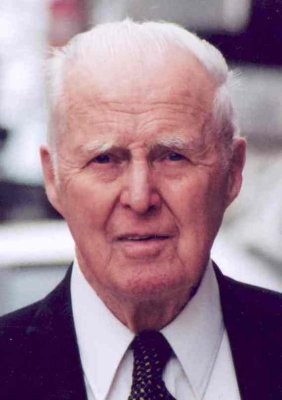
Norman Borlaug

Plant pathologist and agronomist; Nobel Peace Prize, 1970

Recorded said elsewhere, not written here
Oh, my granddad was ahead of his time. He was always in favor of education. My dad and mother were too, but Granddad was very aggressive in that. You know, as he used to say, “You’ve got to fill your head with new ideas so you can use them later to improve your own status and that of the neighborhood.”

Academy of Achievement recorded interview, American Academy of Achievement, 12 May 2008 source ↗

Others on this question

View all 23 →
Gustavo Dudamel Conductor; Music and Artistic Director of the Los Angeles Philharmonic
Maestro Abreu always said something very, very beautiful. He said, “The culture for poor people cannot be a poor culture.” You know, and he said in the sense that for the poor people, for the people that needs, we have to give the best, the best that we can.
Recorded Academy of Achievement (achievement.org) source ↗
Susan Butcher Dog musher; four-time winner of the Iditarod Trail Sled Dog Race
One of my favorite lessons is best summed up in the words of an old Athabascan Indian who told me, “There are many hard things in life, but there is only one sad thing, and that is giving up.”
Recorded Academy of Achievement interview, 29 June 1991 source ↗
Andrew Young Civil rights leader, US Ambassador to the United Nations, Mayor of Atlanta
[My father] used to say all the time, “You’re in a struggle, but if you get in a fight and lose your temper, you’ll lose the fight. So don’t get mad, get smart.”
Recorded Academy of Achievement interview, 14 August 2013 source ↗
Willie Mays Baseball centre fielder; twice National League Most Valuable Player
My father said to me, “You need a piece of paper to go into a door sometimes.” I didn’t understand about résumés, but when you write a résumé you have to put down things that people want to know about.
Recorded Academy of Achievement interview, 19 February 1996 source ↗

More from Norman Borlaug

View profile →
Question What counsel would you give your twenty-year-old self — and what should they ignore? Time & hindsight
Study broadly. Don’t specialize too early. Read history. Sooner or later, you’re going to have to specialize, but within the limits that you have to take obligatory courses to get a degree, keep your general education as broad as you can, because you never know what doors are going to open to new opportunities — ten, 15, 20 years down the road — because of changes in science and technology.
Recorded Academy of Achievement recorded interview, American Academy of Achievement, 12 May 2008 source ↗
Question How has a setback or failure set you up for later success? Failure & regret
So we had to take this special exam and I flunked it. Erv Upton passed it, and I was scared. I figured if I failed it, I wouldn’t have any chance of getting in. So I failed it beautifully. ... And so it was the first year of this general college, which gave an Associate of Arts degree after two years, and that was expected to be a terminal course. It turned out it wasn’t.
Recorded Academy of Achievement recorded interview, American Academy of Achievement, 12 May 2008 source ↗

More on time & hindsight

Also answered this

Tenley Albright, Anthony Fauci, Jimmy Carter, Willie Mays, August Wilson, David Oyelowo

Search the directory for somebody in particular.

Explore further

Report this answer