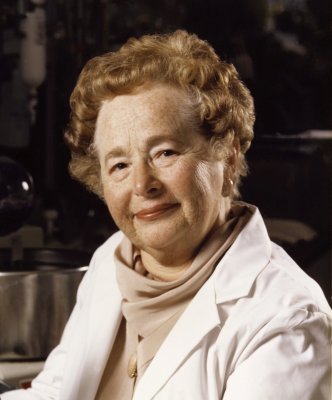
Gertrude B. Elion

Biochemist and pharmacologist; Nobel laureate in physiology or medicine

Recorded said elsewhere, not written here
I can’t remember that anyone in particular did. I think perhaps it was my mother who influenced me the most. She was a housewife. She had no higher education, but had the most common sense of anyone I knew, and she wanted me to have a career. So she was always very supportive, at a time when many women of her generation would not have been.

Academy of Achievement interview source ↗

Others on this question

View all 57 →
Wole Soyinka Playwright, poet and novelist; Nobel laureate in Literature, 1986
The early influence in my life I think was my father. That’s the earliest influence. He and his circle of friends. Usually, in our society, children are supposed to be neither seen nor heard. When elders are around, they’re supposed to very respectfully leave them alone. But I was curious. I just loved their debates. They used to get excited over issues, and so somehow I was allowed to eavesdrop, unlike the other children. And I picked up some of the ideas that they had, and I would ask questions. I was known as the questioner. Afterwards, I would ask questions, and my father would indulge me by trying to explain things to me. So that’s one of the reasons I consider him the earliest influence. And also, he had a small library, and I used to go into his library and try and read the books which I found there. Later on, as my circle of adult acquaintances increased, I think the next influence on me was my uncle, the Reverend I.O. Ransome-Kuti, who was another very erudite person, a great educationist. I used to visit them in Igbein, where he lived with his wife and they ran a school. So on weekends sometimes I would go there. And of course it was the usual story. I wanted to listen to them discussing and so on. Don’t misunderstand me. I was also very playful. I loved disappearing by myself, climbing trees, all that I did. But additionally, I was just fascinated by the whole discourse. Exchange of ideas between adults just used to fascinate me for some reason. I was never tired of listening to them. So my uncle was my next great influence.
Recorded Academy of Achievement interview source ↗
Herschel Walker Running back; winner of the 1982 Heisman Trophy
I didn’t have role models like football players in my life when I was growing up. I never thought, “You can be a football player,” so I never watched it as a little kid. But what I did see was my mother and father getting up early in the morning, going to work and coming back late in the afternoon, and they never complained about it. I’d see my mother saying, “I love God,” and my father loving God. So they put that love on me and they threw all that on me to love God. So my role models in life would be my parents because they never complained about anything they’d ever done — and that was seven kids! My father has six sisters. He was the only boy, and when he was 12, his father was killed. So he took the responsibility to raise his six sisters. He never complained. He never said anything about it. That’s my role model in life.
Recorded Academy of Achievement interview source ↗
Edmund Hillary Mountaineer and explorer; first ascent of Everest, 1953
I did have — definitely — one heroic figure who impressed me very much indeed, and that was the great Antarctic explorer, Shackleton. Shackleton I always admired because he was a tough man and a very good leader. And whenever he was in difficult circumstances, which he frequently was, he seemed to have the great ability to inspire his men and lead his party safely out of those conditions. So certainly Shackleton, I would have said, more than anything, was a role model for me.
Recorded Academy of Achievement interview source ↗
Mario Molina Atmospheric chemist; Nobel laureate in Chemistry, 1995
I had a number of very good teachers in high school, in fact. Some mathematics teachers that perhaps allowed me the freedom to go beyond the normal routine of the class and to explore some more advanced areas. The same thing happened in college. I was able to communicate with a few of my teachers and professors, and go beyond the normal expectations. And then, as I mentioned before, Professor Pimentel, my mentor for graduate studies, was really influential in terms of the influence that he had for me.
Recorded Academy of Achievement interview, Sun Valley, Idaho, 29 June 1996 source ↗

More from Gertrude B. Elion

View profile →
Question What fills you with the most pride? Identity & self
I think I’m most proud of the fact that so many of the drugs have really been useful in saving lives. I’ve run into people whose lives have been saved, and the kind of satisfaction that you get from having someone come up and say, “My child had acute leukemia and your drug saved him.” Or, “My little girl had herpes encephalitis, and she is now cured, she is back at school. She is doing very well. People told me that she might be mentally affected, but she is not.” I run into people who have had kidney transplants for 20 years who are still taking the drug. And I don’t think that anything else that happens to you can match that type of satisfaction.
Recorded Academy of Achievement interview, San Francisco, California, 6 March 1991 source ↗
Question Which writers or artists have most influenced your work? Taste & recommendation
It was a very important finding for us because we were involved in nucleic acids. There weren’t many people interested in nucleic acids. There weren’t many people who believed that was the way to find drugs. But when we found out the structure, and we began to understand what kind of bases could be incorporated, and which ones couldn’t, and where they could be incorporated, it put a whole new dimension on it. So it had a very significant effect.
Recorded Academy of Achievement interview, San Francisco, California, 6 March 1991 source ↗

More on relationships

Also answered this

Michael DeBakey, Richard Feynman, Edward Teller, Eric Lander, Elizabeth Blackburn, Paul Farmer

Search the directory for somebody in particular.

Explore further

Report this answer