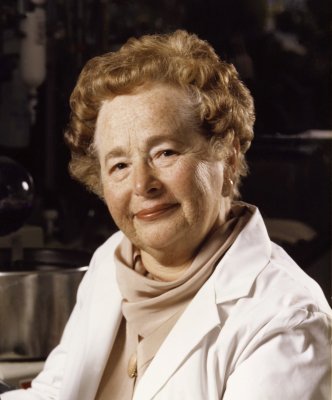
What are you most proud of?

Originally asked

Vogue, to one guest at a time, on camera, 73 Questions

Vogue's 73 Questions repeatedly asks respondents to select the work, relationship, or achievement that makes them proudest.

You answer as yourself. Nobody on FLAPSS answers as anybody else.

Recorded Gertrude B. Elion said elsewhere, not written here
I think I’m most proud of the fact that so many of the drugs have really been useful in saving lives. I’ve run into people whose lives have been saved, and the kind of satisfaction that you get from having someone come up and say, “My child had acute leukemia and your drug saved him.” Or, “My little girl had herpes encephalitis, and she is now cured, she is back at school. She is doing very well. People told me that she might be mentally affected, but she is not.” I run into people who have had kidney transplants for 20 years who are still taking the drug. And I don’t think that anything else that happens to you can match that type of satisfaction.

Academy of Achievement interview, San Francisco, California, 6 March 1991 source ↗

Others on this question

View all 103 →
Dereck Joubert Wildlife film-maker and conservationist; National Geographic Explorer-in-Residence
There are a lot of images to be proud of. There are a lot of images that I’m very happy with, in the film context, that were very hard to do or that happened in the right moment, and that were the embodiment of the fact that I engulf myself in the spirit of an understanding of those animals at that time.
Recorded Academy of Achievement interview, Washington, D.C., 18 June 2018 source ↗
Winston Churchill Prime Minister of the United Kingdom, 1940–1945 and 1951–1955; Member of Parliament 1900–1964
When I think of the fate of poor old women, so many of whom have no one to look after them and nothing to live on at the end of their lives, I am glad to have had a hand in all that structure of pensions and insurance which no other country can rival and which is especially a help to them.
Recorded Chapter of his autobiography, written at Chartwell in 1930, Winston S. Churchill, My Early Life (Thornton Butterworth, 1930), Project Gutenberg Canada, October 1930 source ↗
Jarrod Bowen English footballer; West Ham United captain and England international forward
Probably my family in terms of kids I've got, my mum and dad, the whole network of family. I'm really close with my aunties, uncles, nans, grandads, trying to spend as much time together as possible, so I'd say that's one thing I'm really proud of, that I have a loving family.
Recorded Kelly Somers, BBC Sport's The Football Interview, 30 August 2025 source ↗
Aaron Ciechanover Biologist and physician; Nobel laureate in chemistry for the discovery of ubiquitin-mediated protein degradation
I cannot tell you even. I have to ask my son and my wife that were with me in the room because I came to say ”hello,” that I’m leaving. And, I was caught in total surprise. It’s wonderful. What can I tell you? Obviously, it’s wonderful. That’s the climax that every scientist can ever dream of. I will not deny that I am proud for me, for this science, for the state of Israel, for my family, for everybody.
Recorded Joanna Rose, Telephone interview following the announcement of the 2004 Nobel Prize in Chemistry, The Nobel Prize, 6 October 2004 source ↗

More from Gertrude B. Elion

View profile →
Question Which teacher, parent, coach or friend most made you who you are, and what did you learn from them? Relationships
I can’t remember that anyone in particular did. I think perhaps it was my mother who influenced me the most. She was a housewife. She had no higher education, but had the most common sense of anyone I knew, and she wanted me to have a career. So she was always very supportive, at a time when many women of her generation would not have been.
Recorded Academy of Achievement interview source ↗
Question Which writers or artists most influenced your work? Taste & recommendation
It was a very important finding for us because we were involved in nucleic acids. There weren’t many people interested in nucleic acids. There weren’t many people who believed that was the way to find drugs. But when we found out the structure, and we began to understand what kind of bases could be incorporated, and which ones couldn’t, and where they could be incorporated, it put a whole new dimension on it. So it had a very significant effect.
Recorded Academy of Achievement interview, San Francisco, California, 6 March 1991 source ↗

More on identity & self

Also answered this

Shinya Yamanaka, Mario Molina, Martinus Veltman, Kei May Lau, Willem Kolff, Jennifer Doudna

Search the directory for somebody in particular.

Explore further

Report this answer