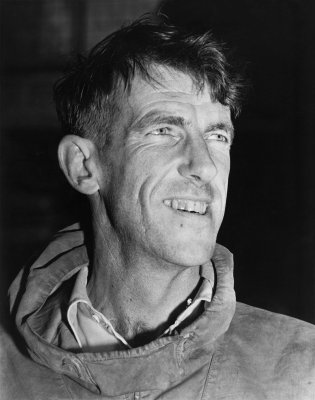
What is the hardest thing that has happened to you, and what did you carry out of it?
Recorded
Edmund Hillary
·
said elsewhere, not written here
Well, then of course, came the disaster in 1975, when my wife and my youngest daughter were flying into the Nepal hills where I was building a hospital and their plane crashed and they were killed. And this certainly, for me, was an absolute disaster, really because the two people that meant most to me in life had been killed in one fell swoop. It did take me quite a number of years to get over it. I found the only way to deal with it was to carry on very energetically, doing the things that we had all been doing together, which was largely building schools and things for the mountain people. Although, people used to say to me, “Time is the great healer,” certainly for the first two years I simply didn’t accept this. But, time was a great healer and after the years passed, the memories still remain. But, I think quite a lot of the pain tends to fade a little bit, and life did become a little bit easier.
Academy of Achievement interview
source ↗
Suzanne Farrell
Ballerina and ballet master; répétiteur for the Balanchine Trust
Well, I’ve had injuries, but I’d always get out on stage because I think the body is a wonderful thing, and you have to treat it with respect. We haven’t even reached our potential for what we can do as human beings. I went through a period where I had hip trouble. I thought it was just a typical pulled muscle, so I used liniment, and warmed up more than I thought was necessary, all the things we learn to do when you have a typical dance-related injury or sore muscle. Over the months, it didn’t go away. In fact, it got worse. Eventually I realized that I had a very serious problem, and it was the first time that dance had let me down. What had been my salvation and my security with my body was abandoning me. This was emotionally and physically devastating.
Recorded
Academy of Achievement (achievement.org)
source ↗
Thank God I found sobriety. I could sustain myself with my work, my reading, the movies, my friends. And walking, walking, walking. Of all the purposes of education, I think the most useful is this: It prepares you to keep yourself entertained. It gives you a better chance of an interesting job. ... I can't remember the last time I felt bored. I can't eat, drink or talk, and yet I have so many other resources to keep myself entertained. I think I must be a case study.
Recorded
Roger Ebert's Journal, rogerebert.com, 6 November 2010
source ↗
Siya Kolisi
South Africa international rugby union flanker and captain
It went past being hungry; it was actually painful in your stomach. I could feel my intestines twisting in the middle of the night. I would scream to my grandmother and she would get me sugar water and it would settle it down. A lot of my values come from being resilient. The people from my community might be poor financially but they are happy, proud and resilient people.
Recorded
Dan Roan, The Sports Desk podcast, BBC, BBC Sport, 15 October 2021
source ↗
Barack Obama
44th President of the United States, 2009–2017; United States Senator from Illinois 2005–2008
I was raised by a heroic single mom, wonderful grandparents -- made incredible sacrifices for me. … But I sure wish I had had a father who was not only present, but involved. Didn't know my dad. And so my whole life, I've tried to be for Michelle and my girls what my father was not for my mother and me. … I want to be a better father, a better husband, a better man.
Recorded
Morehouse College, Atlanta, Georgia, The White House (Obama administration archive), 19 May 2013
source ↗
Question
What advice would you give your twenty-year-old self, and what should they ignore?
Time & hindsight
I would advise them to aim high. To set their sights at a pretty tough target and don’t be too worried if you’re not successful at first. Just keep persisting and keep improving your standards, getting better and better and ultimately, you’ve got a pretty fair chance at achieving your desired goal. ... But, I do think that virtually everybody that’s born has the ability to be very competent at doing something. I think that, in itself, is worthy of aiming towards, just to be competent at doing anything you particularly wish to do.
Recorded
Academy of Achievement recorded interview, American Academy of Achievement, 16 November 1991
source ↗
Question
When were you happiest?
Time & hindsight
Those years from 1953 to 1975 were extremely happy years for me. I did many adventurous activities. I got deeply involved in these aid programs for the people of the Himalayas. I had a nice family, we took our family into the out-of-doors, we camped and we swam and we clambered around the hills. For me, it was a very full and a very happy existence.
Recorded
Academy of Achievement interview
source ↗
Question
Which moment embarrassed you most?
Failure & regret
I can always remember, when I was at high school we had a school sort of army battalion and because, at that time, I was one of the larger boys, I was appointed sergeant of the number one platoon, and I was always absolutely petrified that when I was meant to turn the platoon left or turn it right, I was really actually hopeless at knowing quite what to do. But fortunately, my platoon, who were really all the misfits in the school, the larger misfits, they stood by me, and some of them were quite good at knowing when to turn left or turn right. So whatever command I gave, they would do the right thing. We were a pretty good platoon as a consequence although, at the time, I felt an absolute idiot.
Recorded
Academy of Achievement interview
source ↗
Question
What role should instinct play in major decisions?
Craft & work
I think it was a combination of feeling and judgment. I happened to be that sort of person that enjoyed making out plans, but I also enjoy changing plans. On an expedition, although I may start out with a detailed plan, I’m prepared to change it at any moment and completely redo it. So our expeditions turned out to be very adaptable ones. We achieved the final objectives just the same as many other expeditions, but maybe we had more fun in the process because it seemed something we could vary. We still carried on to achieve our major objectives.
Recorded
Academy of Achievement interview
source ↗
Question
What did you want to be when you were growing up?
Identity & self
I really had no idea whatsoever. I feel that my life developed as I went along. I was never one of those people who, at an early age, had picked an objective and worked steadily towards it. All I knew was that I wanted to get involved in adventurous activity. I didn’t have any specific type of activity in mind, but I wanted to do things that were exciting and adventurous. I had a fairly diffused feeling as to what precisely it should be.
Recorded
Academy of Achievement interview
source ↗
Question
What are you still hoping to finish?
Death & what remains
As I’ve gotten older, my goals have become more solidified. My main concentration is on the welfare of the people I’ve worked with in the Himalayas and on human welfare in general. I’m also extremely interested in the environment and trying to encourage people to be more concerned about what we’re doing to our world. Now I’m just one of thousands and thousands of people who have these same views these days. I think this is one of the great steps forward we’ve seen in modern decades — the considerable growing interest that people have in the environment and in keeping it reasonably clean and wholesome. I certainly hope it remains that way.
Recorded
Academy of Achievement interview
source ↗
Report this answer