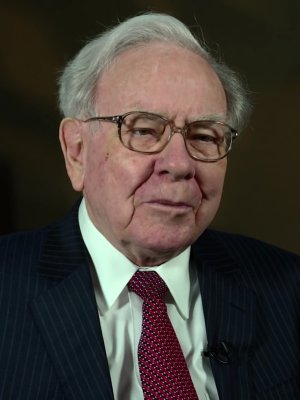
To the people who, because of my career, I cannot spend time with. I have to be selfish, unfortunately.
Originally asked
The Guardian, to a different person each week, The Q&A
A fixed Guardian Q&A prompt asked directly across respondents and years.
You answer as yourself. Nobody on FLAPSS answers as anybody else.
His letter to Berkshire Hathaway shareholders in the 1997 annual report, Berkshire Hathaway Inc., February 1998 source ↗
Others on this question
View all 209 →My mum. I was horrendous growing up – I was always arguing with her.
Sorry, I’m British and middle class, so I’ve already apologised to virtually everybody I have ever met.
A little girl called Pat. We were nine-year-olds together and all the class made her life a misery. I knew she wanted to be my friend and I would only be friends with her if nobody else was around. I feel dreadful about that.
More from Warren Buffett
View profile →The asset I most value, aside from health, is interesting, diverse, and long-standing friends.
We've just passed a milestone: Twenty years ago, on January 3, 1972, Blue Chip Stamps (then an affiliate of Berkshire and later merged into it) bought control of See's Candy Shops, a West Coast manufacturer and retailer of boxed-chocolates. The nominal price that the sellers were asking - calculated on the 100% ownership we ultimately attained - was $40 million. But the company had $10 million of excess cash, and therefore the true offering price was $30 million. Charlie and I, not yet fully appreciative of the value of an economic franchise, looked at the company's mere $7 million of tangible net worth and said $25 million was as high as we would go (and we meant it). Fortunately, the sellers accepted our offer. The sales of trading stamps by Blue Chip thereafter declined from $102.5 million in 1972 to $1.2 million in 1991. But See's candy sales in the same period increased from $29 million to $196 million. Moreover, profits at See's grew even faster than sales, from $4.2 million pre-tax in 1972 to $42.4 million last year.
Well, I won't say what I thought about them, particularly related to Bill Gates, but I would say it's astounding to me how human people are. I mean, it, here you had a guy that was a convicted guy, a sensational con man, and the percentage of people that he knocked off. I mean, whether it was, he found their weakness, it might have been sex. It might be power, it might be, whatever it might be.
Charlie and I decided long ago that in an investment lifetime it's just too hard to make hundreds of smart decisions. That judgment became ever more compelling as Berkshire's capital mushroomed and the universe of investments that could significantly affect our results shrank dramatically. Therefore, we adopted a strategy that required our being smart - and not too smart at that - only a very few times. Indeed, we'll now settle for one good idea a year. (Charlie says it's my turn.)
The extraordinary delegation of authority now existing at Berkshire is the ideal antidote to bureaucracy. In an operating sense, Berkshire is not a giant company but rather a collection of large companies. At headquarters, we have never had a committee nor have we ever required our subsidiaries to submit budgets (though many use them as an important internal tool). We don't have a legal office nor departments that other companies take for granted: human relations, public relations, investor relations, strategy, acquisitions, you name it. We do, of course, have an active audit function; no sense being a damned fool.
Ironically, though, this is also the purchase in which I made my biggest mistake - of a kind, however, never recognized on financial statements. We paid $600 million in 1989 for Gillette preferred shares that were convertible into 48 million (split-adjusted) common shares. Taking an alternative route with the $600 million, I probably could have purchased 60 million shares of common from the company. The market on the common was then about $10.50, and given that this would have been a huge private placement carrying important restrictions, I probably could have bought the stock at a discount of at least 5%. I can't be sure about this, but it's likely that Gillette's management would have been just as happy to have Berkshire opt for common. But I was far too clever to do that.
More on failure & regret
- What has been your biggest disappointment? 366 answers
- If you could edit your past, what would you change? 203 answers
- What is the worst thing anyone has said to you? 122 answers
- Which moment embarrassed you most? 122 answers
- How has a failure, or apparent failure, set you up for later success? Do you have a favourite failure? 63 answers
- What is the hardest thing that has happened to you, and what did you carry out of it? 36 answers
Also answered this
Bella Freud, Katharine Hamnett, Douglas Stuart, Terence Conran, Mo Gilligan, Stanley Tucci
Search the directory for somebody in particular.
Explore further
- All failure & regret questions
- The The Q&A questionnaire — 25 questions from the same format
- Explore the archive — by field, age, era, and subject